
 postscript
Abstract...
postscript
Abstract...
 Abstract...
 2 Fitting procedures and ...
Superclusters of galaxies, the largest known luminous structures in the
Universe, should hold correspondingly large masses of dark matter. Their study
may lead us to the structure (Bahcall et al. (1995)) and perhaps the constituents
of dark matter (David et al. (1995); Turner (1991)), and their mass and
kinematics probe  (Gramann et al. (1995); Bahcall et al. (1994);
Cen (1994); Zabludoff & Geller (1994)). Most models of structure formation
predict that superclusters contain residual intra-supercluster (ISC) matter in
the form of diffuse, hot gas at the present epoch. This ISC gas could be either
primordial (Cen & Ostriker, (1993)); processed by an early generation of stars
and subsequently ejected in winds from early massive star formation or active
galactic nuclei (Elbaz et al. (1995); Matteucci et al. (1995);
Metzler & Evrard (1994)) or stripped from merging clusters and protoclusters.
Governato et al. (1996) using N-body simulations found this tidal stripping very
effective. Eskridge et al. (1995) used Einstein data to show that the deep
potential wells in clusters of galaxies can retain the enriched ejecta of early
star bursts. The expected temperature of the ISC gas is about
(Gramann et al. (1995); Bahcall et al. (1994);
Cen (1994); Zabludoff & Geller (1994)). Most models of structure formation
predict that superclusters contain residual intra-supercluster (ISC) matter in
the form of diffuse, hot gas at the present epoch. This ISC gas could be either
primordial (Cen & Ostriker, (1993)); processed by an early generation of stars
and subsequently ejected in winds from early massive star formation or active
galactic nuclei (Elbaz et al. (1995); Matteucci et al. (1995);
Metzler & Evrard (1994)) or stripped from merging clusters and protoclusters.
Governato et al. (1996) using N-body simulations found this tidal stripping very
effective. Eskridge et al. (1995) used Einstein data to show that the deep
potential wells in clusters of galaxies can retain the enriched ejecta of early
star bursts. The expected temperature of the ISC gas is about  (Metzler & Evrard (1994); Anninos & Norman (1996)) and will remain hot,
since the cooling time for gas at the expected low density (
(Metzler & Evrard (1994); Anninos & Norman (1996)) and will remain hot,
since the cooling time for gas at the expected low density ( ) is longer than the Hubble time (Rephaeli & Persic (1992)).
Several X-ray searches for diffuse emission from ISC gas have been carried out. Most recently the search on the HEAO-1 A2 database was extended to the Batuski & Burns (1985) sample of superclusters (Persic et al. (1990)). No significant emission was found, and a strong upper limit was set on the flux originating in superclusters.
Although this work has used X-ray data, the ISC gas may also be sought using
its signature on the cosmic background radiation (CBR) caused by
Sunyaev-Zel'dovich (SZ) effect (Sunyaev & Zel'dovich (1980); for recent reviews see
Rephaeli (1995) and Birkinshaw (1997)). Using Persic et al. (1990)'s limits for
diffuse X-ray emission, Rephaeli (1993) estimated a supercluster-generated
anisotropy in the spatial distribution of the CBR,  , significantly below the anisotropy detected by the COBE DMR
experiment (Bennett et al. (1996)). Banday et al. (1996)'s cross-correlation analysis
of the four year COBE DMR sky maps with rich clusters of galaxies,
extragalactic IRAS sources, HEAO-1 A2 X-ray emission, and 5 GHz radio sources
found no non-cosmological signals at an rms level
, significantly below the anisotropy detected by the COBE DMR
experiment (Bennett et al. (1996)). Banday et al. (1996)'s cross-correlation analysis
of the four year COBE DMR sky maps with rich clusters of galaxies,
extragalactic IRAS sources, HEAO-1 A2 X-ray emission, and 5 GHz radio sources
found no non-cosmological signals at an rms level  K (95 % CL at
 resolution). They also found no evidence for the SZ effect in several
nearby clusters. This tends to support the idea that superclusters are not
detectable SZ effect sources.
resolution). They also found no evidence for the SZ effect in several
nearby clusters. This tends to support the idea that superclusters are not
detectable SZ effect sources.
Some recent observational results, however, seem to indicate that superclusters do contain detectable baryonic matter. Boughn (1996) found evidence in the HEAO data for gas in the local supercluster. Using pointed ROSAT PSPC observations Bardelli et al. (1996) found evidence for some enhanced diffuse X-ray emission in the Shapley Supercluster between the two clusters A3558 and SC1327-312 possibly due to their gravitational interaction. Soltan et al. (1996) analyzed the cross-correlation between the angular positions of Abell clusters of galaxies and the intensity of the X-ray background of the ROSAT All-Sky Survey. They concluded that Abell clusters are associated with extended, low surface brightness X-ray haloes, which may be caused by hot diffuse gas. Based on these population studies, we may proceed to investigate individual rich super-clusters to get some more information about the origin and reality of halo emission.
The most prominent supercluster near us (at  ) is the Shapley
Supercluster (SSC), which consists of many Abell and other clusters centered
on A3558 (Shapley 8), at mean recession velocity 14 000
) is the Shapley
Supercluster (SSC), which consists of many Abell and other clusters centered
on A3558 (Shapley 8), at mean recession velocity 14 000  (at a
distance
(at a
distance 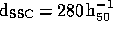 Mpc, where
  , and with an extended core radius of about
  Mpc. The estimated baryon over-density,
  , is the largest known on such a scale: the SSC may be the largest
gravitationally bound structure in the observable Universe (Raychaudhury et al. (1991);
Fabian (1991)). These features make the SSC a good candidate for searches for
ISC gas.
, is the largest known on such a scale: the SSC may be the largest
gravitationally bound structure in the observable Universe (Raychaudhury et al. (1991);
Fabian (1991)). These features make the SSC a good candidate for searches for
ISC gas.
Day et al. (1991) carried out a search for large scale ISC gas in the SSC with the GINGA satellite and concluded that there was no evidence for excess diffuse emission associated with SSC. The GINGA measurements are limited by fluctuations in the X-ray background, unresolved point sources, and the model used to remove the underlying background.
Although the surface brightness of the SZ effect for the SSC must be low, the SZ effect will be more extended than the X-ray emission by a factor of roughly 2. That means that with a suitable CBR database, it should be possible to integrate over the angular structure of the supercluster to obtain a better signal-to-noise ratio than would be possible for a point source, and hence perhaps to find the diffuse ISC gas through the SZ effect.
Based on these ideas we selected the SSC as a first candidate for a search for the SZ effect on a large angular scale database. Because of the way ground based observations are carried out (neither beam switching, nor position switching gives enough angular coverage; Birkinshaw (1990)), we have to use satellite data. The best data were collected by the COBE satellite, so we use the COBE DMR four year data in the SZ effect search. We used the HEAO-1 A2 and ROSAT All-Sky Survey data, repeating the analysis of Persic et al. (1988) to search for diffuse ISC X-ray emission from the SSC.
In this paper we describe fits of template maps to the HEAO-1 A2, ROSAT, and
COBE DMR data. The template maps are generated based on the thermal
bremsstrahlung X-ray emission and SZ decrement of truncated isothermal  models for ISC gas, although the assumptions on which these models are based,
such as constant temperature and hydrostatic equilibrium, are questionable.
models for ISC gas, although the assumptions on which these models are based,
such as constant temperature and hydrostatic equilibrium, are questionable.