

|
|
| Superconducting Detectors | Optical Physics | Instrumentation | Group Facilities | Publications |
|
Millimetrewave Direct Detectors |
SIS Mixers |
STS Optical Detectors |
STS X-ray Detectors |
TES X-ray Detecrors |
Superconducting Electromagnetics |
The STJ consists of two films. For optical photon detection, the photon absorption length is much less than the film thickness so that the interaction occurs in one film only (generally the base film which has the best electronic characteristics). For X-ray detection, interaction in either film will occur and this can lead to complicated energy responsivity.
One way to avoid this is to fabricate the STJ as a Distributed ReadOut Imaging Device or DROID for short.
Picture showing the Principle of operation of the DROID.
For X-ray detection a large sensitive area is required. To overcome the problems associated with Fiske resonances in the STJ, we use two “mini-arrays” to read-out each side of the absorbing Ta film.
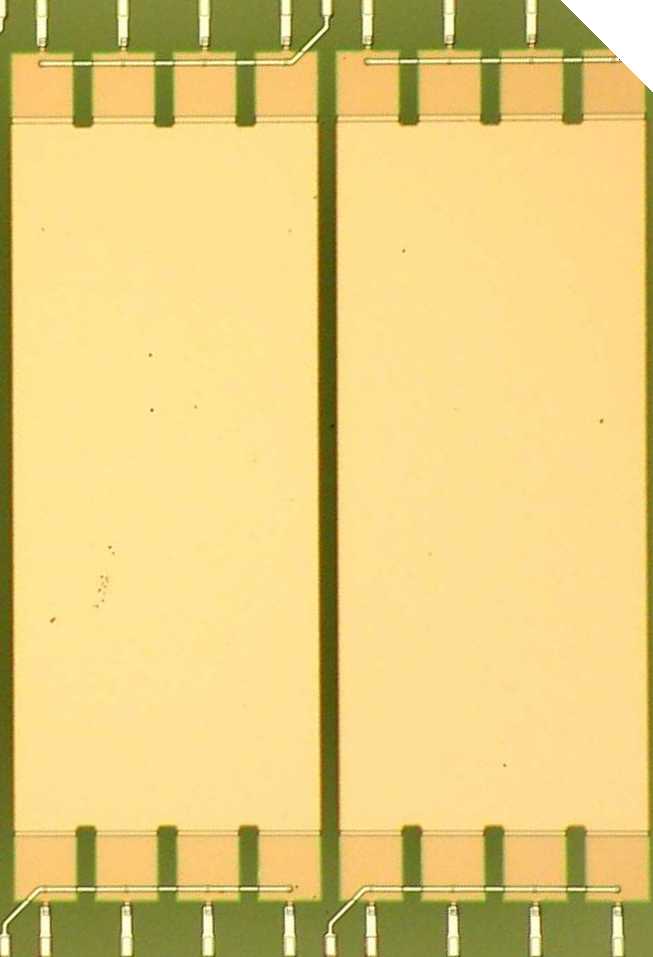
Two DROID detectors for X-ray detection. Each Ta absorber is read-out by 2 mini-arrays each of 4 STJs.
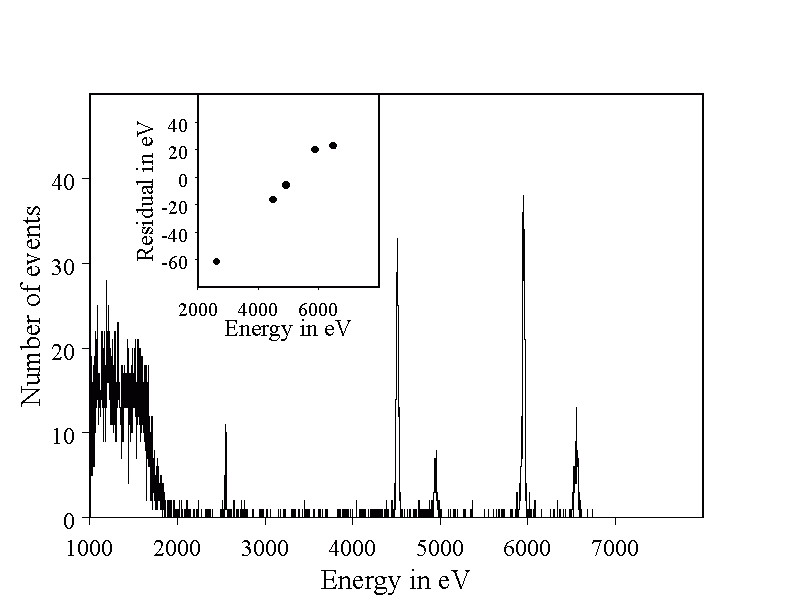
Result of irradiation with a multi-line fluorescence X-ray source
| Back | | | Home |