
 postscript
3 Application to simulated ...
postscript
3 Application to simulated ...
 Abstract...
 Acknowledgements...
In particular, we simulate Planck Surveyor observations of a  degree patch of sky at ten different observing frequencies. The sky emission
includes contributions from primary CMBR fluctuations, kinetic and thermal
Sunyaev--Zel'dovich effects from clusters and dust, free--free and synchrotron
emission from the Galaxy.
degree patch of sky at ten different observing frequencies. The sky emission
includes contributions from primary CMBR fluctuations, kinetic and thermal
Sunyaev--Zel'dovich effects from clusters and dust, free--free and synchrotron
emission from the Galaxy.
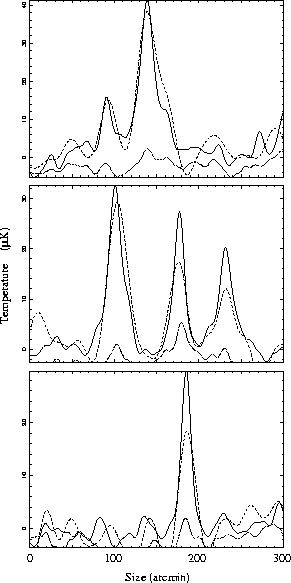
Figure 19: The cluster profiles of some SZ effect
reconstructions compared to the input profiles convolved with a 10 arcmin beam
(solid line). The full MEM with full ICF information was used to reconstruct
the dashed line whereas the quadratic approximation to this was used to
reconstruct the dotted line.
The reconstructions presented in Section 3 show that, in the
absence of severe point source contamination, the Planck Surveyor observations
enable the recovery of the CMBR fluctuations with an absolute accuracy of about
 . Moreover, depending on assumed knowledge of the power spectra
of the various components, we find that it is possible to reconstruct the
emission due to other components with varying degrees of accuracy. In
particular, the Galactic dust emission may be reconstructed with an accuracy of
about
. Moreover, depending on assumed knowledge of the power spectra
of the various components, we find that it is possible to reconstruct the
emission due to other components with varying degrees of accuracy. In
particular, the Galactic dust emission may be reconstructed with an accuracy of
about  . The main features of Galactic free--free are also
reconstructed. We find that both the magnitude and radial profile of the
thermal SZ effect may be recovered for rich clusters, but the reconstruction of
the kinetic SZ effect is only possible in clusters which also have a large
thermal SZ effect. Given the cluster gas profile derived from the thermal SZ
effect, however, it may be possible to recover the kinetic effect more
successfully by using optimal filtering methods tailored to individual cluster
shapes (Haehnelt & Tegmark (1996)).
. The main features of Galactic free--free are also
reconstructed. We find that both the magnitude and radial profile of the
thermal SZ effect may be recovered for rich clusters, but the reconstruction of
the kinetic SZ effect is only possible in clusters which also have a large
thermal SZ effect. Given the cluster gas profile derived from the thermal SZ
effect, however, it may be possible to recover the kinetic effect more
successfully by using optimal filtering methods tailored to individual cluster
shapes (Haehnelt & Tegmark (1996)).
We find that in nearly all cases the MEM algorithm produces more accurate reconstructed maps and power spectra of the various components than the WF, and this is particularly true for reconstructions of the thermal SZ effect. This difference is most likely a result of the assumption in the WF method that the fields to be reconstructed are well-described by Gaussian random fields. This is clearly not the case for the SZ effect, and other foreground components such as Galactic dust also appear quite non-Gaussian in nature.
In creating the reconstructions presented in the is paper, we have throughout assumed that the frequency dependence of all the components are known a priori. This is reasonable for the CMBR emission, as well as the kinetic and thermal SZ effects, but it is unlikely to be the case for the three Galactic components. For real observations, the spectral indices of the free--free and synchrotron emission will be uncertain to within about 20 per cent. Moreover, the dust temperature and emissivity may be known to even poorer accuracy.
If we assume for the moment that the frequency dependence of each component is
the same across the entire  degree field, then we find that
reasonable uncertainties in the parameters describing the Galactic components do
not significantly affect our reconstructions. In fact, we find that the dust
temperature and emissivity may be determined to within 1 per cent
accuracy from the data by including them as free parameters in either the MEM
or WF algorithm. The resulting reconstructions of all the physical components
are virtually indistinguishable from those obtained by assuming these
parameters. Unfortunately, we find that it is not possible to determine either
the free--free or synchrotron spectral index in this way. Nevertheless, if in
the algorithm we assume a spectral index for either component that is in error
by within 20 per cent, we find that the reconstructions of the remaining
components are virtually unaffected.
degree field, then we find that
reasonable uncertainties in the parameters describing the Galactic components do
not significantly affect our reconstructions. In fact, we find that the dust
temperature and emissivity may be determined to within 1 per cent
accuracy from the data by including them as free parameters in either the MEM
or WF algorithm. The resulting reconstructions of all the physical components
are virtually indistinguishable from those obtained by assuming these
parameters. Unfortunately, we find that it is not possible to determine either
the free--free or synchrotron spectral index in this way. Nevertheless, if in
the algorithm we assume a spectral index for either component that is in error
by within 20 per cent, we find that the reconstructions of the remaining
components are virtually unaffected.
In this paper, the simulated Planck Surveyor observations were somewhat idealised in that it was assumed that the beam at each observing frequency was a simple Gaussian. For the real observations, however, it is unavoidable that the beam will infact possess sidelobes at some level, and care must be taken to incorporate any such features into the analysis, in particular if these sidelobes contain emission from any strong sources.
The simulated observations presented here also assume that any striping due to the scan strategy has been removed to a sufficient level so that it may be considered negligible. In fact, it may be possible to use MEM to perform the destriping of the maps and the component separation simultaneously. Indeed the simultaneous reconstruction of a deconvolved CMBR maps and the removal of scan baselines has already been performed using MEM in the analysis of Tenerife data (Jones et al. (1998)).
In terms of computational speed, however, the most important assumption made in
our simulations were that the beam at each frequency does not change shape with
position on the sky This assumption is not unreasonable in the analysis of
small patches of sky considered here, but may be questionable for all-sky maps.
The importance of this assumption lies in the fact that the beam-smoothing may
be written as a convolution and therefore allows us to analyse the observations
entirely in the Fourier domain, where each mode may be considered
independently. As discussed in the companion paper, this means that the
analysis is reduced to a large number (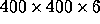 ) of small-scale
linear inversion problems and so is computationally very fast.
) of small-scale
linear inversion problems and so is computationally very fast.
If the beam is spatially varying, however, the beam-smoothing cannot be written
as a simple convolution. In this case the analysis should properly be
performed in the sky plane, and requires the use of sparse matrix techniques to
compute the beam-smoothing at each point on the sky as opposed to Fast Fourier
Transforms (FFTs). In addition, the matrices involved in the linear problem are
then very large indeed, since we are attempting simultaneously to determine
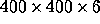 parameters by the minimisation of a function of
corresponding dimensionality. Nevertheless, the authors have investigated the
use of MEM and the WF in this case and find that reconstructions similar to
those presented here can be performed in about 12 hours of CPU on a SPARC 20
workstation, For both MEM and WF, however, the calculation of errors cannot be
performed by inverting the Hessian matrix of the posterior probability, since
this matrix has dimensions
parameters by the minimisation of a function of
corresponding dimensionality. Nevertheless, the authors have investigated the
use of MEM and the WF in this case and find that reconstructions similar to
those presented here can be performed in about 12 hours of CPU on a SPARC 20
workstation, For both MEM and WF, however, the calculation of errors cannot be
performed by inverting the Hessian matrix of the posterior probability, since
this matrix has dimensions 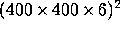 . Although this matrix
is in fact reasonable sparse, the inversion is still not feasible. Instead, the
errors on the reconstructions must be estimated by performing several hundred
Monte-Carlo simulations for different noise realisations (see
Maisinger et al. (1997)).
. Although this matrix
is in fact reasonable sparse, the inversion is still not feasible. Instead, the
errors on the reconstructions must be estimated by performing several hundred
Monte-Carlo simulations for different noise realisations (see
Maisinger et al. (1997)).
Finally, perhaps the most important improvement on the simulations and reconstructions presented here is the inclusion of a realistic population of point sources. Using the point source simulations of Toffolatti et al. (1998), a full investigation of the effects on the reconstruction of the CMBR and other components will be presented in a forthcoming paper (Hobson et al, in preparation).