
 postscript
2 The CAT...
postscript
2 The CAT...
 Abstract...
 4 Analysis...
Because CAT observes relatively small patches of sky with modest resolution,
sample variance will be important. With that in mind, CAT has been observing
several  fields, all chosen to be relatively free
from strong radio sources at frequencies up to 5 GHz (Condon et al. (1989)), and lie
at high Galactic latitude (
fields, all chosen to be relatively free
from strong radio sources at frequencies up to 5 GHz (Condon et al. (1989)), and lie
at high Galactic latitude ( ). The second of these fields,
called `CAT2', is centred at
). The second of these fields,
called `CAT2', is centred at 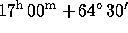 (B1950). To date, CAT2 has been observed at 13.5 GHz, 15.5 GHz and 16.5 GHz for
200-400 hours per frequency (the greatest amount of data has been collected at
the two extreme frequencies) in arrays with baselines scaled with frequency.
The data were analysed using standard procedures, as described by
O'Sullivan et al. (1995). After excluding excessively noisy regions of visibility data
by eye, images were made for each frequency with a final rms sensitivity of
about 9 mJy/beam at 13.5 and 16.5 GHz. Point sources were clearly visible in
these images, although most were weaker on average than those in the first
`CAT1' field.
(B1950). To date, CAT2 has been observed at 13.5 GHz, 15.5 GHz and 16.5 GHz for
200-400 hours per frequency (the greatest amount of data has been collected at
the two extreme frequencies) in arrays with baselines scaled with frequency.
The data were analysed using standard procedures, as described by
O'Sullivan et al. (1995). After excluding excessively noisy regions of visibility data
by eye, images were made for each frequency with a final rms sensitivity of
about 9 mJy/beam at 13.5 and 16.5 GHz. Point sources were clearly visible in
these images, although most were weaker on average than those in the first
`CAT1' field.
Nevertheless, a total of 27 discrete sources with  were
removed from the CAT2 field after RT raster scanning (simultaneous with the CAT
observations). Long term monitoring with the RT showed that the brightest one
was very highly variable, its flux density fluctuating by as much as a factor
of two in a few days. This illustrates the importance of simultaneous
monitoring for source subtraction. Comparison of the final source-subtracted
maps with reconstructed maps of the foreground radio sources only showed no
significant correlation.
were
removed from the CAT2 field after RT raster scanning (simultaneous with the CAT
observations). Long term monitoring with the RT showed that the brightest one
was very highly variable, its flux density fluctuating by as much as a factor
of two in a few days. This illustrates the importance of simultaneous
monitoring for source subtraction. Comparison of the final source-subtracted
maps with reconstructed maps of the foreground radio sources only showed no
significant correlation.
After source subtraction, excess power was seen in all three maps, mostly at
16.5 GHz, consistent with the detection of CMB signal. Figure 1
shows the 16.5 GHz image of CAT2 after the sources have been subtracted--there
is excess power in the centre, although a 5- negative feature dominates
the actual map (note the map has not been CLEANed, i.e. instrumental response
has not been taken out). We have checked that this feature is real by splitting
the data in time, frequency and polarisation, and seeing it in all subsets.
Also, the feature disappears in a polarisation-difference map. Furthermore, the
strength of the feature in the maps at different frequencies is well described
by the spectrum of the CMB. In any case, simulations of Gaussian CMB skies show
clearly that it is not necessarily unusual to see a 5-
negative feature dominates
the actual map (note the map has not been CLEANed, i.e. instrumental response
has not been taken out). We have checked that this feature is real by splitting
the data in time, frequency and polarisation, and seeing it in all subsets.
Also, the feature disappears in a polarisation-difference map. Furthermore, the
strength of the feature in the maps at different frequencies is well described
by the spectrum of the CMB. In any case, simulations of Gaussian CMB skies show
clearly that it is not necessarily unusual to see a 5- feature on its
own in a map with low resolution and a relatively small field of view. Again,
this convinces us of that observations of several fields are essential to
obtain representative average values.
feature on its
own in a map with low resolution and a relatively small field of view. Again,
this convinces us of that observations of several fields are essential to
obtain representative average values.