
 postscript
3 CAT2: The Second ...
postscript
3 CAT2: The Second ...
 Abstract...
 5 Cosmological implications from ...
To confirm the detection of CMB anisotropy in the CAT2 field statistically, a
Bayesian maximum-likelihood analysis (Hobson et al. (1995)) was performed on the raw
complex visibilities, which were split first into two bins of low and high  .
CMB and Galactic signals were modelled as independent Gaussian distributions,
the CMB with a fixed spectral index of 2 in flux density and the Galactic
spectral index variable between 0 and 1. After marginalising over the Galactic
parameters, this analysis confirmed that the bulk of the power in the 16.5 GHz
map is due to CMB signal, with relative amplitudes in the two bins of
.
CMB and Galactic signals were modelled as independent Gaussian distributions,
the CMB with a fixed spectral index of 2 in flux density and the Galactic
spectral index variable between 0 and 1. After marginalising over the Galactic
parameters, this analysis confirmed that the bulk of the power in the 16.5 GHz
map is due to CMB signal, with relative amplitudes in the two bins of  and
and  centred on (spherical harmonic) multipoles
  and
and  respectively.
These values of  in the CAT2 field are slightly lower than found in
CAT1 but fall within the error bars, consistent with sample variance. The good
agreement between the two independent measurements in two different patches of
sky reinforces the impact of the CAT points on the power spectrum, and together
with other data on larger scales, clearly marks the presence of the first
Doppler peak.
in the CAT2 field are slightly lower than found in
CAT1 but fall within the error bars, consistent with sample variance. The good
agreement between the two independent measurements in two different patches of
sky reinforces the impact of the CAT points on the power spectrum, and together
with other data on larger scales, clearly marks the presence of the first
Doppler peak.
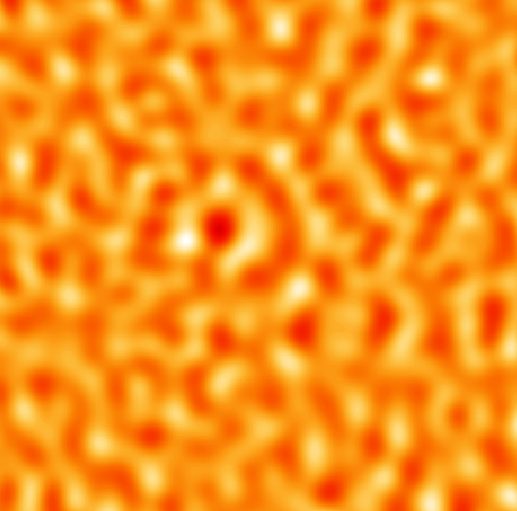
Figure 1: 16.5 GHz CAT image of  area centred on the CAT2 field, after discrete sources have been
subtracted. Excess power can be seen in the central
area centred on the CAT2 field, after discrete sources have been
subtracted. Excess power can be seen in the central  primary beam (because the sensitivity drops sharply outside this
area, the outer regions are a good indicator of the noise level on the map).
The flux density range scale spans
primary beam (because the sensitivity drops sharply outside this
area, the outer regions are a good indicator of the noise level on the map).
The flux density range scale spans  mJy per beam.