
 postscript
Abstract...
postscript
Abstract...
 Abstract...
 2 The Mass Function ...
By holes in the microwave sky, we hope to invoke an image of the
Sunyaev--Zel'dovich (SZ) effect at low frequencies: a region of lower than
average sky brightness, or a hole in the cosmic microwave background (CMB). The
image presented by B. Partridge at these proceedings is an excellent example
and, along with a similar detection by the Ryle Telescope, is the motivation
for this presentation; because if the two radio decrements are indeed due to SZ
effect, this can have powerful implications for the value of  .
.
In what has yielded the deepest radio map to date, the VLA discovered a radio
decrement -- characteristic of the SZ effect below 1.4 mm -- during an
observation of one of the HST Medium Deep Survey fields (Richards et al. (1996)). The
object is just resolved, extending over an area of about 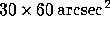 . The other object (Jones et al. (1996)) was found by the RYLE Telescope
(RT) during an ongoing program of double quasar observations (Saunders (1997)).
They find a radio decrement covering an area of about
. The other object (Jones et al. (1996)) was found by the RYLE Telescope
(RT) during an ongoing program of double quasar observations (Saunders (1997)).
They find a radio decrement covering an area of about 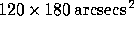 . In both cases, subsequent follow-up in the optical and in the
X-ray band has not revealed the supposed clusters (Richards et al. (1996), Jones et al. (1996), Saunders et al. (1997)).
Definite confirmation of the SZ nature of the two decrements will thus come
from efforts to measure the effect at different frequencies, to see if the
spectra are consistent with the SZ effect. If they are indeed clusters, then
the lack of optical or X-ray counterparts may be interpreted as evidence that
they lie at large redshift. It is in this way that we may obtain very strong
constraints on
. In both cases, subsequent follow-up in the optical and in the
X-ray band has not revealed the supposed clusters (Richards et al. (1996), Jones et al. (1996), Saunders et al. (1997)).
Definite confirmation of the SZ nature of the two decrements will thus come
from efforts to measure the effect at different frequencies, to see if the
spectra are consistent with the SZ effect. If they are indeed clusters, then
the lack of optical or X-ray counterparts may be interpreted as evidence that
they lie at large redshift. It is in this way that we may obtain very strong
constraints on  : The number of massive, high-redshift clusters
depends sensitively on
: The number of massive, high-redshift clusters
depends sensitively on  , so much so that the observation of
even a small number of such clusters can eliminate the critical model
(Oukbir & Blanchard (1992), Barbosa et al. (1996), Eke et al. (1996), Oukbir & Blanchard (1997)).
, so much so that the observation of
even a small number of such clusters can eliminate the critical model
(Oukbir & Blanchard (1992), Barbosa et al. (1996), Eke et al. (1996), Oukbir & Blanchard (1997)).