
 postscript
1 Introduction...
postscript
1 Introduction...
 Abstract...
 3 The Sunyaev--Zel'dovich Effect...

The easiest way to understand this dependence is by considering the mass function, the number density of collapsed objects as a function of mass and redshift (e.g. Bartlett (1997)). In `standard' models, based on the growth of initially small density perturbations with Gaussian statistics, this takes the general form of a power law times a Gaussian (Press & Schechter (1974)):
In this equation,  is the mean, comoving density of the Universe and
 is the power spectrum as a function of the mass scale,
  . The
quantity
. The
quantity

is a function of the linear growth factor,  , which depends on
  and
and  , of the critical
density needed for collapse,
, of the critical
density needed for collapse,  , which has only a weak dependence on
 and
and  , and of
  , the present-day
power spectrum, a function of mass only. The appearance of
, the present-day
power spectrum, a function of mass only. The appearance of  in the
exponential of the mass function indicates that the
in the
exponential of the mass function indicates that the  dependence
can be quite strong; hence, the comment that even a small number of clusters at
large
dependence
can be quite strong; hence, the comment that even a small number of clusters at
large  can severely constrain the density parameter. The key point is that
the shape of the redshift distribution of clusters of a given mass is only
determined by the cosmological parameters (the power spectrum cannot be
changed to alter this fact) (Oukbir & Blanchard (1997)).
can severely constrain the density parameter. The key point is that
the shape of the redshift distribution of clusters of a given mass is only
determined by the cosmological parameters (the power spectrum cannot be
changed to alter this fact) (Oukbir & Blanchard (1997)).
The problem is that we do not measure mass directly; we need some other, more readily observable quantity which correlates well with cluster mass. Because we believe that the hot cluster gas is heated by infall during cluster formation, we expect that the X-ray temperature should represent the depth of the cluster potential well and, therefore, its mass. This has in fact been well established by various hydrodynamical simulations (in `standard' scenarios) (Evrard et al. (1996)), which also provide the exact form of the temperature-mass relation. The X-ray luminosity, on the other hand, is a more complicated animal, depending not only on the temperature of the gas, but also on its abundance and spatial distribution. As we discuss below, observing clusters via the Sunyaev--Zel'dovich effect avoids these problems associated with the X-ray flux, while preserving the simplicity of a straightforward flux measurement (plus other advantages). This is important because X-ray spectra demand time-consuming, space-based observations.
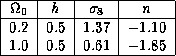
Table 1: Model Parameters normalised to the local X-ray
temperature function (Henry & Arnaud (1991))
For our discussion here, we take a phenomenological point of view and adopt a
power-law approximation to the power spectrum:  , where
  is the bias parameter and
  is the mass
contained in a sphere of
is the mass
contained in a sphere of  . We will focus on the
comparison of two extreme models, a critical model and an open model with
. We will focus on the
comparison of two extreme models, a critical model and an open model with
 (
( in both cases). The parameters
 and
and  for each model are constrained by fitting to the local X-ray
temperature function of galaxy clusters (Henry & Arnaud (1991)), the results of which are
given in Table 1 (Oukbir et al. (1997), Oukbir & Blanchard (1997)).
for each model are constrained by fitting to the local X-ray
temperature function of galaxy clusters (Henry & Arnaud (1991)), the results of which are
given in Table 1 (Oukbir et al. (1997), Oukbir & Blanchard (1997)).
