
 postscript
Abstract...
postscript
Abstract...
 Abstract...
 2 The properties of ...
The properties of the population and the individual appearance of distant galaxies can both be modified significantly by the gravitational lensing effect of foreground masses (Schneider et al. (1992)). Gravitational lensing has been investigated in most detail in the near-infrared/optical and radio wavebands, in which faint distant galaxies can be observed with sub-arcsecond resolution. However, there are excellent prospects for extending these studies into the submillimetre waveband (Blain (1996a), Blain (1996b), Blain (1997a), Blain (1997c)). The fraction of gravitational lenses expected in a sample of galaxies selected in the submillimetre waveband can be up to three orders of magnitude larger as compared with a sample selected in other wavebands.
The concept of magnification bias provides a useful way of describing the
effects of lensing on a population of distant galaxies (Borgeest et al. (1991)). If the
surface density of galaxies with flux densities greater than  per unit
redshift is
per unit
redshift is  at redshift
  , then magnification by a factor
  due to gravitational lensing would predict a modified count,

If  locally, then the magnification bias
  is
given by
is
given by  . Hence, if
  then the surface density of
galaxies is increased and the magnification bias is positive; if
then the surface density of
galaxies is increased and the magnification bias is positive; if  then the surface density is decreased and the bias is negative. Magnification
bias was first discussed in the context of samples of bright quasars; however,
counts of galaxies at faint flux densities in the submillimetre waveband are
expected to be uniquely steep, with
then the surface density is decreased and the bias is negative. Magnification
bias was first discussed in the context of samples of bright quasars; however,
counts of galaxies at faint flux densities in the submillimetre waveband are
expected to be uniquely steep, with  or less (Blain & Longair (1996), Blain & Longair (1993)),
and so the magnification bias for faint galaxies in this waveband is expected
to be very significant (Blain (1996b)). At brighter flux densities the
submillimetre-wave counts are expected to be less steep, and to follow the
Euclidean slope, with
or less (Blain & Longair (1996), Blain & Longair (1993)),
and so the magnification bias for faint galaxies in this waveband is expected
to be very significant (Blain (1996b)). At brighter flux densities the
submillimetre-wave counts are expected to be less steep, and to follow the
Euclidean slope, with  . The magnification bias is expected to be
largest at flux densities at which the counts begin to rise above the Euclidean
slope. If the population of dusty star-forming galaxies evolves strongly, then
the largest magnification bias is predicted to occur at flux densities
. The magnification bias is expected to be
largest at flux densities at which the counts begin to rise above the Euclidean
slope. If the population of dusty star-forming galaxies evolves strongly, then
the largest magnification bias is predicted to occur at flux densities 
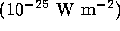 (Blain (1997a)), flux densities
that are comparable with the sensitivity of Planck (Bersanelli et al. (1996)).
(Blain (1997a)), flux densities
that are comparable with the sensitivity of Planck (Bersanelli et al. (1996)).
The submillimetre-wave counts of gravitationally-lensed galaxies are expected
to be very sensitive to changes in both the world models and scenarios of
galaxy formation and evolution that are assumed. Hence, the properties of the
lensed galaxies or quasars detected in a Planck survey would allow both
the evolution of galaxies and the values of cosmological parameters to be
investigated. A value of Hubble's constant  is assumed throughout this paper.