
 postscript
1 Introduction...
postscript
1 Introduction...
 Abstract...
 3 A lens survey ...
The surface and flux densities of gravitational lenses in the
millimetre/submillimetre wavebands can be predicted by combining models of the
population of distant dusty star-forming galaxies (Blain & Longair (1996)) with a model of
the magnification distribution due to lensing as a function of redshift
(Peacock (1982), Blain (1996b)). The magnification distribution can be derived from
the mass distribution of galaxies, and takes the form  if
if  is
large. A range of estimates of
is
large. A range of estimates of  are presented in Fig.1; these
are calculated for four different world models and for both evolving and
non-evolving models of the distribution of lensing masses. In the evolving
model the mass distribution of the population of lensing galaxies is derived
using the Press--Schechter formalism for structure formation by hierarchical
clustering (Press & Schechter (1974)), in which galaxies typically become smaller and more
numerous as redshift increases. The probability of lensing is predicted to be
smaller in the evolving model as compared with the non-evolving model, and to
increase in flat world models as the size of the cosmological constant
increases. The form of
are presented in Fig.1; these
are calculated for four different world models and for both evolving and
non-evolving models of the distribution of lensing masses. In the evolving
model the mass distribution of the population of lensing galaxies is derived
using the Press--Schechter formalism for structure formation by hierarchical
clustering (Press & Schechter (1974)), in which galaxies typically become smaller and more
numerous as redshift increases. The probability of lensing is predicted to be
smaller in the evolving model as compared with the non-evolving model, and to
increase in flat world models as the size of the cosmological constant
increases. The form of  assumed in this letter is normalised to match a
particular set of earlier predictions (Pei (1993)).
assumed in this letter is normalised to match a
particular set of earlier predictions (Pei (1993)).
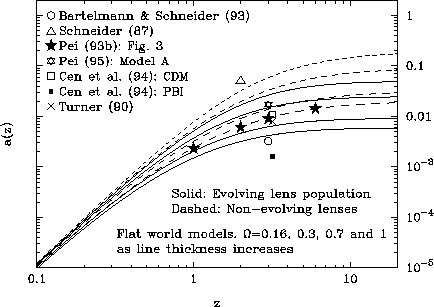
Figure 1: The probability of galaxy--galaxy lensing as a
function of redshift. The probability can change significantly if either the
cosmological constant  or the mass distribution of the
population of lensing galaxies evolves. All world models are flat, with
or the mass distribution of the
population of lensing galaxies evolves. All world models are flat, with
 . The optical depth to lensing
  . The
full references are listed elsewhere (Blain (1996b)).
. The
full references are listed elsewhere (Blain (1996b)).
Investigations of the evolution of galaxies and active galactic nuclei (AGN) in
many different wavebands (for example Hewett et al. (1993), Dunlop & Peacock (1990), Oliver et al. (1993), Lilly et al. (1996)) indicate that
the observed evolution of both the global star-formation rate and the
luminosity density of AGN is consistent with pure luminosity evolution (PLE) of
the form  out to
  . All three models of galaxy evolution
discussed here are normalised to match the
. All three models of galaxy evolution
discussed here are normalised to match the  -
- luminosity
function of IRAS galaxies at small redshifts
luminosity
function of IRAS galaxies at small redshifts  (Saunders et al. (1990))
and undergo this form of PLE out to a redshift
(Saunders et al. (1990))
and undergo this form of PLE out to a redshift  . However, at
larger redshifts
. However, at
larger redshifts  each involves a different form of evolution. In
modelA
each involves a different form of evolution. In
modelA  -- that is there are no galaxies at
  . In model
B
. In model
B  , but there is no further PLE at redshifts between
  and
and
 . In model C
  and galaxies undergo negative PLE of the form
 at redshifts
  ;
;
 is the cosmic epoch at redshift
  .
.
The counts predicted in all three models of galaxy evolution are compared in
Fig.2(a), assuming both an evolving and a non-evolving distribution
of lenses. The surface density of lensed images is predicted to be smaller in
the evolving model. The counts predicted in different world models are compared
in Fig.2(b). A non-zero cosmological constant both increases the
predicted surface density of lensed galaxies -- due to an increased probability
of lensing -- and decreases the counts of unlensed galaxies -- due to a smaller
volume element at large redshifts as compared with an Einstein--de Sitter
model. The wavelength dependence of both the lensed and unlensed counts is
presented in Figs2(c)&(d). The principal feature is the large
increase in the ratio of the surface densities of lensed and unlensed galaxies
in the submillimetre waveband at flux densities of about  , which
correspond to the onset of the steep rise in the unlensed counts above the
Euclidean slope at each wavelength. This increase is by two orders of magnitude
as compared with the
, which
correspond to the onset of the steep rise in the unlensed counts above the
Euclidean slope at each wavelength. This increase is by two orders of magnitude
as compared with the  -
- counts, which have a similar form to
the counts expected in the optical or radio wavebands. Another notable feature
is the predicted increase in the surface density of unlensed 0.1-Jy galaxies as
the observing wavelength in the submillimetre waveband decreases. The surface
density of unlensed 0.1-Jy galaxies is predicted to be larger by a factor of
about 40 at a wavelength of
counts, which have a similar form to
the counts expected in the optical or radio wavebands. Another notable feature
is the predicted increase in the surface density of unlensed 0.1-Jy galaxies as
the observing wavelength in the submillimetre waveband decreases. The surface
density of unlensed 0.1-Jy galaxies is predicted to be larger by a factor of
about 40 at a wavelength of  as compared with a wavelength
of
as compared with a wavelength
of  . The counts of lensed 0.1-Jy galaxies are also expected
to increase as the observing wavelength in the submillimetre waveband decreases
>from
. The counts of lensed 0.1-Jy galaxies are also expected
to increase as the observing wavelength in the submillimetre waveband decreases
>from  to about
  ; however, at wavelengths
shorter than about
; however, at wavelengths
shorter than about  this effect is reversed, and the counts
are predicted to decrease as the observing wavelength decreases.
this effect is reversed, and the counts
are predicted to decrease as the observing wavelength decreases.
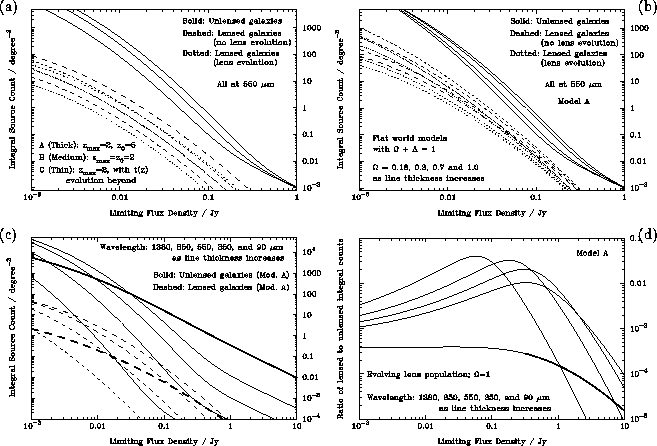
Figure 2: The counts of lensed and unlensed field galaxies
expected in a range of galaxy evolution scenarios (a) and world models (b). The
wavelength dependence of the predicted counts is presented in (c) and (d).
The general form of the lensed and unlensed counts at flux densities of a few tenths of mJy is consistent with the expectation of an increasing number of lenses, but with lenses contributing a smaller fraction of the total number of detected sources, as the observing wavelength decreases in the submillimetre waveband.