
 postscript
1 Introduction...
postscript
1 Introduction...
 Abstract...
 3 Calculating Hubble's Constant...
The Ryle Telescope (RT) (Jones (1991)) is an eight-element interferometer operating at 15 GHz situated at Lord's Bridge, just outside Cambridge. For S-Z work we use only five of these 13-m diameter aerials in a compact array, giving access to baselines as short as 18 m; it is these baselines which give the required sensitivity to detect the extended, low-surface-brightness decrement. The longer baselines almost entirely resolve out the S-Z effect and are only sensitive to any point sources in the field (see Figure 1).
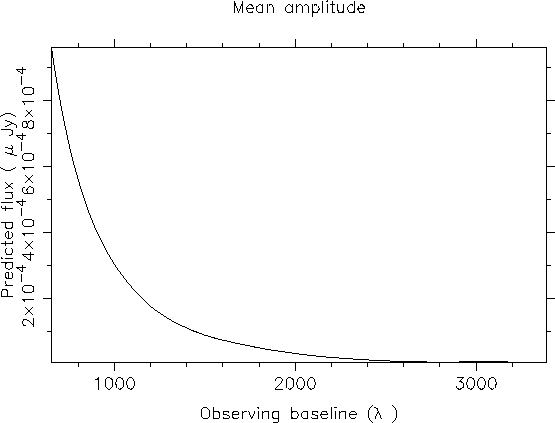
Figure 1: Plot of the predicted S--Z flux that would be
detected by the RT against observing baseline for a rich cluster (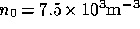 ,
,  ,
,  ,
,  )
)
We are therefore able to use the long baseline observations to remove the effect of these confusing sources from our short baseline data. We have now successfully detected the S--Z effect in twelve clusters (Figure 2)(Jones et al. (1993), Grainge et al. (1993), Saunders (1995), Grainge et al. (1996)). Where X-ray maps exist, they agree well with our S--Z images; for example Figure 3 shows our results for the cluster A1914. The centre of the S--Z decrement does not coincide with the peak of the X-ray emission, but it does agree well with the X-ray centroid. The off centre X-ray peak indicates the presence of an over-dense region of gas which will contribute little to the S--Z signal. It is the bulk of the gas which determines the shape and position of both the S--Z effect and the extended X-ray emission.
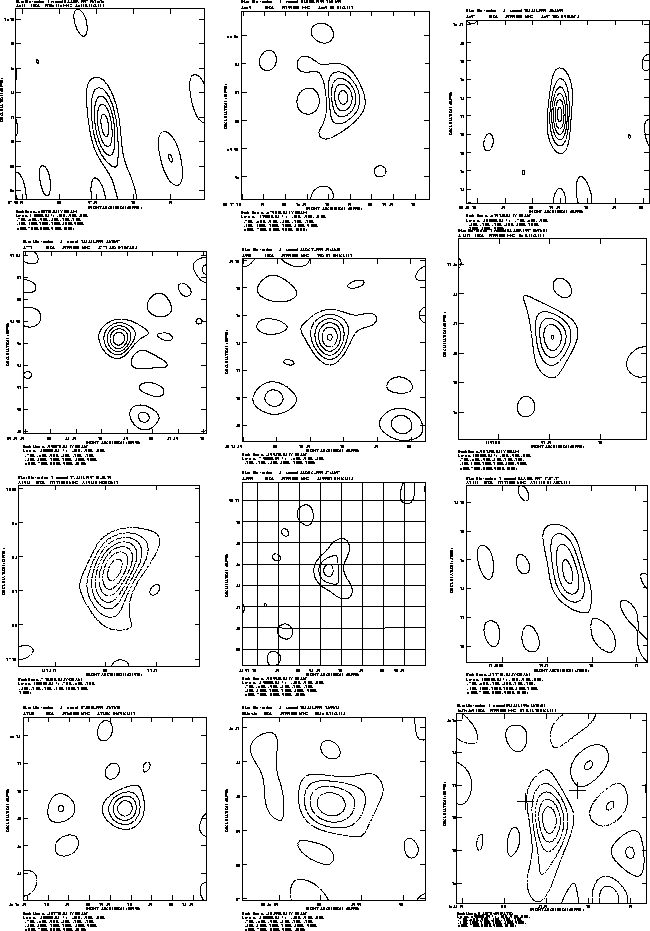
Figure 2: S--Z detections with the RT
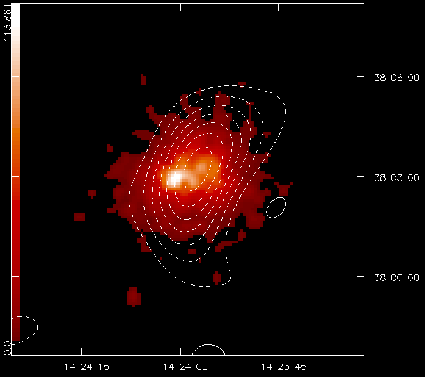
Figure 3: Map of A1914. The colour plot is the ROSAT PSPC
image, and the contours show the CLEANed map of the naturally weighted RT
0--1 k visibilities, after subtraction of 1 source.