postscript
1 Introduction...
postscript
1 Introduction...
 Abstract...
 Acknowledgements...
A general myth created by the Chaotic Inflation, that ``
T/S is negligible for the Harrison--Zel'dovich spectrum'', proved to be an
artifact of the model, namely, the  -potential-choice there (the
power-law inflation has demonstrated the consistency with the myth displaying
that large
-potential-choice there (the
power-law inflation has demonstrated the consistency with the myth displaying
that large  can be obtained only while rejecting from the
HZ-slope of density perturbations,
can be obtained only while rejecting from the
HZ-slope of density perturbations,  ). The reason is that the
CI-models generate cosmological-scale-perturbations only for
). The reason is that the
CI-models generate cosmological-scale-perturbations only for  (as the process of inflation is to be intrinsicly stopped at
  )
so, the
)
so, the 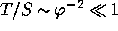 remains always there. At the same time,
smooth
remains always there. At the same time,
smooth  -potentials produce ``red'' HZ spectra of scalar
perturbations, which is also a general property of CI. Although both
properties, small T/S and
-potentials produce ``red'' HZ spectra of scalar
perturbations, which is also a general property of CI. Although both
properties, small T/S and  , originate from a single condition
-- the
, originate from a single condition
-- the  inflation, -- the latter is not a general case for
inflationary process at all. More of that, the relationship between T/S
and
inflation, -- the latter is not a general case for
inflationary process at all. More of that, the relationship between T/S
and  is not confirmed (in particular, it is violated when the slow-roll
approximation is broken). Instead, the connection of T/S to
is not confirmed (in particular, it is violated when the slow-roll
approximation is broken). Instead, the connection of T/S to  seems a
fundamental one (see below).
seems a
fundamental one (see below).
Obviously, it is clear that T/S becomes large if the cosmological
perturbations are generated at  . In this case the inflation
must continue to smaller
. In this case the inflation
must continue to smaller  . This possibility is realised for a
rather general class of the fundamental inflations with one scalar field and
the effective
. This possibility is realised for a
rather general class of the fundamental inflations with one scalar field and
the effective  -term (Lukash & Mikheeva (1996)):
The vacuum density  (
( ) should be metastable
(otherwise inflation will proceed infinitely) and decay at some
) should be metastable
(otherwise inflation will proceed infinitely) and decay at some  . The mechanism of the
  decay may be arbitrary and is
not fixed in this simple model (as an example of
decay may be arbitrary and is
not fixed in this simple model (as an example of  -decay see hybrid
inflation, Linde (1994)).
-decay see hybrid
inflation, Linde (1994)).
Regarding that the inflation proceeds up to small  , eq(2) can be
relevantly understood as the decomposition of
, eq(2) can be
relevantly understood as the decomposition of  near the
local-minimum-point
near the
local-minimum-point  .
.
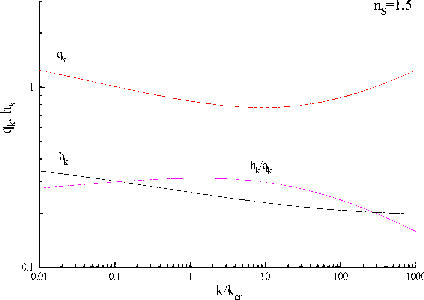
Figure 1: The spectra of scalar ( ) and tensor (
 )
metric perturbations in the model (2) with
)
metric perturbations in the model (2) with  in arbitrary
normalisation. In the ``blue'' asymptotic
in arbitrary
normalisation. In the ``blue'' asymptotic  .
.
Another important parameter of the model (besides  ) is
) is
 where
where 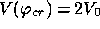 . For
. For

the process of the inflation is dominated by the  -term. Such a stage,
being impossible in the chaotic inflation, brings about the generation of
``blue'' spectra of S-perturbations. Taking into account that for
-term. Such a stage,
being impossible in the chaotic inflation, brings about the generation of
``blue'' spectra of S-perturbations. Taking into account that for
 the spectrum is ``red'', we come to very generic
properties of the S and T spectra in the models with
the spectrum is ``red'', we come to very generic
properties of the S and T spectra in the models with
 -term.
 , corresponding to
  .
.
 for COBE).

 ;
;
 works well at any scale, where
  should be understood as the effective (local) spectral index of the
T-mode where T/S is measured.
should be understood as the effective (local) spectral index of the
T-mode where T/S is measured.
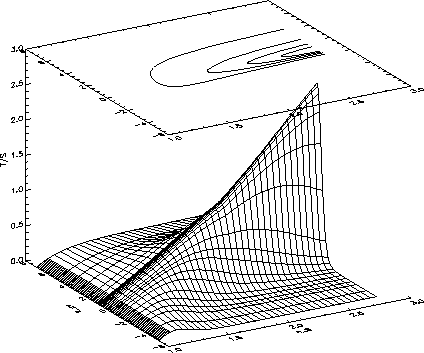
Figure 2: T/S ratio for the model (2) with
 .
.
Figure 1 presents S and T perturbation spectra (dashed and
solid lines, respectively) and a ratio between them (dotted line). The
gauge-invariant metric perturbations generated in the inflation, are determined
in the synchronous reference system comoving to the  -field in large
scales (
-field in large
scales ( ):
):

where  and
and 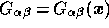 are
random Gaussian functions of spatial coordinates,
are
random Gaussian functions of spatial coordinates, 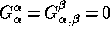 ,
,

For HZ-spectra  and
and  would be
  -independent (
 and
and
 , respectively). The normalisation of both spectra is arbitrary and
can be calculated exactly after defining
, respectively). The normalisation of both spectra is arbitrary and
can be calculated exactly after defining  .
.
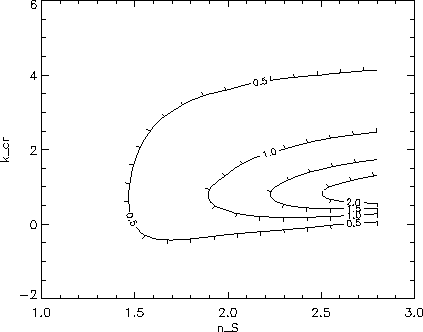
For the case  ,
,  , T/S was calculated by the authors
for the following model parameters:
, T/S was calculated by the authors
for the following model parameters:  ,
,  (Figure 2). Figure 3 shows the same
two-parametric function T/S as a set of the slices of constant T/S
values. We see that the probability to find
(Figure 2). Figure 3 shows the same
two-parametric function T/S as a set of the slices of constant T/S
values. We see that the probability to find  in the model
plane is roughly 50%.
in the model
plane is roughly 50%.
As the ``blue'' S-spectra appearing naturally in the  -dominated
inflation models have important implications for LSS formation theories,
below we write down explicitly (
-dominated
inflation models have important implications for LSS formation theories,
below we write down explicitly ( ).
).
For  :
:

For  :
:

For  the dimensionless power spectrum of density perturbations is
as follows:
the dimensionless power spectrum of density perturbations is
as follows: