
 postscript
2 Fitting procedures and ...
postscript
2 Fitting procedures and ...
 Abstract...
 Acknowledgements...
In order to discuss the cosmological consequences of our results, we converted
our results into limits on intrinsic physical properties of the SSC (for
details see Molnar & Birkinshaw (1996)). Figure 1 shows 95 % upper
limits for the central electron number density as a function of electron
temperature for truncated beta models with  (Fig. 1a) and
  (Fig. 1b), which bracket the likely range of this parameter, and a
core radius of
(Fig. 1b), which bracket the likely range of this parameter, and a
core radius of  suggested by optical observations, from our fits to
COBE DMR, HEAO and ROSAT data. We also show the GINGA limits (Day et al. (1991)),
and estimates of the limits that could be reached using moderate-duration XTE
scans across the SSC (Jahoda et al. (1996)).
suggested by optical observations, from our fits to
COBE DMR, HEAO and ROSAT data. We also show the GINGA limits (Day et al. (1991)),
and estimates of the limits that could be reached using moderate-duration XTE
scans across the SSC (Jahoda et al. (1996)).
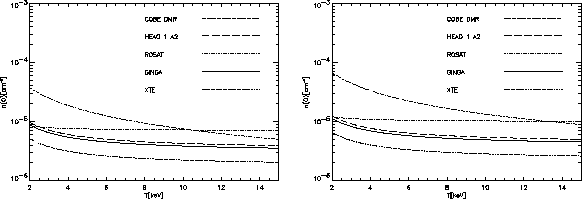
Figure 1: 95% upper
limits on the central electron number density of intra-supercluster gas as a
function of electron temperature from the COBE DMR (Galactic emission removed)
and HEAO-1 A2 data. The solid line represents the limits that can be set based
on the sensitivity of GINGA (see Day et al. (1991)). The 95% estimated
sensitivity limits that could be achieved by a long XTE scan
(Jahoda et al. (1996)) are also shown. The two panels correspond to truncated
isothermal beta models with a core radius of  , and (left) beta = 0.6;
(right) beta = 1.2.
, and (left) beta = 0.6;
(right) beta = 1.2.
The HEAO-1 A2 limits are slightly less sensitive than the GINGA limits of
Day et al. (1991), and more sensitive than those obtained using the COBE DMR data
unless the gas temperature is unexpectedly high. The ROSAT All-Sky Survey
results provide slightly better constraints than the COBE results, but the
results from the other satellites are more stringent. The central electron
density in the SSC is constrained to be less than about 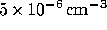 for most values of
  . XTE scans should achieve about a
factor of three improvement on the GINGA limits. Two proposed missions, to
study the CBR, MAP and PLANCK, have (
. XTE scans should achieve about a
factor of three improvement on the GINGA limits. Two proposed missions, to
study the CBR, MAP and PLANCK, have ( ) sensitivities of
  at 90 GHz (the highest MAP frequency, where galactic contamination has
the minimum antenna temperature), and
at 90 GHz (the highest MAP frequency, where galactic contamination has
the minimum antenna temperature), and  at 143 GHz (a PLANCK
frequency, where the SZ effect has its maximum in intensity units) with an
angular resolution of 20 and 10 arc minutes respectively (Bennett et al. (1995),
Tauber et al. (1996)). MAP and PLANCK should be able to detect gas in the SSC with
central electron densities of about
at 143 GHz (a PLANCK
frequency, where the SZ effect has its maximum in intensity units) with an
angular resolution of 20 and 10 arc minutes respectively (Bennett et al. (1995),
Tauber et al. (1996)). MAP and PLANCK should be able to detect gas in the SSC with
central electron densities of about  and
and  , based on their sensitivity alone, but the practical detection limit
is likely to be set by confusion with primordial fluctuations.
, based on their sensitivity alone, but the practical detection limit
is likely to be set by confusion with primordial fluctuations.
White & Fabian (1995) have shown that the average baryonic densities in a sample
of 13 clusters are considerably higher ( ) than the limit on the average baryon density of the
Universe derived from standard nucleosynthesis theories
) than the limit on the average baryon density of the
Universe derived from standard nucleosynthesis theories  (assuming
  , Walker et al. (1991),
Smith et al. (1993)). It is important to find out if this baryon problem exists at
a supercluster scale. Fabian (1991) estimated the baryon fraction in the SSC
by extrapolating the gas mass and luminosity relation for clusters of galaxies
(Jones & Forman (1984)), and concluded that
, Walker et al. (1991),
Smith et al. (1993)). It is important to find out if this baryon problem exists at
a supercluster scale. Fabian (1991) estimated the baryon fraction in the SSC
by extrapolating the gas mass and luminosity relation for clusters of galaxies
(Jones & Forman (1984)), and concluded that 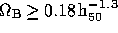 . We derived limits on the average gas density over a
  core radius in the SSC >from the same two truncated beta models we used for
Figure 1 (
core radius in the SSC >from the same two truncated beta models we used for
Figure 1 ( 0.6 and 1.2) using GINGA sensitivity limits, the estimated
sensitivity of proposed XTE scan, and the expected sensitivities of MAP, and
PLANCK missions. We plot the 95 % upper limits on the ISC gas density in units
of the critical density (
0.6 and 1.2) using GINGA sensitivity limits, the estimated
sensitivity of proposed XTE scan, and the expected sensitivities of MAP, and
PLANCK missions. We plot the 95 % upper limits on the ISC gas density in units
of the critical density (  ) on Figure 2. We also
plot average densities derived from the same isothermal models with a central
peak (4
) on Figure 2. We also
plot average densities derived from the same isothermal models with a central
peak (4  ) equal to the estimated primordial fluctuation on a
 scale at two frequencies, 90 GHz, and 143 GHz. These models represent
limits below which single frequency observations are limited by primordial
fluctuations.The lower lines represent limits using
scale at two frequencies, 90 GHz, and 143 GHz. These models represent
limits below which single frequency observations are limited by primordial
fluctuations.The lower lines represent limits using  , the upper
lines belong to
, the upper
lines belong to  .The area enclosed by these lines represent the
upper limits over the full likely range of beta. The prediction for the average
baryon density derived from standard nucleosynthesis theories is also shown
with 2
.The area enclosed by these lines represent the
upper limits over the full likely range of beta. The prediction for the average
baryon density derived from standard nucleosynthesis theories is also shown
with 2 error bars (two horizontal lines). The limits on
  based on GINGA sensitivities range from 0.19
  to 0.08
 with increasing temperature. Thus we can conclude that
the SSC does not contain much more hot (
with increasing temperature. Thus we can conclude that
the SSC does not contain much more hot ( ) large scale
diffuse ISC gas than it is predicted by standard nucleosynthesis theories. Any
reasonable value for
) large scale
diffuse ISC gas than it is predicted by standard nucleosynthesis theories. Any
reasonable value for  would not change our conclusion.
The temperature and distribution of the intra-(super)cluster diffuse gas
strongly depend on the dynamics of the clustering (Governato et al. (1996)). The
lack of such diffuse gas could tell us about the efficiency of clustering
(Frisch et al. (1995), West et al. (1995)). Therefore it is important to continue to
search for ISC gas in superclusters with instruments with higher sensitivity.
Assuming hot ISC gas ( ), we can conclude from Figure
2 that XTE would be able to detect gas in the SSC with
), we can conclude from Figure
2 that XTE would be able to detect gas in the SSC with 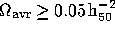 . Single frequency observations with
sensitivities
. Single frequency observations with
sensitivities  are limited by primordial
fluctuations.
are limited by primordial
fluctuations.
The estimated 95 % detection limits of MAP and the PLANCK for extended objects
at 90 and 143 GHz make it possible to detect ISC gas in the SSC at density 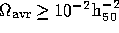 and
and 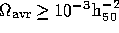 or better. These limits are much lower than the limits derived
from standard nucleosynthesis theories, and the single frequency primordial
limits. These observations are limited by primordial fluctuations on angular
scale of the observed extended object, and the accuracy of doing spectral
separation of the SZ effect from primordial fluctuations and Galactic
contamination. A detailed modeling of galactic contamination and point sources
will be clearly needed to analyze the data collected by the next generation of
satellites, but the signature of ISC gas should be evident in their result.
or better. These limits are much lower than the limits derived
from standard nucleosynthesis theories, and the single frequency primordial
limits. These observations are limited by primordial fluctuations on angular
scale of the observed extended object, and the accuracy of doing spectral
separation of the SZ effect from primordial fluctuations and Galactic
contamination. A detailed modeling of galactic contamination and point sources
will be clearly needed to analyze the data collected by the next generation of
satellites, but the signature of ISC gas should be evident in their result.
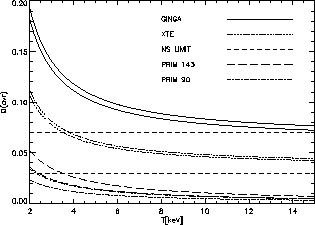
Figure 2: 95 % upper limits on the average
intra-cluster gas density,  , as a function of electron
temperature in the core (
, as a function of electron
temperature in the core ( ) of the SSC in units of the critical
density, that can be derived based on non-detections with GINGA (see
Day et al. (1991)), and a long XTE scan (Jahoda et al. (1996)), and limits derived
from models with a central peak (4
) of the SSC in units of the critical
density, that can be derived based on non-detections with GINGA (see
Day et al. (1991)), and a long XTE scan (Jahoda et al. (1996)), and limits derived
from models with a central peak (4  ) equal to the estimated
primordial fluctuation on a
) equal to the estimated
primordial fluctuation on a  scale (PRIM) using truncated isothermal
models with a core radius of
scale (PRIM) using truncated isothermal
models with a core radius of  , and beta = 0.6 (lower line), or beta =
1.2 (upper line). The two horizontal lines (NS LIMIT) bound at
, and beta = 0.6 (lower line), or beta =
1.2 (upper line). The two horizontal lines (NS LIMIT) bound at  the average baryon density required by standard nucleosynthesis theories.