
 postscript
Abstract...
postscript
Abstract...
 Abstract...
 2 An Isolated Microwave ...
As part of an ongoing program to use the VLA to set limits on fluctuations in
the cosmic microwave background (CMBR), Ed Fomalont, Ken Kellermann, Eric
Richards, Rogier Windhorst and I made extended observations of a region
centered at (J2000)  and
and 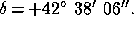 The field contained no radio sources with
flux density at our observing frequency of 8.4 GHz exceeding 500
The field contained no radio sources with
flux density at our observing frequency of 8.4 GHz exceeding 500  ;
optical data was available as part of the Medium Deep Survey (see
Windhorst et al. (1995)). We combined observations in the C and D configurations of the
VLA, giving us a synthesized beam of
;
optical data was available as part of the Medium Deep Survey (see
Windhorst et al. (1995)). We combined observations in the C and D configurations of the
VLA, giving us a synthesized beam of  full width at half
maximum and a field of view of
full width at half
maximum and a field of view of  to the half power points of
primary beam. Our
to the half power points of
primary beam. Our  resolution image had an rms sensitivity of
1.5
resolution image had an rms sensitivity of
1.5  , making it the most sensitive radio image obtained to date at
any frequency or resolution. Lower resolution images were made by applying a
gaussian taper to the data. Radio contours of the map are shown in
Fig.1, superimposed on the MDS survey image from HST (see
Windhorst et al. (1995)). That paper also discusses the optical identifications of the 46
radio sources we detected above a 4.7
, making it the most sensitive radio image obtained to date at
any frequency or resolution. Lower resolution images were made by applying a
gaussian taper to the data. Radio contours of the map are shown in
Fig.1, superimposed on the MDS survey image from HST (see
Windhorst et al. (1995)). That paper also discusses the optical identifications of the 46
radio sources we detected above a 4.7 flux threshold of 7
  .
.
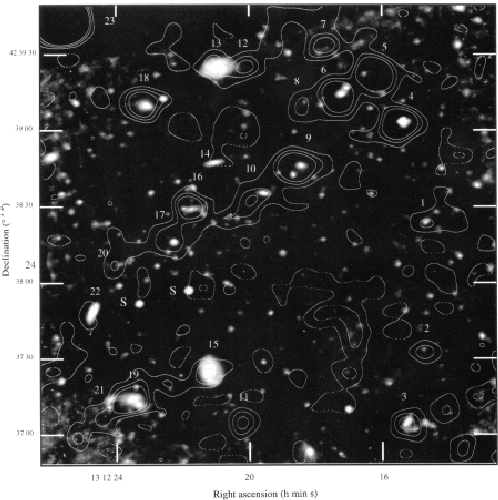
Figure 1: The 13 MDS field (grey scale) with the radio
contours overlaid. The possible S--Z feature, or ``Black Cloud'', is southwest
of the image center.
MDS field (grey scale) with the radio
contours overlaid. The possible S--Z feature, or ``Black Cloud'', is southwest
of the image center.
 .
.
In order to use this image to set limits on  , we needed to remove
the effect of foreground radio sources and of instrument noise. The obvious
sources, those visible in Fig.1 or exceeding
, we needed to remove
the effect of foreground radio sources and of instrument noise. The obvious
sources, those visible in Fig.1 or exceeding  were removed as described in Fomalont et al. (1993) or Partridge et al. (1997). We found the
position of each source, then performed a CLEAN in a
were removed as described in Fomalont et al. (1993) or Partridge et al. (1997). We found the
position of each source, then performed a CLEAN in a  box around each to a predetermined level of
  , and finally subtracted the visibility function formed from these clean
components from the raw visibility to provide a corrected set of visibility
data. The resulting map is thus free of bright sources and their side lobes at
all resolutions. But we recognized that additional, weaker sources were still
present. The variance contributed by these was removed by Monte Carlo
simulations. We assumed that the source counts obeyed the law (Kellermann et al. (1997)),
, and finally subtracted the visibility function formed from these clean
components from the raw visibility to provide a corrected set of visibility
data. The resulting map is thus free of bright sources and their side lobes at
all resolutions. But we recognized that additional, weaker sources were still
present. The variance contributed by these was removed by Monte Carlo
simulations. We assumed that the source counts obeyed the law (Kellermann et al. (1997)),

then scattered sources with fluxes ranging from 7  down to 0.1
 at random in the map. This allowed us to estimate (see
Partridge et al. (1997)) the weak source variance
at random in the map. This allowed us to estimate (see
Partridge et al. (1997)) the weak source variance  , which was
subtracted from the observed map variance.
, which was
subtracted from the observed map variance.
We also needed to estimate instrument noise. We used several means to do so
(see Partridge et al. (1997)); in particular, we constructed a difference map by
subtracting one half of the data from the other. In this map, real sky signals
subtract out, leaving just instrument noise uniformly spread over the map. Some
of the values found by this process are shown in Table 1. Subtracting
both the weak source variance and the instrument variance allowed us to
estimate the residual variance in the maps. To be conservative in setting
upper limits on  , we ascribe all of the observed residual
variance to fluctuations in the microwave background at the appropriate angular
scale. Sky variances were converted to 95% confidence limits on
, we ascribe all of the observed residual
variance to fluctuations in the microwave background at the appropriate angular
scale. Sky variances were converted to 95% confidence limits on  assuming
  K and using the measured beam solid angle at each
resolution.
K and using the measured beam solid angle at each
resolution.

Table 1: Instrument noise.  Corrected for primary beam
response.
Corrected for primary beam
response.  1993 and 1996 results combined (Fomalont et al. (1993), Partridge et al. (1997)).
We also combined these observations with some made in a different field in order to produce overall limits on total intensity and polarized CMBR fluctuations on a range of angular scales. Results from our work (Partridge et al. (1997)) are displayed in Table 2, along with comparable results from other groups.
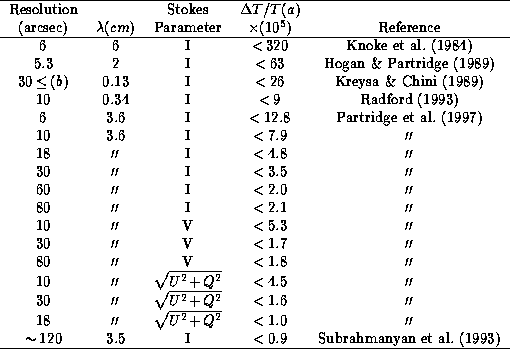
Table 2: Observational results,  .
(a)At 95% confidence. (b) Beam-switch angle.
.
(a)At 95% confidence. (b) Beam-switch angle.