
 postscript
1 Introduction ...
postscript
1 Introduction ...
 Abstract...
 Acknowledgements...
I will focus on the case of cosmic strings. In this case the contribution of
the latest long string comes in the form of a step-like discontinuity
(Kaiser & Stebbins (1984), Gott (1985)) coherent on large angular scales. As a toy model we may first
consider a one dimensional pixel array of standardized, scale invariant
Gaussian fluctuations with a superposed temperature discontinuity of amplitude
 (Perivolaropoulos (1997)).
A statistical variable designed to pick up the presence of this step is the
Sample Mean Difference (SMD)  which assigns to each pixel of the map the
difference of the mean of pixels
which assigns to each pixel of the map the
difference of the mean of pixels  minus the mean
  of pixels
  . It is straightforward to show (Perivolaropoulos (1997)) that

where  labels the
  out of the
  random variables of
the pixel map and
random variables of
the pixel map and  is the location of the superposed coherent
discontinuity. The SMD average statistic Z is defined as the average of
is the location of the superposed coherent
discontinuity. The SMD average statistic Z is defined as the average of  over all

It is straightforward to show that the mean  over many realizations
and locations of the step function is
over many realizations
and locations of the step function is  and the variance of
 depends both on the number of pixels
  and on the step function
amplitude
and on the step function
amplitude 

The condition for detectability of the coherent step discontinuity at  level is that
  is larger than the standard deviation of
  which
implies that
which
implies that  for
for  where
where  is measured in
units of the standard deviation of the underlying Gaussian map. It is
straightforward to apply a similar analysis for the more conventional
statistics skewness and kurtosis. That analysis (Perivolaropoulos (1997)) shows that the
minimum value of
is measured in
units of the standard deviation of the underlying Gaussian map. It is
straightforward to apply a similar analysis for the more conventional
statistics skewness and kurtosis. That analysis (Perivolaropoulos (1997)) shows that the
minimum value of  detectable at the
  level is about an order
of magnitude larger. It is therefore clear that SMD statistical variable is
particularly effective in detecting coherent step-like discontinuities
superposed on Gaussian CMB maps.
level is about an order
of magnitude larger. It is therefore clear that SMD statistical variable is
particularly effective in detecting coherent step-like discontinuities
superposed on Gaussian CMB maps.
A detailed understanding of the effectiveness of the SMD statistic requires the use of Monte-Carlo simulations. In order to verify the analytical results for the mean and variance of the SMD variable I first applied this statistic on one-dimensional Monte-Carlo maps of scale invariant Gaussian fluctuations with step function superposed. The results were in good agreement with the analytical predictions shown above and are described in detail in Perivolaropoulos (1997). Here I will only discuss the two dimensional Monte Carlo simulations.
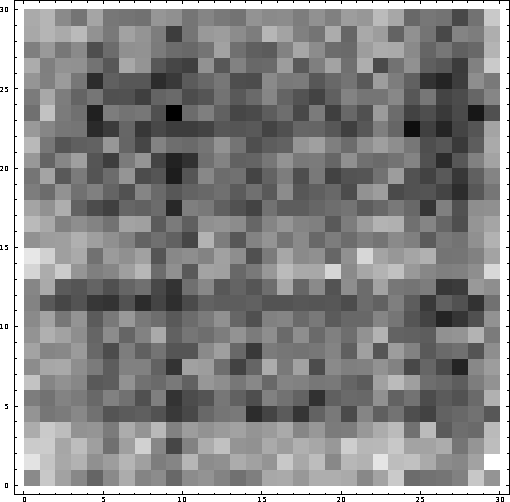
Figure 1: A standardized two dimensional pixel array of scale
invariant Gaussian fluctuations. No step function has been superposed.
Figures 1 and 2 show  pixel maps of
standardised Gaussian scale invariant fluctuations without (1) and
with (2) a coherent step function superposed. The amplitude of the
superposed coherent seed is
pixel maps of
standardised Gaussian scale invariant fluctuations without (1) and
with (2) a coherent step function superposed. The amplitude of the
superposed coherent seed is  .
.
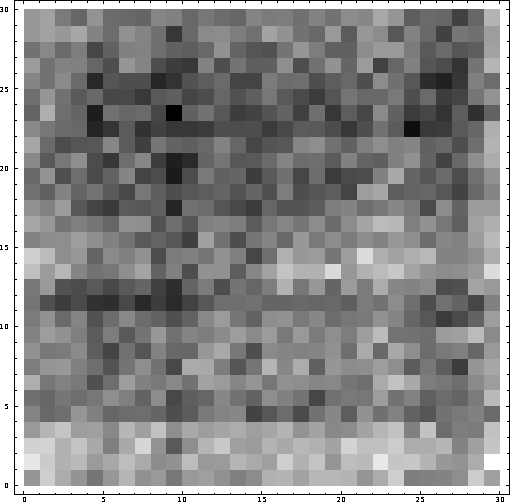
Figure 2: The two dimesnsional array of Figure 2 with a
superposed coherent step-discontinuity of amplitude  defined by
the random points
defined by
the random points  and
and  .
.
Uncorrelated noise has also been included with noise to signal ratio of 0.5.
The scale invariant background  was constructed in the usual way by
taking its Fourier transform
was constructed in the usual way by
taking its Fourier transform  to be a Gaussian complex random
variable. Its phase was taken to be random with a uniform distribution and its
magnitude was a Gaussian random variable with 0 mean and variance equal to a
scale invariant power spectrum. The SMD was obtained by randomly dividing the
map in two sectors and taking the difference of the means of the two sectors.
The SMD average was then obtained by averaging over many randomly chosen
divisions for each map realization. Using 50 such map realizations I obtained
the mean and the standard deviation of the statistics skewness and SMD average
for several values of
to be a Gaussian complex random
variable. Its phase was taken to be random with a uniform distribution and its
magnitude was a Gaussian random variable with 0 mean and variance equal to a
scale invariant power spectrum. The SMD was obtained by randomly dividing the
map in two sectors and taking the difference of the means of the two sectors.
The SMD average was then obtained by averaging over many randomly chosen
divisions for each map realization. Using 50 such map realizations I obtained
the mean and the standard deviation of the statistics skewness and SMD average
for several values of  . The results are shown on Table 1
and indicate
that the statistics skewness and kurtosis can not identify a coherent
discontinuity of amplitude
. The results are shown on Table 1
and indicate
that the statistics skewness and kurtosis can not identify a coherent
discontinuity of amplitude  but would require a much larger
amplitude for such identification.
but would require a much larger
amplitude for such identification.
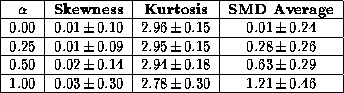
Table 1: A comparison of the effectiveness of the
statistics considered in detecting the presence of a coherent step
discontinuity with amplitude  relative to the standard deviation of
the underlying Gaussian map. The SMD average was obtained after ignoring 150
pixels on each boundary of the Monte Carlo maps. The discontinuities were also
excluded from these 300 pixels. This significantly improved the sensitivity of
the SMD test.
relative to the standard deviation of
the underlying Gaussian map. The SMD average was obtained after ignoring 150
pixels on each boundary of the Monte Carlo maps. The discontinuities were also
excluded from these 300 pixels. This significantly improved the sensitivity of
the SMD test.
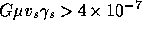
On the other hand the SMD statistic can identify a coherent discontinuity at
the  to
to  level with
  . For
. For  where
where  is the mass
per unit length of the string,
is the mass
per unit length of the string,  is its velocity and
  is the
relativistic Lorenz factor.
is the
relativistic Lorenz factor.
The main points I wanted to stress in this talk are the following:
 in maps with about
  pixels and with a noise to signal ratio of
about 0.5 in a Gaussian background with
pixels and with a noise to signal ratio of
about 0.5 in a Gaussian background with 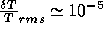 .
.