
 postscript
2 The site...
postscript
2 The site...
 Abstract...
 4 The 96--97 mission...
The APACHE96 experiment is based on a 60 cm, off-axis, Newtonian telescope. The
primary mirror is wobbled sinusoidally at 2 Hz, with  beam throw on
the sky. The field of view is 30 arcmin at 2 mm and the throughput is
beam throw on
the sky. The field of view is 30 arcmin at 2 mm and the throughput is  . The primary mirror is under-illuminated by the Winston
cone which feeds the detectors. The secondary flat mirror is placed very close
to photometer window and is surrounded by an ECCOSORB(TM) shield, to prevent
stray radiation to reach the detectors.
. The primary mirror is under-illuminated by the Winston
cone which feeds the detectors. The secondary flat mirror is placed very close
to photometer window and is surrounded by an ECCOSORB(TM) shield, to prevent
stray radiation to reach the detectors.
A large, conical shield surrounds the telescope, to reject radiation from the ground and to reduce the perturbation introduced by secondary lobes of the telescope. Since the sun is always above the horizon at Dome C in December, the experiment must be surrounded by a solar shield. This is made by aluminium reflecting panels and it is shaped, in the internal part, like a roof-mirror. It is possible, in this way, to get a large effective shield, while keeping the overall dimensions quite small (Figure 3).
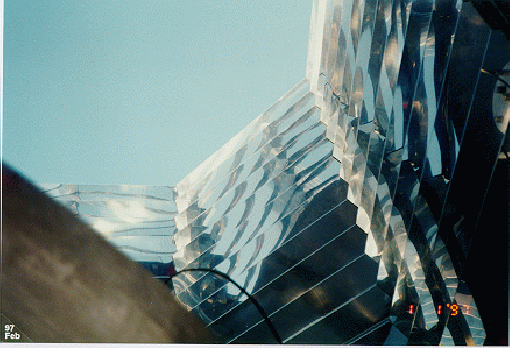
Figure 3: APACHE96 solar shield. Internal part.
The outer part of the shield, thermally decoupled from the inside part, is made of reflecting, flat panels. It should be remembered that APACHE96 was designed to be disassembled in parts to be loaded in a small aircraft. A sketch of APACHE96 is shown in Figure 4.
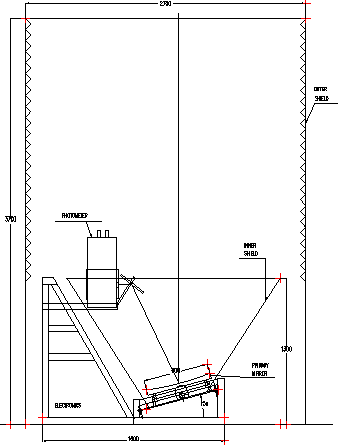
Figure 4: Schematic view of APACHE96. Dimensions are in
millimeters.
A light aluminium structure houses all the subsystems, including the electronics. Optical alignment is made possible by carefully adjusting many different parts on the mounting.
The photometer is based on four  bolometric detectors, operating at
 . A single Winston cone (Winston (1970), Harper et al. (1976)), feeds
all detectors and the radiation is separated by dichroic beam-splitters in four
different bands, defined by inductive meshes (see Table 2). The
optical block, housing detectors and filters is shown in Figure 5.
. A single Winston cone (Winston (1970), Harper et al. (1976)), feeds
all detectors and the radiation is separated by dichroic beam-splitters in four
different bands, defined by inductive meshes (see Table 2). The
optical block, housing detectors and filters is shown in Figure 5.
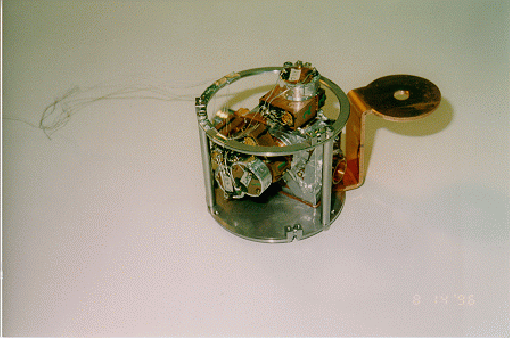
Figure 5: The optical block of APACHE96 photometer.
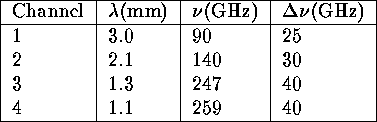
Table 2: Band-pass filter characteristics of APACHE96
photometer.
Background radiation on detectors is blocked by several filters on the entrance window, on the first shield at 77 K, on the second shield at 4.2 K and on the entrance pupil of the Winston cone.
Bolometers operating temperature is obtained with a closed-cycle  refrigerator, described in (Dall'Oglio et al. (1997)). This compact unit, able to keep the
operating temperature for about 36 hours, in mounted on the cold plate of a
standard LHe/LN cryostat.
refrigerator, described in (Dall'Oglio et al. (1997)). This compact unit, able to keep the
operating temperature for about 36 hours, in mounted on the cold plate of a
standard LHe/LN cryostat.
Detectors signals are amplified by 4 separated low-noise AC coupled amplifiers, with a bandpass of about 32 Hz. A high speed, high resolution data acquisition system samples the 4 scientific channels and the mirror reference signal at a frequency of 128 Hz and 10 kHz respectively, allowing a reliable synchronization which is required for the harmonic reconstruction of signals, described in the following section. A local PC, with a dedicated software, manages all the acquisition process, controlling the 4 separated analog to digital converters, the GPS receiver for the synchronization with the UT, the opto-electronic system for the position of the wobbling mirror and the distributed sensors for temperature monitoring of different components of APACHE96. Two temperature sensors are placed inside the photometer, to monitor detectors temperature, and ten probes are placed in the different sections of the experiment, allowing us to detect systematic effects, due to thermal drifts, on data. All the electronic subsystems on the APACHE96 experiment are housed in a temperature controlled box, thermally insulated from the severe ambient conditions. Digital data are buffered and sent, via a TCP/IP protocol, to a remote PC, placed 100 m away in the laboratory, which provides a quick-look analysis and their storage on disk. Files are then transferred on a DAT tape for back-up. Details of the APACHE96 experiment are reported in Valenziano et al. (1997).