 ,
Harold Kenny
,
Harold Kenny ,
Jim Cohen
,
Jim Cohen ,
Huw Lloyd
,
Huw Lloyd ,
Sean Dougherty
,
Sean Dougherty ,
Richard Davis
,
Richard Davis and
Mike Bode
and
Mike Bode
e-mail: spe@jb.man.ac.uk
Please Note: the e-mail address(es) and any external links in this paper were correct when it was written in 1995, but may no longer be valid.
Stewart
Eyres,
Harold Kenny,
Jim Cohen,
Huw Lloyd,
Sean Dougherty,
Richard Davis
and
Mike Bode
e-mail: spe@jb.man.ac.uk
 University of Manchester, NRAL, Jodrell Bank, Macclesfield,
Cheshire SK11 9DL, UNITED KINGDOM
University of Manchester, NRAL, Jodrell Bank, Macclesfield,
Cheshire SK11 9DL, UNITED KINGDOM
 Royal Military College of Canada, Kingston, Ontario K7K 5LO,
CANADA
Royal Military College of Canada, Kingston, Ontario K7K 5LO,
CANADA
 School of Chemical and Physical Sciences, Liverpool John Moores
University, Byrom Street, Liverpool, L3 3AF, UNITED KINGDOM
School of Chemical and Physical Sciences, Liverpool John Moores
University, Byrom Street, Liverpool, L3 3AF, UNITED KINGDOM
Symbiotic stars are a group of around 130 stars, defined by the features apparent in their optical spectra (Kenyon (1986),Allen (1984)). In the red part, the underlying spectrum is typical of a red giant, with a cool continuum, and prominent absorption features, such as TiO. However, superimposed on this are strong emission lines, extending into the violet and UV, and consistent with those from the ionised nebulae associated with hot stars. The most commonly accepted explanation for the peculiar spectra of symbiotic stars is that they are binaries, with a cool component, usually considered to be a red giant or a Mira-type variable, and a hot component, either a white dwarf or a main sequence star. Given the broadness of this definition, objects have occasionally been misclassified as symbiotics. On the other hand, many symbiotic stars have previously been misclassified as planetary nebulae (PNe). HM Sagittae is one such object, and has been proposed as a candidate for a proto-planetary nebula. Many, although by no means all, have been shown to be binaries, which is consistent both with the explanation of the spectra, and with some theories for the formation of PNe.
HM Sagittae is an example of the small subclass of symbiotic novae, which show weak nova-like optical outbursts lasting in excess of decades. As with classical novae, these outbursts are accompanied by radio emission, and HM Sagittae has been proven to be one of the brightest symbiotic radio emitters. Since its discovery by Dokuchaeva (1976), following an optical outburst, it has been well studied in the radio. Some of the earliest measurements were made in 1977 at the Algonquin Radio Observatory (Purton et al. (1983)). Initial work by Kwok & Purton (1979) (see also Purton et al. (1983)) found the emission to be thermal, while Kwok et al. (1984) pointed out that the radio brightness was increasing. This trend stopped in 1984 Kwok (1988), and it seems likely that the brightening was associated with the effects of the optical outburst. Kwok et al. (1984) attributed the increase in flux to expansion of the ionised nebula, as the emission remained thermal and optically thick for ten years following outburst. It was suggested that the `halo' around HM Sagittae was the wind of the Mira-type cool component, swept-up by the hot component white dwarf wind, caused by the onset of a thermonuclear flash at outburst.
To date, only a few attempts have been made to map the radio emission from HM
Sagittae. Purton et al. (1983) published two VLA maps, finding the overall angular
size, in 1980, to be  at 6 cm and
  at 2 cm. The first
hint of structure within the nebula was found by Kwok et al. (1984) in their 1.3 cm
VLA map. This shows an elongated central peak, which in later images separates
into two peaks (Li (1993)). Kenny et al. (1993) have published the most up to date
VLA map, made at 6 cm. Although this shows no new structure, the angular
extent has increased to
at 2 cm. The first
hint of structure within the nebula was found by Kwok et al. (1984) in their 1.3 cm
VLA map. This shows an elongated central peak, which in later images separates
into two peaks (Li (1993)). Kenny et al. (1993) have published the most up to date
VLA map, made at 6 cm. Although this shows no new structure, the angular
extent has increased to  , and the integrated flux to 56 mJy.
Here, we report radio observations of HM Sagittae at 6 cm and 18 cm made with the Multi Element Radio Linked Interferometer Network (MERLIN). The resolution of MERLIN at these wavelengths allows us to trace the structure and spectral behaviour of the star's circumstellar matter at very small scales. We have resolved new structures, and have found definite evidence of a non-thermal component to the radio emission.
HM Sagittae was observed at both 6 cm and 18 cm with MERLIN. Observations at 6
cm were made on 1992 December 26, using six telescopes, at Cambridge, Knockin,
Defford, Darnhall, Tabley, and the Mark II Telescope at Jodrell Bank. The
observing frequency was 5.008 GHz, with a bandwidth of 15 MHz. Both right- and
left-hand circular polarisations were recorded. We observed in phase
referencing mode, spending  minutes on the source and then switching
regularly to the phase calibrator 1932+204 for
minutes on the source and then switching
regularly to the phase calibrator 1932+204 for  minutes. The total
observing time was 9 hours 18 minutes.
minutes. The total
observing time was 9 hours 18 minutes.
The 18 cm observations were carried out on 1993 October 9 using all eight
telescopes of MERLIN (those listed above, along with Wardle, and the Lovell
Telescope at Jodrell Bank). The total observing time was 15 hours 10 minutes.
Again, we observed in the phase referencing mode, spending  to 8
minutes on the source and switching regularly to the phase calibrator
to 8
minutes on the source and switching regularly to the phase calibrator
 for
for  to 2 minutes. However, the Lovell Telescope was only
switched to the phase calibrator approximately every 17 to 28 minutes, i.e.
every third calibration observation, due to that telescope's slow slew-rate.
The calibration interpolation was then carried out over a smaller number of
calibration points for the Lovell Telescope. The observing frequency was 1.658
GHz, with a bandwidth of 15 MHz; both right and left hand circular
polarisations were recorded.
to 2 minutes. However, the Lovell Telescope was only
switched to the phase calibrator approximately every 17 to 28 minutes, i.e.
every third calibration observation, due to that telescope's slow slew-rate.
The calibration interpolation was then carried out over a smaller number of
calibration points for the Lovell Telescope. The observing frequency was 1.658
GHz, with a bandwidth of 15 MHz; both right and left hand circular
polarisations were recorded.
At both wavelengths, the flux calibration was carried out using  , and
this was itself calibrated against 3C286, using the flux scale of Baars et al. (1977).
The calibrated flux for
, and
this was itself calibrated against 3C286, using the flux scale of Baars et al. (1977).
The calibrated flux for  was
was 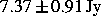 at 6 cm, and
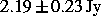 at 18 cm. Initial calibration was carried out using
the MERLIN-Specific software procedure DPROC, with which the absolute
flux scale for the observations was determined. At this stage, the right and
left hand polarisations were added. Subsequent calibration and mapping were
carried out using the AIPS package. The phase calibrator
at 18 cm. Initial calibration was carried out using
the MERLIN-Specific software procedure DPROC, with which the absolute
flux scale for the observations was determined. At this stage, the right and
left hand polarisations were added. Subsequent calibration and mapping were
carried out using the AIPS package. The phase calibrator  was mapped
with three passes of self-calibration over a
was mapped
with three passes of self-calibration over a  pixel field, and
the data were reweighted to account for the differing telescope sensitivities.
As HM Sagittae is a relatively weak radio source, we used the gain and phase
solutions from the phase calibrator to correct the data, without any further
self-calibration.
pixel field, and
the data were reweighted to account for the differing telescope sensitivities.
As HM Sagittae is a relatively weak radio source, we used the gain and phase
solutions from the phase calibrator to correct the data, without any further
self-calibration.
The 6 cm map was made using a pixel size of 15 mas (milli-arcsec), which
resulted in a final CLEANed field of size  . The
data were naturally weighted to optimise the signal to noise ratio, and finally
reconvolved with a 60 mas gaussian beam. The rms noise of the final map was
. The
data were naturally weighted to optimise the signal to noise ratio, and finally
reconvolved with a 60 mas gaussian beam. The rms noise of the final map was
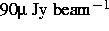 . The 18 cm map was made with a pixel size of 45
mas, giving a
. The 18 cm map was made with a pixel size of 45
mas, giving a  field. Again, the data were naturally
weighted to optimise noise, and the resultant beam was
field. Again, the data were naturally
weighted to optimise noise, and the resultant beam was 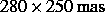 , at position angle
  (north through east). The rms noise of
the final map was
(north through east). The rms noise of
the final map was  .
.
At both observing wavelengths, we have resolved new structure. The 6 cm image is shown in Figure 1. The most important features in this image are the two ridges to the north and south of a central minimum (called N and S respectively hereafter). The ridges are clearly symmetric about the minimum, and are aligned approximately parallel. These features may be associated with those found in previous VLA images made at 1.3 cm (Kwok et al. (1984),Li (1993)), but the resolution of MERLIN has allowed us to discern two distinct ridges, separated by a central minimum. This is the first time these features have been resolved at 6 cm. Each ridge has a flux density indicating a brightness temperature of around 45,000 K, while in the central minimum the brightness temperature drops to 6,400 K.
The MERLIN observations did not detect the extended halo emission found by
Kenny et al. (1993) at 6 cm. This is to be expected, as the extended emission in the
VLA map drops to only a few  when observed with MERLIN
at the same wavelength, because of the much smaller beam. The MERLIN map
includes around 85% of the total flux of the source at 6 cm, as measured by
Kenny et al. (1993).
when observed with MERLIN
at the same wavelength, because of the much smaller beam. The MERLIN map
includes around 85% of the total flux of the source at 6 cm, as measured by
Kenny et al. (1993).
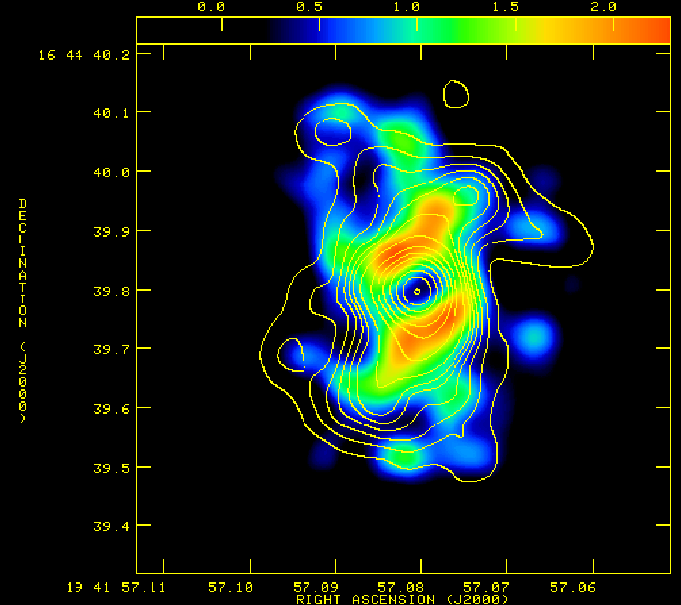
Figure 1: Radio map of HM Sagittae made using MERLIN at 6 cm. The rms noise is
 . The ridges called N and S in the text are
prominent in red. The contours overlaid are the HST UV image of
Hack & Paresce (1993). The UV contours are
. The ridges called N and S in the text are
prominent in red. The contours overlaid are the HST UV image of
Hack & Paresce (1993). The UV contours are  , 1, 2, 3, 4, 5, 6, 8, 12, 16,
20, 26, 32, 38, 44 times
, 1, 2, 3, 4, 5, 6, 8, 12, 16,
20, 26, 32, 38, 44 times  .
.
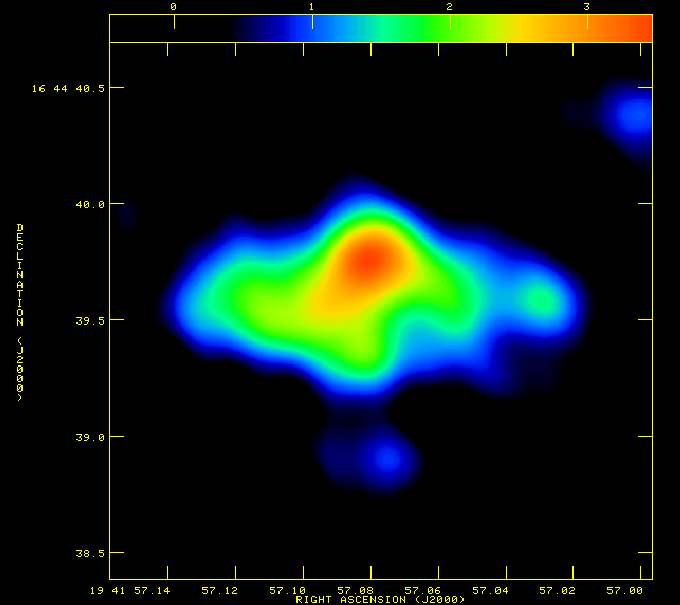
Figure 2: Radio map of HM Sagittae made using MERLIN at 18 cm. The rms noise is
 at 18 cm. The regions referred to as E and W in
the text are coloured green at the east and west extremes of the structure.
at 18 cm. The regions referred to as E and W in
the text are coloured green at the east and west extremes of the structure.
The 18 cm map is shown in Figure 2. This image is elongated in the
E-W direction, with two new components (called E and W respectively
hereafter). The direction and extent of this structure are similar to that of
the optical outflow discovered by Solf (1984) and Solf (1993) with high-resolution
long-slit spectroscopy of [N II] at  . The radio emission of E
and W is clearly non-thermal, as we discuss in more detail below. Prior to this
work, the radio emission from HM Sagittae had been thought to be entirely
thermal in character.
. The radio emission of E
and W is clearly non-thermal, as we discuss in more detail below. Prior to this
work, the radio emission from HM Sagittae had been thought to be entirely
thermal in character.
Spectral indices  (following the
  convention) were calculated using the 18 cm MERLIN map (Figure 2) and
a VLA image at 6 cm made on 1991 August 19 (Kenny et al. (1993)). The VLA map was used
to ensure all the flux at 6 cm was included. This required interpolation of
the MERLIN map to the VLA
convention) were calculated using the 18 cm MERLIN map (Figure 2) and
a VLA image at 6 cm made on 1991 August 19 (Kenny et al. (1993)). The VLA map was used
to ensure all the flux at 6 cm was included. This required interpolation of
the MERLIN map to the VLA  pixel grid, and then smoothing the
result to the resolution of the VLA map. Spectral indices were then calculated
on a pixel-by-pixel basis. Figure 3 shows the variation of mean
spectral index
pixel grid, and then smoothing the
result to the resolution of the VLA map. Spectral indices were then calculated
on a pixel-by-pixel basis. Figure 3 shows the variation of mean
spectral index  from east to west along the major axis of the
bipolar structure in Figure 2. Each point is a weighted mean of the
four pixels between Declination at each
from east to west along the major axis of the
bipolar structure in Figure 2. Each point is a weighted mean of the
four pixels between Declination at each  interval of Right
Ascension. The weight chosen was the inverse square of the error in the value
of
interval of Right
Ascension. The weight chosen was the inverse square of the error in the value
of  for each pixel.
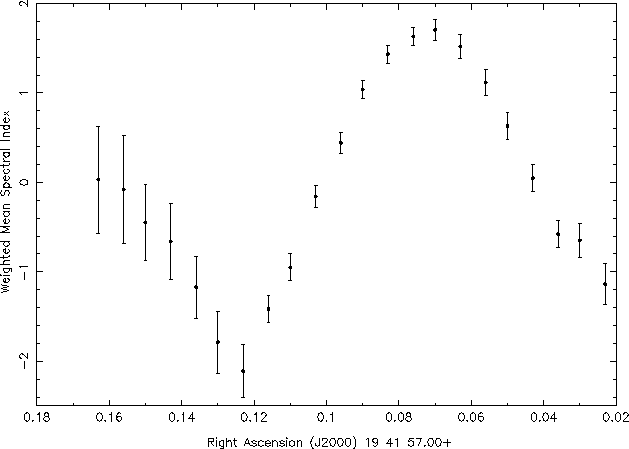
Figure 3: Variation of mean spectral index  with Right Ascension.
The error bars are determined in the usual manner for a weighted mean. See
text for explanation.
with Right Ascension.
The error bars are determined in the usual manner for a weighted mean. See
text for explanation.
The spectral indices vary systematically from east to west across the source.
Feature E was found to have a mean spectral index as low as  , while feature W has a minimum at
  . This is an unambiguous signature of non-thermal emission. The central
region reaches a maximum of
. This is an unambiguous signature of non-thermal emission. The central
region reaches a maximum of 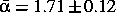 , while in the area
of the VLA peak (Kenny et al. (1993))
, while in the area
of the VLA peak (Kenny et al. (1993)) 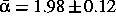 . This indicates
emission from optically thick thermal plasma. We believe this to be the radio
emission closest to the central stars. We also find that the spectral index
returns to near-zero values eastward of Right Ascension
. This indicates
emission from optically thick thermal plasma. We believe this to be the radio
emission closest to the central stars. We also find that the spectral index
returns to near-zero values eastward of Right Ascension  , at the extreme eastern edge of E, suggesting optically thin
thermal emission. Unfortunately, no reliable conclusions regarding
, at the extreme eastern edge of E, suggesting optically thin
thermal emission. Unfortunately, no reliable conclusions regarding  to
the extreme west of W can be obtained, as the emission there is too weak.
to
the extreme west of W can be obtained, as the emission there is too weak.
On 1992 December 1, only 25 days before our 6 cm observations, Hack & Paresce (1993)
observed HM Sagittae with the Hubble Space Telescope (HST). Using the Faint
Object Camera (FOC), they obtained an image with approximately 67 mas
resolution in the band 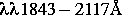 .
.
This HST image bears a remarkable similarity to our MERLIN 6 cm image. The
image is reproduced in contour form in Figure 1, The HST used the
position of 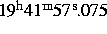 ,
, 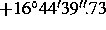 (J2000), with absolute pointing accuracies of only
  (Hack (1993)). Thus, the features have been aligned with those of the 6 cm
MERLIN map by eye. The correspondence between the two images (see
Figure 1) is striking.
(Hack (1993)). Thus, the features have been aligned with those of the 6 cm
MERLIN map by eye. The correspondence between the two images (see
Figure 1) is striking.
The major discrepancy between our MERLIN map and HST image of Hack & Paresce (1993) is
the presence of a UV peak at the location of our radio minimum. We suggest
that this is due primarily to the presence of the hot component, which emits
strongly in the UV, but has negligible emission at radio wavelengths. Modelling
the hot component as a blackbody, of temperature 200,000 K and angular diameter
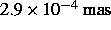 Mürset et al. (1991), we find the calculated approximate
UV emission to be commensurate with the observed peak UV emission.
Hack & Paresce (1993) suggest that the UV emission from the nebula is dominated by
emission lines, particularly the CIII]
Mürset et al. (1991), we find the calculated approximate
UV emission to be commensurate with the observed peak UV emission.
Hack & Paresce (1993) suggest that the UV emission from the nebula is dominated by
emission lines, particularly the CIII]  line and the SiIII]
 line. Conversely, the central UV peak is dominated by the hot
component continuum. As the hot component will not contribute significantly to
the radio emission, this results in the central minimum apparent in
Figure 1, as the surrounding nebula becomes dominant.
line. Conversely, the central UV peak is dominated by the hot
component continuum. As the hot component will not contribute significantly to
the radio emission, this results in the central minimum apparent in
Figure 1, as the surrounding nebula becomes dominant.
The observations of Solf (1984) and Solf (1993) show extended optical emission from HM
Sagittae in [N II] at  using long-slit spectroscopy. His
decomposition of the results gave information about the sub-arcsecond
structure. Figure 4 of Solf (1984) shows the locations of five separate
radial velocity features. The emission is dominated by a broad component,
centred on the systemic velocity, which has approximately the same angular
extent as the 6 cm radio emission shown in Figure 1. In addition to
this component, there are high velocity features to the east and west, at
using long-slit spectroscopy. His
decomposition of the results gave information about the sub-arcsecond
structure. Figure 4 of Solf (1984) shows the locations of five separate
radial velocity features. The emission is dominated by a broad component,
centred on the systemic velocity, which has approximately the same angular
extent as the 6 cm radio emission shown in Figure 1. In addition to
this component, there are high velocity features to the east and west, at  . These correspond spatially with the E-W extension seen
in Figure 2, suggesting that E and W are the result of bipolar
outflow from the central stars.
. These correspond spatially with the E-W extension seen
in Figure 2, suggesting that E and W are the result of bipolar
outflow from the central stars.
From Figure 2, we measure the maximum east-west extent of the radio
emission to be  . At a distance of
  (kpc), this corresponds
to
(kpc), this corresponds
to  . If we assume that this region expanded from a point
following the outburst in 1975, the components have separated at a mean
transverse velocity of
. If we assume that this region expanded from a point
following the outburst in 1975, the components have separated at a mean
transverse velocity of 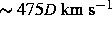 .
.
As indicated in Section 3, N and S may be associated with peaks
found with the VLA at 1.3 cm at several epochs between 1983 and 1988
(Li (1993)). These VLA images show the peaks to be separating at a rate of
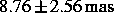 per year. This corresponds to a separation velocity
of
per year. This corresponds to a separation velocity
of  . Fitting gaussian components to N
and S, we find the angular separation of N and S to be
. Fitting gaussian components to N
and S, we find the angular separation of N and S to be 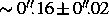 , which corresponds to a transverse velocity of
  , assuming uniform expansion following the outburst
in 1975. This is in close agreement with the result from the VLA maps.
, assuming uniform expansion following the outburst
in 1975. This is in close agreement with the result from the VLA maps.
Solf also found two radial velocity features A1 and A2, at  and
and  respectively. His analysis suggested an angular separation
of
respectively. His analysis suggested an angular separation
of  in the north-south direction for A1 and A2.
It seems sensible to associate A1 and A2 directly with N and S respectively.
However, the radial velocities of these features need to be reconciled with the
separation velocity we have determined above.
in the north-south direction for A1 and A2.
It seems sensible to associate A1 and A2 directly with N and S respectively.
However, the radial velocities of these features need to be reconciled with the
separation velocity we have determined above.
We have used MERLIN to map the circumstellar gas associated with HM Sagittae at 6 cm and 18 cm, and found a number of new aspects to both the structure and the emission. Spatial correlations between the 18 cm elongated structure and optical features found by Solf (1984) and Solf (1993) have led us to conclude that we have directly observed bipolar outflow from the central stars. Spectral indices for components E and W unequivocally point to a non-thermal emission mechanism. This is the first time this has been found in HM Sagittae.
At 6 cm we have resolved two distinct, parallel ridges to the north and south of a central minimum. An ultra-violet HST image (Hack (1993)) shows a similar structure in the inner nebula. Observing at radio wavelengths has allowed us to avoid contamination by the hot component, which is dominant in the ultra-violet. The north and south radio components have brightness temperatures of 45,000 K, which suggests a non-radiative heating mechanism. For further interpretation see Eyres et al. (1994).
 ajewska J., Friedjung M.J.K.S. & Viotti R., p.129, (Kluwer,
Dordrecht).
ajewska J., Friedjung M.J.K.S. & Viotti R., p.129, (Kluwer,
Dordrecht).