 ,
Alan Pedlar
,
Alan Pedlar ,
Stefi Baum
,
Stefi Baum ,
Chris O'Dea
,
Chris O'Dea ,
Jack
Gallimore
,
Jack
Gallimore ,
and
Elias Brinks
,
and
Elias Brinks
e-mail: cgm@jb.man.ac.uk
Please Note: the e-mail address(es) and any external links in this paper were correct when it was written in 1995, but may no longer be valid.
Carole G.
Mundell,
Alan Pedlar,
Stefi Baum,
Chris O'Dea,
Jack
Gallimore,
and
Elias Brinks
e-mail: cgm@jb.man.ac.uk
 NRAL, Jodrell Bank, Macclesfield, Cheshire, SK11 9DL,
UNITED KINGDOM
NRAL, Jodrell Bank, Macclesfield, Cheshire, SK11 9DL,
UNITED KINGDOM
 STScI, 3700 San Martin Dr., Baltimore, MD21218, USA
 NRAO, P.O.Box 0, Socorro, NM 87801, USA
 arcsec achieved by MERLIN, is ideal for
investigation of neutral gas in the nuclei of nearby Seyferts on scales of
arcsec achieved by MERLIN, is ideal for
investigation of neutral gas in the nuclei of nearby Seyferts on scales of  . We present, here, such observations of the radio source
associated with the nucleus of NGC 4151. We find that only the component
containing the nucleus shows significant absorption, whereas no measurable
absorption is seen against other components within the 4 arcsec radio jet.
There is structure in the absorption on scales as small as 0.1 arcsec, with
column densities in excess of 6
. We present, here, such observations of the radio source
associated with the nucleus of NGC 4151. We find that only the component
containing the nucleus shows significant absorption, whereas no measurable
absorption is seen against other components within the 4 arcsec radio jet.
There is structure in the absorption on scales as small as 0.1 arcsec, with
column densities in excess of 6 
 over
parts of the radio nucleus. The neutral hydrogen column densities are much
higher than UV absorption measurements which implies that the optical/UV
continuum nucleus is not coincident with the strongest radio component. We
suggest that the radio nucleus is associated with a weak VLBI component which
is
over
parts of the radio nucleus. The neutral hydrogen column densities are much
higher than UV absorption measurements which implies that the optical/UV
continuum nucleus is not coincident with the strongest radio component. We
suggest that the radio nucleus is associated with a weak VLBI component which
is  arcsec (
 ) to the west of the deepest
absorption. We deduce that any neutral hydrogen torus, in which the nucleus is
embedded, can be no thicker than 50pc and may have a linear (E-W) extent
of
) to the west of the deepest
absorption. We deduce that any neutral hydrogen torus, in which the nucleus is
embedded, can be no thicker than 50pc and may have a linear (E-W) extent
of  .
.
Seyfert galaxies, discovered optically by Carl Seyfert in 1943 (Seyfert (1943))
in spiral galaxies exhibiting bright nuclei with broad emission lines in their
spectra, are not as powerful as radio galaxies or quasars (in fact they are
radio quiet - but not radio silent) but can be found in  % of field
galaxies, making them the most common class of AGN. They are also the closest,
so we can study each object in considerable detail, giving us clues about the
physics involved in other types of AGN.
% of field
galaxies, making them the most common class of AGN. They are also the closest,
so we can study each object in considerable detail, giving us clues about the
physics involved in other types of AGN.
Khachikian & Weedman (1971) separated Seyferts into two types, Seyfert 1's and Seyfert 2's,
according to the width of their emission lines. Seyfert type 1's are
characterised by broad permitted lines (e.g. HI, HEI, HEII),
with widths of up to  , and narrow forbidden lines.
Seyfert type 2's have narrow forbidden and permitted lines with widths between
300 and
, and narrow forbidden lines.
Seyfert type 2's have narrow forbidden and permitted lines with widths between
300 and  .
.
There is also a strong non-thermal (i.e. non-stellar) continuum present in Seyfert 1 spectra that is weak or absent in Seyfert 2's (Giuricin et al. (1990)). It was thought that these broad and narrow lines were emitted from different regions of gas in the nucleus - the Broad Line region (BLR) and Narrow line region (NLR). The BLR consists of high velocity, high density gas, close to the nucleus. The absence of broad forbidden lines in Seyfert 1's imply gas densities so high that the lines are collisionally de-excited before they can radiate. The NLR extends from 100 to 1000 pc, and has lower velocities and densities. The fact that Seyfert 2's did not have a non-thermal continuum or broad permitted lines suggested that they did not have a BLR or a continuum source.
However Antonucci & Miller (1985) discovered a hidden BLR and non-stellar continuum in the polarised flux spectrum of Seyfert 2 galaxy NGC 1068 that closely resembled that of a Seyfert type 1. They suggested that the BLR and continuum source were located inside an optically and geometrically thick disk or torus, so that they couldn't be seen directly, but that continuum and broad line photons were scattered into the line of sight by free electrons above and below the disk. This leads to the idea that Seyfert 1's and 2's are not distinctly different objects but can be explained by one model viewed from different angles with the true nucleus obscured by a thick disk or torus. The torus is also thought to collimate the nuclear UV radiation that ionizes the neutral gas in the galaxy and produces the ENLR (Unger et al. (1987)). Figure 1 shows a schematic representation of the standard model of a Seyfert nucleus.
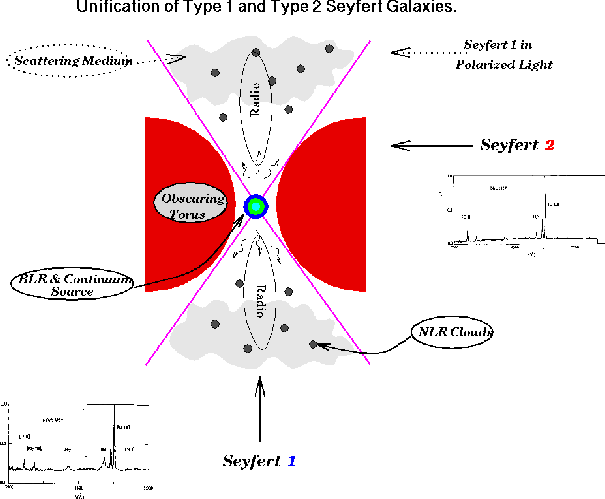
Figure 1: Schematic representation of the Standard model (Unified Scheme) of a
Seyfert nucleus.
There are several ways in which to look for and study the dusty, molecular torus that is invoked in unified schemes:
We have chosen to use the third method.
The properties of ionized and relativistic plasmas associated with Seyfert
nuclei have been studied extensively in the optical (e.g. Ulrich (1973)) and
radio continuum (e.g. Wilson & Ulvestad (1982),Pedlar et al. (1993)) on arcsecond and sub-arcsecond
scales. There is often evidence for significant quantities of neutral hydrogen
in the vicinity of the active nucleus. 21-cm neutral hydrogen (HI)
emission studies are limited to angular resolutions of order 10 arcsec
( kpc). The reason for this is that the spin temperature of the hydrogen
is typically a few hundred kelvin, and hence, even when optically thick, its
arcsecond structure falls below the sensitivity of present day instruments.
However, neutral hydrogen absorption studies are eminently suited for
detailed investigations of the nuclear environment and its dynamics on scales
of a few parsecs.
kpc). The reason for this is that the spin temperature of the hydrogen
is typically a few hundred kelvin, and hence, even when optically thick, its
arcsecond structure falls below the sensitivity of present day instruments.
However, neutral hydrogen absorption studies are eminently suited for
detailed investigations of the nuclear environment and its dynamics on scales
of a few parsecs.
We have therefore embarked on a study of several radio bright Seyfert nuclei using the VLA (Gallimore et al. (1994)) and MERLIN. We report on some of the first HI absorption measurements using MERLIN.
NGC 4151 is one of the brightest and best studied of all Seyferts. The radio
continuum structure has been investigated using MERLIN (Booler et al. (1982)), the VLA
(Wilson & Ulvestad (1982),Pedlar et al. (1993)) and the European VLBI Network (Harrison et al. (1986)). The radio
emission shows elongated structure extending over  arcseconds
consisting of several knots and is consistent with collimated ejection at PA
arcseconds
consisting of several knots and is consistent with collimated ejection at PA
 . The brightest radio component (C4 - using the naming scheme of
Carral et al. (1990); see Figure 2 below) shows a relatively flat spectral
index (Carral et al. (1990),Pedlar et al. (1993)) and compact VLBI structure (Harrison et al. (1986)). The
position of this component agrees closely with the position of the optical
continuum nucleus (Clements (1981)), and hence it seems likely that this radio
component contains the active nucleus.
. The brightest radio component (C4 - using the naming scheme of
Carral et al. (1990); see Figure 2 below) shows a relatively flat spectral
index (Carral et al. (1990),Pedlar et al. (1993)) and compact VLBI structure (Harrison et al. (1986)). The
position of this component agrees closely with the position of the optical
continuum nucleus (Clements (1981)), and hence it seems likely that this radio
component contains the active nucleus.
Neutral hydrogen studies with angular resolutions of 12 arcmin (Davies (1973)),
 arcmin (Bosma et al. (1977)) and
  arcsec (Pedlar et al. (1992)) have
established the atomic hydrogen distribution and dynamics over the galaxy.
Dickey (1986) made a preliminary study of the neutral hydrogen absorption
against the radio continuum nucleus and deduced a column density of
arcsec (Pedlar et al. (1992)) have
established the atomic hydrogen distribution and dynamics over the galaxy.
Dickey (1986) made a preliminary study of the neutral hydrogen absorption
against the radio continuum nucleus and deduced a column density of 
 assuming
  , however
his observations did not resolve the nuclear radio source. We assume NGC 4151
to be at a distance of 13.3 Mpc, so 1 arcsec corresponds to 65 pc in the
galaxy.
, however
his observations did not resolve the nuclear radio source. We assume NGC 4151
to be at a distance of 13.3 Mpc, so 1 arcsec corresponds to 65 pc in the
galaxy.
Figure 2 shows a selection of spectra obtained by integrating over the peak of the radio components seen in the source. The knots in the jets show no evidence for absorption, in strong contrast to the deep absorption seen against the component (C4) containing the nucleus (Mundell et al. (1994)).
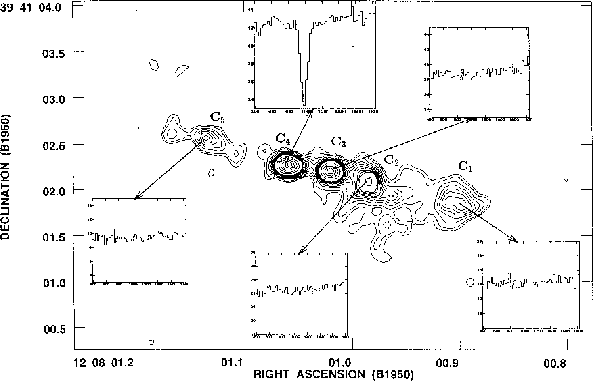
Figure 2: The radio continuum image (resolution  ). Spectra are the average over the central brightest pixels on each
component.
). Spectra are the average over the central brightest pixels on each
component.
C1, C2 and C3 do not show significant absorption, but this is not due to
sensitivity limitations; any absorption comparable to that seen in C4 would be
visible if present in the other components. The lack of absorption in these
components is not too surprising as they are part of a jet which previous
studies (e.g. Pedlar et al. (1993)) have suggested points towards us at  to
the line of sight. Hence the jet might be expected to be in front of any
neutral hydrogen disk which contained the nuclear component.
to
the line of sight. Hence the jet might be expected to be in front of any
neutral hydrogen disk which contained the nuclear component.
The eastern component of the jet (component C5) might be expected to be on the
far side of the nucleus, and hence could be behind a disk of neutral gas
containing the nucleus. Unfortunately this component is the weakest with a peak
brightness of only 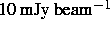 . Hence absorption comparable to
that in the nucleus would be close to our detection limit.
. Hence absorption comparable to
that in the nucleus would be close to our detection limit.
The neutral hydrogen column density across C4 increases from 
 on the western side to
 on the eastern side. There is also weak evidence for a
decrease in velocity, across the source, of
on the eastern side. There is also weak evidence for a
decrease in velocity, across the source, of  in an
approximately north-south direction.
in an
approximately north-south direction.
Harrison et al. (1986) have in fact shown that most of the 18 cm flux density of
component C4 is from a region only  mas in extent. Hence a
column density of
mas in extent. Hence a
column density of 
 over this small
area could be provided by a cloud of neutral hydrogen, with mass
over this small
area could be provided by a cloud of neutral hydrogen, with mass  , 1.5 pc in extent.
Lyman absorption measurements (Kriss et al. (1992)) give column densities ranging from
 to
to 
 -
significantly lower than our measurements. Our column density estimates could
be made consistent with the high end of the UV measurements if the excitation
temperature were
-
significantly lower than our measurements. Our column density estimates could
be made consistent with the high end of the UV measurements if the excitation
temperature were  K rather than the 100 K assumed above. However, it
is clear from the high blue shifted velocities and large intrinsic widths
(
K rather than the 100 K assumed above. However, it
is clear from the high blue shifted velocities and large intrinsic widths
(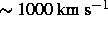 ) of the UV lines that the 21-cm absorption,
which has a velocity close to systemic and width of
) of the UV lines that the 21-cm absorption,
which has a velocity close to systemic and width of  , is not from the same cloud as the UV absorption.
Our column densities would result in an extinction of  magnitudes
in front of C4 (Staveley-Smith & Davies (1987)) and if we extrapolate the value of this blue
extinction, then
magnitudes
in front of C4 (Staveley-Smith & Davies (1987)) and if we extrapolate the value of this blue
extinction, then  magnitudes of absorption would be expected in the
vicinity of the Lyman continuum. This must mean that the UV continuum is not
intercepted by the neutral hydrogen cloud responsible for the absorption of the
radio continuum.
magnitudes of absorption would be expected in the
vicinity of the Lyman continuum. This must mean that the UV continuum is not
intercepted by the neutral hydrogen cloud responsible for the absorption of the
radio continuum.
So, how can we explain the fact that 
 do not
intercept the UV continuum? Unfortunately, given the inaccuracy of the UV
positions, it is unclear where the UV continuum is located relative to the
radio structure. However, VLBI observations (Harrison et al. (1986)) have shown that C4
consists of two components separated by
do not
intercept the UV continuum? Unfortunately, given the inaccuracy of the UV
positions, it is unclear where the UV continuum is located relative to the
radio structure. However, VLBI observations (Harrison et al. (1986)) have shown that C4
consists of two components separated by  arcsecs (
 pc). Which
of these components contains the radio nucleus is a crucial issue. Pedlar et al. (1993)
assumed that the eastern component in the VLBI image was the radio nucleus and
the western component was part of a jet. However, our observations strongly
suggest that the stronger, eastern component of C4 is not the nucleus.
Most of the HI absorption clearly must be against this stronger, eastern
component and this is consistent with the gradient in optical depth.
pc). Which
of these components contains the radio nucleus is a crucial issue. Pedlar et al. (1993)
assumed that the eastern component in the VLBI image was the radio nucleus and
the western component was part of a jet. However, our observations strongly
suggest that the stronger, eastern component of C4 is not the nucleus.
Most of the HI absorption clearly must be against this stronger, eastern
component and this is consistent with the gradient in optical depth.
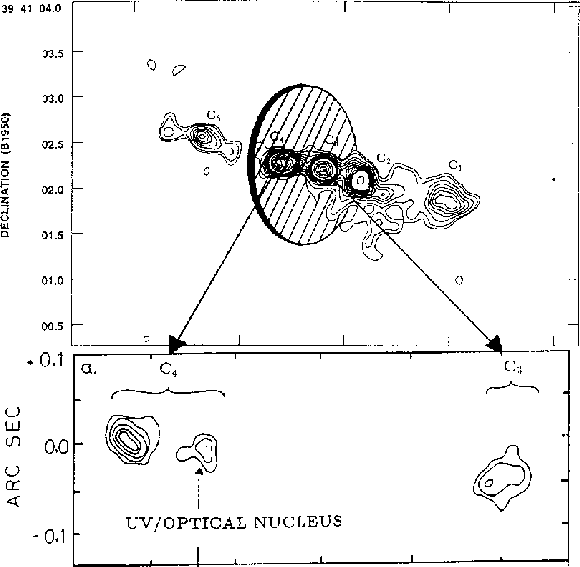
Figure 3: MERLIN 20-cm continuum map with sketch of neutral disk:
VLBI structure from Harrison et al. (1986)
We are drawn to the conclusion that the western, weaker (9 mJy) component is the radio nucleus and the eastern component is the first knot in the eastern jet. So, if the western radio component and the optical/UV continuum nucleus were coincident (Figure 3), the differences between UV and HI column densities would be reconciled; this would be consistent with neutral hydrogen absorption against the eastern component of C4, which can be now be considered as part of the eastern jet.
Further tests of this model require 21-cm VLBI observations to study the subparsec structure of the absorption. In addition further high-resolution, multi-frequency studies of the western component of C4 are required to establish its identification as the radio nucleus. Evidence of a flat spectral index or significant time variations in its flux density (particularly if correlated with variability at other wavebands) would be strong evidence in favour of our hypothesis.
 of neutral hydrogen required to
produce the absorption against the nucleus.
of neutral hydrogen required to
produce the absorption against the nucleus.
 pc in E-W extent and
  pc thick. The weak
north-south velocity gradient (
pc thick. The weak
north-south velocity gradient ( in
in  ) may be
evidence for rotation of the torus.
) may be
evidence for rotation of the torus.