
 postscript
1 Introduction...
postscript
1 Introduction...
 Abstract...
 3 Application to simulated ...
In order to create simulated Planck Surveyor observations, we must first build a realistic model of the sky at each of the proposed observing frequencies. As mentioned above, dust, free--free and synchrotron emission from our own Galaxy, extragalactic radiosources and infrared galaxies, and the kinetic and thermal SZ effect from clusters of galaxies all contribute to sky emission at least at some frequencies and angular resolutions of interest. We assume that point sources may be removed as described above, and that the residual background of unsubtracted sources is negligible. Thus the simulations presented here include emission from the three Galactic components, the two SZ effects and the primordial CMBR fluctuations.
Simulated maps of these six components are constructed on  -degree
fields with 1.5 arcmin pixels; thus each map consists of
-degree
fields with 1.5 arcmin pixels; thus each map consists of  pixels. A detailed discussion of these simulations is given by Bouchet et al. (1997)
and Gispert & Bouchet (1997). The primary CMBR fluctuations are a realisation of
strings produced by Francois Bouchet (Hobson et al. (1998) present the results for a
COBE normalised CDM realisation of the CMB). Realisations of the kinetic and
thermal SZ effects are generated using the Press-Schechter formalism, as
discussed in Bouchet et al. (1997), which yields the number density of clusters per
unit redshift, solid angle and flux density interval. The gas profiles of
individual clusters are taken as King models, and their peculiar radial
velocities are drawn at random from an assumed Gaussian velocity distribution
with a standard deviation at
pixels. A detailed discussion of these simulations is given by Bouchet et al. (1997)
and Gispert & Bouchet (1997). The primary CMBR fluctuations are a realisation of
strings produced by Francois Bouchet (Hobson et al. (1998) present the results for a
COBE normalised CDM realisation of the CMB). Realisations of the kinetic and
thermal SZ effects are generated using the Press-Schechter formalism, as
discussed in Bouchet et al. (1997), which yields the number density of clusters per
unit redshift, solid angle and flux density interval. The gas profiles of
individual clusters are taken as King models, and their peculiar radial
velocities are drawn at random from an assumed Gaussian velocity distribution
with a standard deviation at  of
of  .
.
For the Galactic dust and free--free emission,  IRAS maps are
used as spatial templates. Comparison of dust, free--free and 21cm HI
emission suggests the existence of a spatial correlation between these
components (Kogut et al. (1996); Boulanger et al. (1996). In order to take account of
these correlations, the simulations assume the existence of an HI-correlated component that accounts for 50 per cent of the free--free
emission and 95 per cent of the dust emission. The remaining free--free and
dust emission is assumed to come from a second, HI-uncorrelated
component. For any particular simulation, a given
IRAS maps are
used as spatial templates. Comparison of dust, free--free and 21cm HI
emission suggests the existence of a spatial correlation between these
components (Kogut et al. (1996); Boulanger et al. (1996). In order to take account of
these correlations, the simulations assume the existence of an HI-correlated component that accounts for 50 per cent of the free--free
emission and 95 per cent of the dust emission. The remaining free--free and
dust emission is assumed to come from a second, HI-uncorrelated
component. For any particular simulation, a given  IRAS map is
used as a spatial template for the HI-correlated component and a
contiguous map is used for the HI-uncorrelated component. The dust
spectral behaviour is modelled as a single temperature component at 18 K with
dust emissivity
IRAS map is
used as a spatial template for the HI-correlated component and a
contiguous map is used for the HI-uncorrelated component. The dust
spectral behaviour is modelled as a single temperature component at 18 K with
dust emissivity  ; the rms level of fluctuations at any given
frequency is scaled accordingly from the
; the rms level of fluctuations at any given
frequency is scaled accordingly from the  IRAS map. The IRAS map
used here has an rms level approximately equal to the median level for such
maps, i.e. about one-half of IRAS
IRAS map. The IRAS map
used here has an rms level approximately equal to the median level for such
maps, i.e. about one-half of IRAS  maps of this size have a
lower rms, and half have a higher rms. The free--free intensity is assumed to
vary as
maps of this size have a
lower rms, and half have a higher rms. The free--free intensity is assumed to
vary as  , and is normalised to give an rms temperature
fluctuation of
, and is normalised to give an rms temperature
fluctuation of  at 53 GHz.
No spatial template is available for the synchrotron emission at a sufficiently
high angular resolution, so the simulations of this component are performed
using the 408 MHz radio maps of Haslam et al. (1982), which have a resolution of 0.85
degrees, and adding to them small scale structure that follows a  power spectrum. The synchrotron intensity is assumed vary as
 and its normalisation taken directly from the 408 MHz
maps.
and its normalisation taken directly from the 408 MHz
maps.
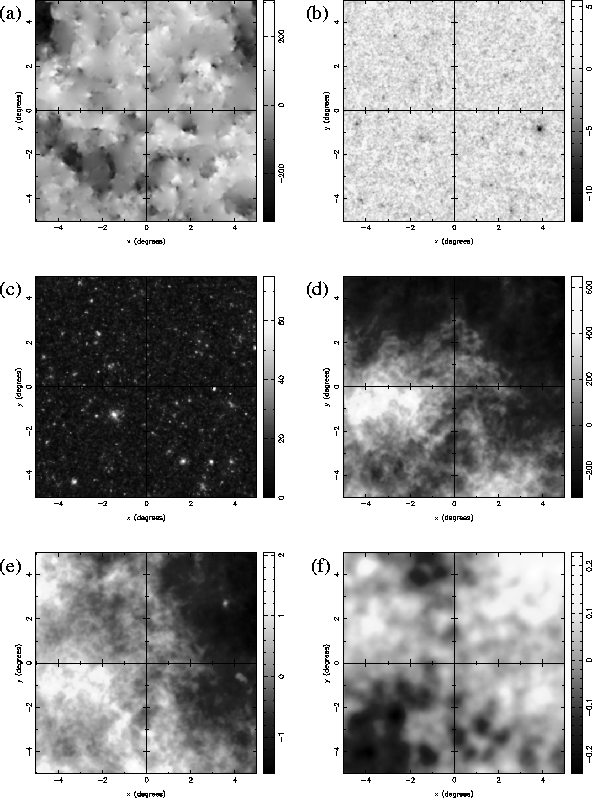
Figure 1: The  -degree
realisations of the six input components used to make simulated Planck Surveyor
observations: (a) primary CMBR fluctuations; (b) kinetic SZ effect; (c) thermal
SZ effect; (d) Galactic dust; (e) Galactic free--free; (d) Galactic synchrotron
emission. Each component is plotted at 300 GHz and has been convolved with a
Gaussian beam of FWHM equal to 4.5 arcmin, the maximum angular resolution
proposed for the Planck Surveyor. The map units are equivalent thermodynamic
temperature in
-degree
realisations of the six input components used to make simulated Planck Surveyor
observations: (a) primary CMBR fluctuations; (b) kinetic SZ effect; (c) thermal
SZ effect; (d) Galactic dust; (e) Galactic free--free; (d) Galactic synchrotron
emission. Each component is plotted at 300 GHz and has been convolved with a
Gaussian beam of FWHM equal to 4.5 arcmin, the maximum angular resolution
proposed for the Planck Surveyor. The map units are equivalent thermodynamic
temperature in  .
.
For primary CMBR fluctuations it is usual to work in terms of temperature
rather than intensity. A temperature difference on the sky  leads to a fluctuation in the intensity given by

where  is the Planck function and
  is the mean
temperature of the CMBR (Mather et al. (1994)). The conversion factor can be
approximated by
is the mean
temperature of the CMBR (Mather et al. (1994)). The conversion factor can be
approximated by

where 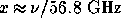 . In order to compare the relative
level of fluctuations in each physical component
we shall adopt the convention of Tegmark & Efstathiou (1996) and
also define the equivalent thermodynamic temperature fluctuation for
the other components by
. In order to compare the relative
level of fluctuations in each physical component
we shall adopt the convention of Tegmark & Efstathiou (1996) and
also define the equivalent thermodynamic temperature fluctuation for
the other components by

where  denotes the relevant physical foreground component. We note that,
in general, the `temperature' fluctuations of these other components
will be frequency dependent, unlike those of the CMBR. For the
remainder of this paper, fluctuations will be quoted in
temperature units measured in
denotes the relevant physical foreground component. We note that,
in general, the `temperature' fluctuations of these other components
will be frequency dependent, unlike those of the CMBR. For the
remainder of this paper, fluctuations will be quoted in
temperature units measured in  .
.
The realisations of the six input components used to make simulated observations are shown in Fig. 1. Each component is plotted at 300 GHz and, for illustration purposes, has been convolved with a Gaussian beam of FWHM equal to 4.5 arcmin, which is the highest angular resolution proposed for the Planck Surveyor. For convenience, we have also set the mean of each map to zero, in order to highlight the relative level of fluctuations due to each component.
From Fig. 1 we see that, as expected, the emission due to
primordial CMBR fluctuations appears non-Gaussian in nature. This is, of
course, a direct consequence of using a topological defect
model to create this realisation. If the CMBR realisation were instead
created assuming an alternative theory of structure formation such as
standard CDM, for example, then the CMBR fluctuations are
required to be Gaussian, and will not exhibit sharp edges.
The emission due to the kinetic and thermal SZ effects
is clearly highly non-Gaussian, being dominated by resolved and
unresolved clusters that appears as sharp peaks of emission. As we
would expect, although an obvious correlation exists between the
positions of the kinetic and thermal SZ effects, the signs and
magnitudes of the kinetic effect are not correlated with those of the
thermal effect. We also note that the IRAS  maps used as
templates for the Galactic dust and free--free emission also appear
quite non-Gaussian; the imposed correlation between the dust and
free--free emission is also clearly seen. Finally, the synchrotron
emission seems quite Gaussian, although this appearance is due mainly
to the addition to the Haslam 408 MHz map of Gaussian small scale
structure, following a
maps used as
templates for the Galactic dust and free--free emission also appear
quite non-Gaussian; the imposed correlation between the dust and
free--free emission is also clearly seen. Finally, the synchrotron
emission seems quite Gaussian, although this appearance is due mainly
to the addition to the Haslam 408 MHz map of Gaussian small scale
structure, following a  power law, on
angular scales below 0.85 degrees.
power law, on
angular scales below 0.85 degrees.
The azimuthally-averaged power spectra of the input maps are shown in
Fig. 2. At lower multipoles, all three Galactic components
have power spectra which vary roughly as  (for the synchrotron component small scale structure with this power
spectrum was added artificially for
(for the synchrotron component small scale structure with this power
spectrum was added artificially for  ).
For the
kinetic and thermal SZ effects, however, the power spectra are quite
different and are better approximated by a white-noise power spectrum
).
For the
kinetic and thermal SZ effects, however, the power spectra are quite
different and are better approximated by a white-noise power spectrum
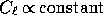 , as expected for Poisson-distributed
processes.
, as expected for Poisson-distributed
processes.
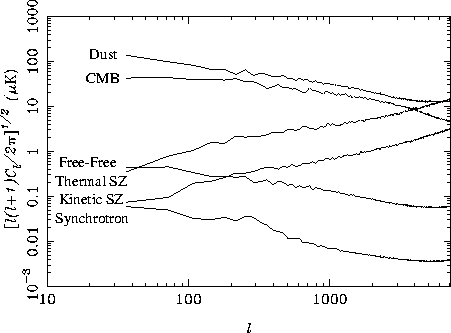
Figure 2: The azimuthally-averaged power spectra of
the input maps at 300 GHz.
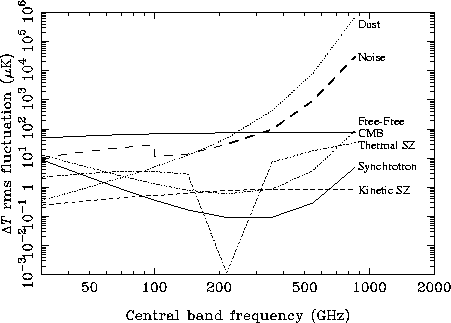
Figure 3: The rms thermodynamic
temperature fluctuations at the Planck Surveyor observing frequencies due to
each physical component, after convolution with the appropriate beam and using
a sampling rate of FWHM/2.4. The rms noise per pixel at each frequency channel
is also plotted.
Using the realisations for each physical component shown in Fig. 1, it is straightforward to simulate Planck Surveyor observations. The experiment consists of two mains parts: the Low Frequency Instrument (LFI), which uses HEMT radio receivers, and the High Frequency Instrument (HFI), which contains bolometer arrays. Since the final design of the satellite is still undecided, the precise values of observational parameters for the LFI and HFI are subject to revision. Nevertheless, recent proposed changes to both instruments may significantly improve the sensitivity of the satellite, as compared to the design outlined in the ESA phase A study (Bersanelli et al. (1996)). Therefore, although these modifications are not yet finalised, we have incorporated the latest design specifications into our simulations. The parameters used in making the simulated observations are given in Table 1 (Efstathiou, private communication).

Table 1: Proposed observational parameters
for the Planck Surveyor satellite (Efstathiou, private communication). Angular
resolution is quoted as FWHM for a Gaussian beam. Sensitivities are quoted per
FWHM for 12 months of observation.
The simulated observations are produced by integrating the emission
due to each physical component across each waveband, assuming the
transmission is uniform across the band. At each observing frequency,
the total sky emission is convolved with a Gaussian beam of the
appropriate FWHM. Finally, isotropic noise is added to the maps,
assuming a spatial sampling rate of FWHM/2.4 at each frequency. We
note, however, that the assumption of isotropic noise is not required by the
separation algorithms discussed in the companion paper. We have also
assumed that any striping due to the scanning strategy and  noise
has been removed to sufficient accuracy that any residuals are negligible.
noise
has been removed to sufficient accuracy that any residuals are negligible.
Fig. 3 shows the rms temperature fluctuations as a function of observing frequency due to each physical component, after convolution with the appropriate beam. The rms noise per pixel at each frequency channel is also plotted. We see from the figure that, as expected, the rms temperature fluctuation of the CMBR is almost constant across the frequency channels, the only variation being due to the convolution with beams of different sizes. Furthermore, for all channels up to 217 GHz, the CMBR signal is several times the level of the instrumental noise. At higher frequencies, the noise level exceeds the CMBR signal but is itself dominated by Galactic dust emission. We also see a sharp dip in the rms level of the thermal SZ effect at 217 GHz, since the emission from this component is close to zero at this frequency. At any given frequency, the rms level of the thermal SZ effect is at least an order of magnitude below that of the dominant component. The kinetic SZ effect has the same spectral characteristics as the CMBR, but the effect of convolution with beams of different sizes has a significant effect on the point-like emission and leads to a more pronounced variation in the observed rms level than for the CMBR. The observed rms level of the kinetic SZ is at least two orders of magnitude below the dominant component at any given frequency. In a similar manner, the Galactic free--free and synchrotron emission are also completely dominated by either CMBR or dust emission at all observing frequencies.
The observed maps at each of the ten Planck Surveyor
frequencies are shown in
Fig. 4 in units of equivalent thermodynamic temperature
measured in  K.
K.
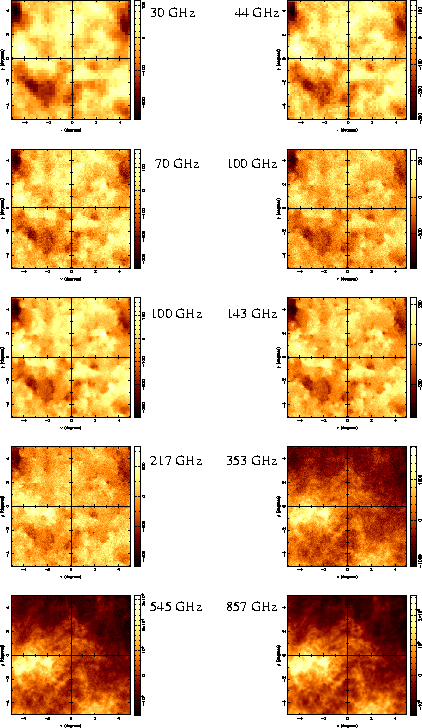
Figure 4: The  -degree maps
observed at each of the ten Planck Surveyor frequencies listed in
Table 1. At each frequency we assume a Gaussian beam with the
appropriate FWHM and a sampling rate of FWHM/2.4. Isotropic noise with the
relevant rms has been added to each map. The map units are equivalent
thermodynamic temperature in
-degree maps
observed at each of the ten Planck Surveyor frequencies listed in
Table 1. At each frequency we assume a Gaussian beam with the
appropriate FWHM and a sampling rate of FWHM/2.4. Isotropic noise with the
relevant rms has been added to each map. The map units are equivalent
thermodynamic temperature in  .
.
The coarse pixelisation at the lower observing frequencies is due to the FWHM/2.4 sampling rate. Moreover, at these lower frequencies, the effect of convolution with the relatively large beam is also easily seen. As the observing frequency increases, the beam size becomes smaller, leading to a corresponding increase in the sampling rate. Consequently, the observed maps more closely resemble the input map of the dominant physical component at each frequency. As may have been anticipated from Fig. 3, the emission in the lowest seven channels is dominated by the CMBR, whereas dust emission dominates in the highest three channels. Indeed, the main reason for the inclusion of the highest frequency channels is to obtain an accurate dust model, in order that it may be subtracted from lower frequency channels with some confidence. Perhaps the most notable feature of the ten channels maps is that, at least by eye, it is not possible to discern features due to physical components other than the CMBR or dust.