
 postscript
1 Introduction...
postscript
1 Introduction...
 Abstract...
 3 Vortices with Non-symmetric ...
We consider a model with a  symmetry explicitly broken to a
  . This
breaking can be realized by the Lagrangian density (Vilenkin & Shellard (1985), Axenides & Perivolaropoulos (1997))
. This
breaking can be realized by the Lagrangian density (Vilenkin & Shellard (1985), Axenides & Perivolaropoulos (1997))

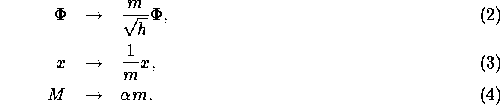
where  is a complex scalar field. After a rescaling
The corresponding equation of motion for the field  is
is

The potential takes the form

For  it has the shape of a ``saddle hat'' potential i.e. at
  there is a local minimum in the
  direction but a local maximum in
the
direction but a local maximum in
the  (Fig.1). For this range of values of
  the
equation of motion admits the well known static kink solution
the
equation of motion admits the well known static kink solution

It corresponds to a symmetric domain wall since in the core of the
soliton the full symmetry of the Lagrangian is manifest ( ) and the
topological charge arises as a consequence of the behaviour of the field at
infinity (
) and the
topological charge arises as a consequence of the behaviour of the field at
infinity ( ).
).
For  the local minimum in the
  direction becomes a local
maximum but the vacuum manifold remains disconnected, and the
direction becomes a local
maximum but the vacuum manifold remains disconnected, and the  symmetry
remains. This type of potential may be called a ``Napoleon hat'' potential in
analogy to the Mexican hat potential that is obtained in the limit
symmetry
remains. This type of potential may be called a ``Napoleon hat'' potential in
analogy to the Mexican hat potential that is obtained in the limit  and corresponds to the restoration of the
  vacuum
manifold.
vacuum
manifold.
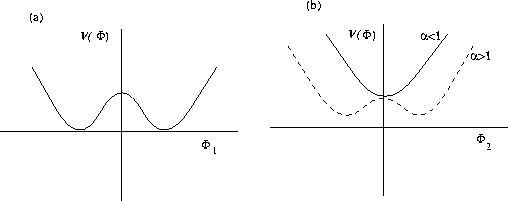
Figure 1: (a) The domain wall potential has a local maximum
at  in the
  direction. (b) For
  (
( )
this point is a local maximum (minimum) in the
)
this point is a local maximum (minimum) in the  direction.
The form of the potential however implies that the symmetric wall solution may
not be stable for  since in that case the potential energy favours a
solution with
since in that case the potential energy favours a
solution with  . However, the answer is not obvious because for
 ,
,  would save the wall some potential energy but
would cost additional gradient energy as
would save the wall some potential energy but
would cost additional gradient energy as  varies from a constant value
at
varies from a constant value
at  to 0 at infinity. Indeed a stability analysis was performed by
introducing a small perturbation about the kink solution reveals the presence
of negative modes for
to 0 at infinity. Indeed a stability analysis was performed by
introducing a small perturbation about the kink solution reveals the presence
of negative modes for  For the
range of values
For the
range of values  the potential takes the shape of a ``High
Napoleon hat''. We study the full non-linear static field equations obtained
from (6) for a typical value of
the potential takes the shape of a ``High
Napoleon hat''. We study the full non-linear static field equations obtained
from (6) for a typical value of  with boundary conditions

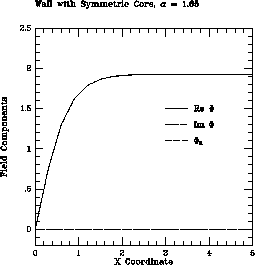
Figure 2: Field configuration for a symmetric wall with
 .
.
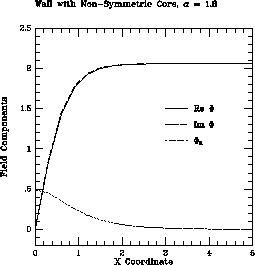
Figure 3: Field configuration for a non-symmetric wall with
 .
.
Using a relaxation method based on collocation at Gaussian points
(Press et al. (1993)) to solve the system (6) of second order non-linear equations we
find that for  the solution relaxes to the expected form
of (7) for
the solution relaxes to the expected form
of (7) for  while
while  (Fig.2). For
  we find
  and
and  (Fig.3) obeying
the boundary conditions (13), (14) and giving the explicit solution for the
non-symmetric domain wall. In both cases we also plot the analytic solution (7)
stable only for
(Fig.3) obeying
the boundary conditions (13), (14) and giving the explicit solution for the
non-symmetric domain wall. In both cases we also plot the analytic solution (7)
stable only for  for comparison (bold dashed line). As
expected the numerical and analytic solutions are identical for
for comparison (bold dashed line). As
expected the numerical and analytic solutions are identical for  (Fig.2).
We now proceed to present results of our study on the evolution of bubbles of a
domain wall. We constructed a two dimensional simulation of the field evolution
of domain wall bubbles with both symmetric and non-symmetric core. In
particular we solved the non-static field equation (6) using a leapfrog
algorithm (Press et al. (1993)) with reflective boundary conditions. We used an  lattice and in all runs we retained
  thus satisfying the Cauchy stability criterion for the timestep
 and the lattice spacing
  . The initial conditions were those
corresponding to a spherically symmetric bubble with initial field ansatz
. The initial conditions were those
corresponding to a spherically symmetric bubble with initial field ansatz

where  and
and  is the initial radius of the bubble.
Energy was conserved to within 2% in all runs. For
is the initial radius of the bubble.
Energy was conserved to within 2% in all runs. For  in the region of
symmetric core stability the imaginary initial fluctuation of the field
in the region of
symmetric core stability the imaginary initial fluctuation of the field  decreased and the bubble collapsed due to tension in a spherically
symmetric way as expected.
decreased and the bubble collapsed due to tension in a spherically
symmetric way as expected.
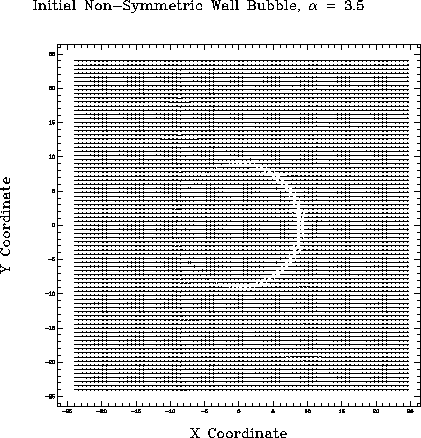
Figure 4: Initial field configuration for a non-symmetric
spherical bubble wall with  .
.
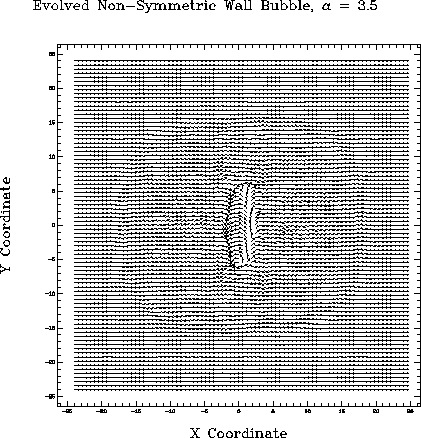
Figure 5: Evolved field configuration ( , 90
timesteps) for a non-symmetric initially spherical bubble wall with
, 90
timesteps) for a non-symmetric initially spherical bubble wall with  .
.
For  in the region of values corresponding to having a non-symmetric
stable core the evolution of the bubble was quite different. The initial
imaginary perturbation increased but even though dynamics favoured the increase
of the perturbation, topology forced the
in the region of values corresponding to having a non-symmetric
stable core the evolution of the bubble was quite different. The initial
imaginary perturbation increased but even though dynamics favoured the increase
of the perturbation, topology forced the  to stay at zero along a
line on the bubble: the intersections of the bubble wall with the
to stay at zero along a
line on the bubble: the intersections of the bubble wall with the  -axis
(Figs 4 and 5). Thus in the region of these points, surface
energy (tension) of the bubble wall remained larger than the energy on other
points of the bubble. The result was a non-spherical collapse with the
-axis
(Figs 4 and 5). Thus in the region of these points, surface
energy (tension) of the bubble wall remained larger than the energy on other
points of the bubble. The result was a non-spherical collapse with the
 -direction of the bubble collapsing first (Fig.5).