
 postscript
2 The Mass Function ...
postscript
2 The Mass Function ...
 Abstract...
 4 Conclusions...
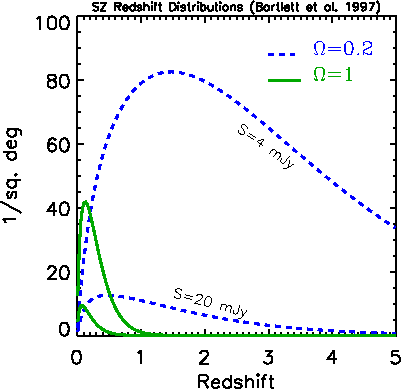
Figure 1: Redshift distribution for clusters of given SZ
flux density in the two cosmological models -- critical (solid lines) and open
with  (dashed lines); see Table 1 for the model
parameters. The curves are drawn for
(dashed lines); see Table 1 for the model
parameters. The curves are drawn for  and
and 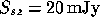 , corresponding to the VLA and RT objects, respectively, when
translated to
, corresponding to the VLA and RT objects, respectively, when
translated to  . For clarity, the two curves for the
critical model are not labelled explicitly. We adopt
. For clarity, the two curves for the
critical model are not labelled explicitly. We adopt  .
.
The Sunyaev--Zel'dovich effect offers unique advantages for finding high
redshift clusters and quantifying their abundance. The surface brightness of a
cluster relative to the unperturbed CMB is expressed as a product of a spectral
function,  , and the Compton
  -parameter, which is an integral of
the electron pressure along the line-of-sight:
-parameter, which is an integral of
the electron pressure along the line-of-sight:  .
Integrating the surface brightness over solid angle yields the following
functional form for the total flux density of a cluster with angular size
.
Integrating the surface brightness over solid angle yields the following
functional form for the total flux density of a cluster with angular size
 :
:
where  is the total, virial mass of the cluster,
  is the hot
gas mass fraction of clusters and
is the hot
gas mass fraction of clusters and  is the angular-size distance. In
the last line, we have used the fact that there exists a tight relation between
X-ray temperature and virial mass:
is the angular-size distance. In
the last line, we have used the fact that there exists a tight relation between
X-ray temperature and virial mass: 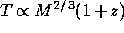 (Evrard et al. (1996)).
Let's compare this with the corresponding expression for the X-ray flux of a
cluster:
(Evrard et al. (1996)).
Let's compare this with the corresponding expression for the X-ray flux of a
cluster:
with  denoting the luminosity distance. By comparing these two
expressions we see that, in contrast to the SZ flux density, the X-ray flux
suffers cosmological surface brightness dimming, represented by the extra
factors of
denoting the luminosity distance. By comparing these two
expressions we see that, in contrast to the SZ flux density, the X-ray flux
suffers cosmological surface brightness dimming, represented by the extra
factors of  in the denominator of Eq. (4) which convert the
angular-size distance to the luminosity distance. Besides this well-known
difference, which tells us that the SZ effect is the more efficient way to find
high-redshift clusters, we note that the X-ray emission depends on the gas
density in addition to the hot gas mass fraction and temperature. This is
unfortunate, because it means that the X-ray flux from a cluster depends on the
core radius and profile of the intracluster medium (ICM) -- two quantities
which are poorly, if at all, understood from the theoretical point of view. The
SZ flux density presents the important advantage that it depends only on
the total gas mass and the temperature, and not on the ICM's distribution. It
is also true that the temperature which appears in the expression for the SZ
flux density is a simpler quantity than the X-ray measured temperature: it is
the mean, particle-weighted energy of the gas particles instead of, as in
the case of X-rays, the emission-weighted gas temperature. This SZ temperature
is a quantity which should be all the more closely related to the virial mass
of a cluster than even the X-ray temperature, and less affected by any
temperature structure in the cluster.
in the denominator of Eq. (4) which convert the
angular-size distance to the luminosity distance. Besides this well-known
difference, which tells us that the SZ effect is the more efficient way to find
high-redshift clusters, we note that the X-ray emission depends on the gas
density in addition to the hot gas mass fraction and temperature. This is
unfortunate, because it means that the X-ray flux from a cluster depends on the
core radius and profile of the intracluster medium (ICM) -- two quantities
which are poorly, if at all, understood from the theoretical point of view. The
SZ flux density presents the important advantage that it depends only on
the total gas mass and the temperature, and not on the ICM's distribution. It
is also true that the temperature which appears in the expression for the SZ
flux density is a simpler quantity than the X-ray measured temperature: it is
the mean, particle-weighted energy of the gas particles instead of, as in
the case of X-rays, the emission-weighted gas temperature. This SZ temperature
is a quantity which should be all the more closely related to the virial mass
of a cluster than even the X-ray temperature, and less affected by any
temperature structure in the cluster.
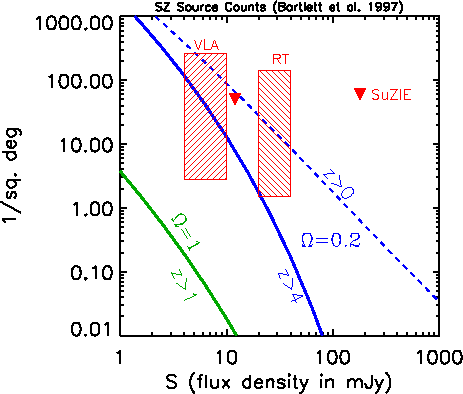
Figure 2: SZ source counts with observational
constraints, as a function of SZ flux density expressed at  . The two hatched boxes show the 95% one-sided confidence limits
from the VLA and the RT; due to the uncertain redshift of the clusters, there
is a range of possible total SZ flux density, which has for a minimum the
value observed in each beam and a maximum chosen here to correspond to
. The two hatched boxes show the 95% one-sided confidence limits
from the VLA and the RT; due to the uncertain redshift of the clusters, there
is a range of possible total SZ flux density, which has for a minimum the
value observed in each beam and a maximum chosen here to correspond to  .
From the SuZIE blank fields, one can deduce the 95% upper limit shown as the
triangle pointing downwards (Church et al. (1997)). We also plot the predictions of
our fiducial open model (
.
From the SuZIE blank fields, one can deduce the 95% upper limit shown as the
triangle pointing downwards (Church et al. (1997)). We also plot the predictions of
our fiducial open model ( ) for all clusters (dashed line) and for
those clusters with
) for all clusters (dashed line) and for
those clusters with  . The critical model has great difficulty explaining
the observed objects even with a lower redshift cutoff of only
. The critical model has great difficulty explaining
the observed objects even with a lower redshift cutoff of only  ; the
actual limit from the X-ray data is stronger, but this would fall well off to
the lower left of the plot. We assume
; the
actual limit from the X-ray data is stronger, but this would fall well off to
the lower left of the plot. We assume  .
.
Now the game is clear: with Eq. (3) we may convert the mass
function into a distribution of clusters in SZ flux density and redshift (the
quantitative relation for  can be found in Barbosa et al. (1996)). The
redshift distribution of clusters and the total source counts are then easily
calculable (Korolyov et al. (1986), Markevitch et al. (1994), Bartlett & Silk (1994), Barbosa et al. (1996), Eke et al. (1996), Colafrancesco et al. (1997)). In Fig.1, we
show the redshift distribution for clusters of two given SZ flux densities and
for two representative cosmologies -- a critical model and a model with
can be found in Barbosa et al. (1996)). The
redshift distribution of clusters and the total source counts are then easily
calculable (Korolyov et al. (1986), Markevitch et al. (1994), Bartlett & Silk (1994), Barbosa et al. (1996), Eke et al. (1996), Colafrancesco et al. (1997)). In Fig.1, we
show the redshift distribution for clusters of two given SZ flux densities and
for two representative cosmologies -- a critical model and a model with
 and
and  . For this calculation, we have used a constant gas
mass fraction
. For this calculation, we have used a constant gas
mass fraction 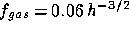 (Evrard (1997)). The two chosen
fluxes are our estimates of the flux density of the VLA and RT objects, when
translated to a wavelength of
(Evrard (1997)). The two chosen
fluxes are our estimates of the flux density of the VLA and RT objects, when
translated to a wavelength of  by using the SZ
spectral function,
by using the SZ
spectral function,  ; this is our fiducial working frequency and
corresponds to the peak of the SZ distortion.
; this is our fiducial working frequency and
corresponds to the peak of the SZ distortion.
The key aspect of this figure is that, at a given flux density, there is an
enormous difference between the number of high-redshift clusters in a critical
and open universe. It is for this reason that even the detection of only two SZ
decrements warrants the present discussion, because they appear to be at large
redshift. Let us now quantify this by comparing the predicted number counts of
clusters with redshifts greater than some minimum value with the counts implied
by the detection of these two objects. This is done in Fig.2. The
observed counts have been estimated using Poisson statistics and the amount of
sky coverage in each case --  for the VLA (two
fields) and
for the VLA (two
fields) and  for the RT (three fields). These
constraints are given as two boxes because there is actually a range of
possible total SZ flux density from each object, due to the unknown
redshifts: at low redshift, the objects would be resolved and their flux
density has to be corrected upwards. The minimum flux density is clearly the
value observed, while for the maximum, we give the values for
for the RT (three fields). These
constraints are given as two boxes because there is actually a range of
possible total SZ flux density from each object, due to the unknown
redshifts: at low redshift, the objects would be resolved and their flux
density has to be corrected upwards. The minimum flux density is clearly the
value observed, while for the maximum, we give the values for  assuming an isothermal
  . The limits on the counts (i.e., in
the vertical direction) are generous in that they represent the 95%
one-sided Poisson confidence limits. We also show an upper limit on the counts
obtained by the SuZIE instrument (Church et al. (1997)), which found no objects in a
survey area of
. The limits on the counts (i.e., in
the vertical direction) are generous in that they represent the 95%
one-sided Poisson confidence limits. We also show an upper limit on the counts
obtained by the SuZIE instrument (Church et al. (1997)), which found no objects in a
survey area of  down to the limiting flux shown; the
symbol represents the resulting 95% confidence upper limit. Predictions for
the number of clusters on the sky for the two cosmological models and with
varying minimum redshifts are shown by the labelled curves.
down to the limiting flux shown; the
symbol represents the resulting 95% confidence upper limit. Predictions for
the number of clusters on the sky for the two cosmological models and with
varying minimum redshifts are shown by the labelled curves.

