
 postscript
1 Introduction...
postscript
1 Introduction...
 Abstract...
 3 Calculation of ...
Although CL 0016+16 was first characterised based on its optical appearance (Koo (1981)), it was quickly shown to be a strong X-ray source (White et al. (1981)) and Sunyaev-Zel'dovich effect cluster (Birkinshaw et al. (1981)). It also appears as an X-ray selected object in the Einstein Medium Sensitivity Survey (Gioia et al. (1990)), and is a member of several X-ray selected distant cluster samples. A mass map of the cluster has recently been derived from the gravitational lensing shear field that it generates (Smail et al. (1996)).
Recent X-ray imaging by ROSAT, and X-ray spectroscopy by ASCA, allow a more
detailed examination of the cluster's gas content than the Einstein data. It is
found that the cluster is strongly elliptical in its X-ray isophotes
(Hughes & Birkinshaw (1997a)), with a centre at J2000 coordinates 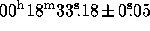 ,
, 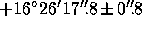 . A fit to an ellipsoidal version of the standard
isothermal beta model leads to structural parameter
. A fit to an ellipsoidal version of the standard
isothermal beta model leads to structural parameter 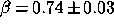 ,
core radius
,
core radius 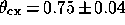 arcmin, and a major to minor axis
ratio of
arcmin, and a major to minor axis
ratio of  , with the major axis in position angle
  degrees. The central X-ray surface brightness of the cluster is
 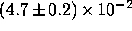 ROSAT PSPC
  .
.
The field of the cluster is also found to contain other clusters at similar
redshift. Two adjacent X-ray emitting clusters have been identified by
Hughes et al. (1995) and Hughes & Birkinshaw (1997b): these are likely to be bound to CL 0016+16 itself,
and may be part of a large-scale structure including also the QSO Q 0015+162
(Margon et al. (1983)) which appears as a bright X-ray source near CL 0016+16. The
redshifts of the three clusters have been measured to be 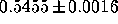 for CL 0016+16 itself,
 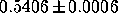 for RX J0018.8+1602, and
 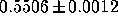 for RX J0018.3+1618. Q 0015+164 has redshift
  .
Connolly et al. (1997) provide evidence that the supercluster may extend a degree or more
on the sky.
.
Connolly et al. (1997) provide evidence that the supercluster may extend a degree or more
on the sky.
The ASCA spectrum of the cluster, first discussed by Yamashita (1994), has been
reanalysed by Hughes & Birkinshaw (1997a), who found consistent results -- the spectrum is that
of an isothermal gas at  , and a
metallicity about 0.1 solar.
, and a
metallicity about 0.1 solar.
Finally, a strong Sunyaev-Zel'dovich effect is associated with the cluster.
This has been detected by the single-dish telescopes (Uson (1986), Birkinshaw et al. (1997)) and
mapped using two interferometers (Carlstrom et al. (1996), Grainge (1996)). The OVRO 40-m telescope
data for the cluster are shown in Figure 1, and are a good match to a
model for the cluster gas based on the X-ray image. An intrinsic central SZ
effect of 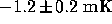 can be deduced for the cluster: less than
half this effect is detectable with the OVRO 40-m telescope because of
beamwidth and beam-switching effects.
can be deduced for the cluster: less than
half this effect is detectable with the OVRO 40-m telescope because of
beamwidth and beam-switching effects.
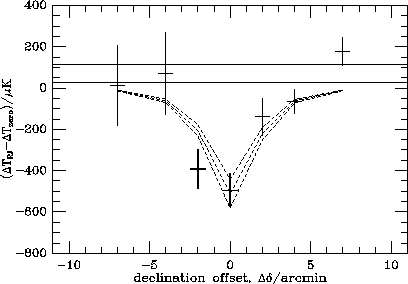
Figure 1: The Sunyaev-Zel'dovich
effect for
CL 0016+16 as seen by the OVRO 40-m
telescope. A model for the effect expected from a simple
isothermal atmosphere consistent with the X-ray image
is superimposed.