
 postscript
2 CL 0016+16...
postscript
2 CL 0016+16...
 Abstract...
 4 The Hubble diagram...

The estimation of the value of the Hubble constant from these data uses a
comparison of the X-ray central surface brightness (which is proportional to
the  ) and the central SZ effect (which is proportional to
 ) to eliminate the central electron concentration in the cluster
atmosphere,
) to eliminate the central electron concentration in the cluster
atmosphere,  , and derive an expression for the scale of the cluster
atmosphere along the line of sight,
, and derive an expression for the scale of the cluster
atmosphere along the line of sight,  . The constants of proportionality
depend on the model of the atmosphere, and on the temperature and metallicity
of the cluster gas. Both density and thermal structures in the atmosphere can
be modelled -- however the absence of direct evidence for thermal substructure
leads us to take the electron temperature
. The constants of proportionality
depend on the model of the atmosphere, and on the temperature and metallicity
of the cluster gas. Both density and thermal structures in the atmosphere can
be modelled -- however the absence of direct evidence for thermal substructure
leads us to take the electron temperature  to be a constant, and we
will assume that the cluster atmosphere is smoothly distributed according to
the isothermal beta model fitted earlier.
to be a constant, and we
will assume that the cluster atmosphere is smoothly distributed according to
the isothermal beta model fitted earlier.
A comparison of  with the angular scale of the cluster,
  ,
then determines the angular diameter distance of CL 0016+16, and hence the
value of the Hubble constant (with some slight dependence on the value of
,
then determines the angular diameter distance of CL 0016+16, and hence the
value of the Hubble constant (with some slight dependence on the value of
 ).
).
A key argument here is that the line-of-sight scale of the cluster can be
related to the cross-line-of-sight scale: this is trivial if the cluster is
spherical, but is clearly not the case for CL 0016+16. Furthermore, we cannot
use the existing data to deduce an unambiguous three-dimensional structure for
the cluster. Hence we can deduce the angular diameter distance only via an
assumption about the intrinsic shape of the cluster and its orientation
relative to the line of sight. For the most extreme oblate or prolate models,
the derived Hubble constant varies by about  per cent from the
``central'' value of
per cent from the
``central'' value of 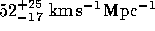 which we
derive from the data including both the random and systematic components of the
errors (but not the structural model-dependent error). Full details of the
derivation of the Hubble constant and its errors are discussed in Hughes & Birkinshaw (1997a).
which we
derive from the data including both the random and systematic components of the
errors (but not the structural model-dependent error). Full details of the
derivation of the Hubble constant and its errors are discussed in Hughes & Birkinshaw (1997a).