
 postscript
3 A lens survey ...
postscript
3 A lens survey ...
 Abstract...
 5 Summary...
Distant galaxies are also lensed by clusters, and their lensed images are
expected to be bright sources of submillimetre-wave radiation
(Blain (1997c)). An example of the effects of gravitational lensing by a
cluster on the appearance of background galaxies in the submillimetre waveband
as compared with the optical waveband is shown in Fig.5.
Individual images could not be detected at the 4-arcmin resolution of
Planck, however their presence in the observing beam is expected to increase
the level of source confusion noise by a factor of about 3 as compared with
observations in the field (Blain (1997b), Blain (1997d)). If a sufficiently large
sample of clusters were observed, then this increased confusion noise could be
measured, and so the form of evolution of star-forming galaxies with flux
densities fainter than the sensitivity of Planck could be investigated. A
large sample of about  distant clusters will be detected in a
Planck survey (Bersanelli et al. (1996)) due to the flux density of their
Sunyaev--Zel'dovich effects (Rephaeli (1995)), and so this type of investigation
will be practical using Planck.
distant clusters will be detected in a
Planck survey (Bersanelli et al. (1996)) due to the flux density of their
Sunyaev--Zel'dovich effects (Rephaeli (1995)), and so this type of investigation
will be practical using Planck.
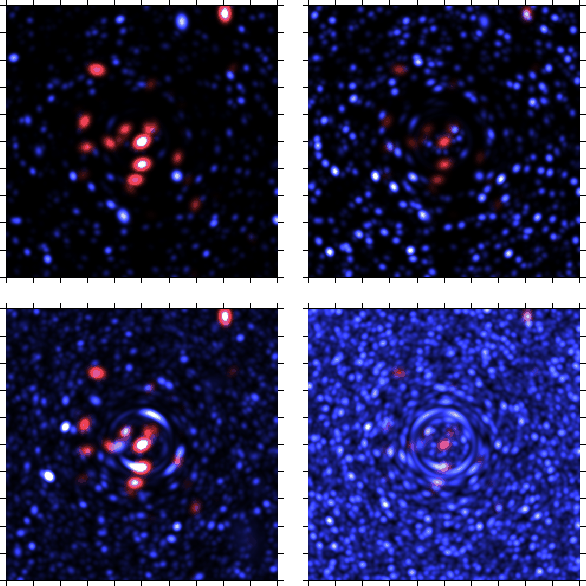
Figure 5: Simulated surface brightness distributions of a
rich cluster of galaxies, such as Abell 2218 at a redshift  , in the
optical R-band (left) and at
, in the
optical R-band (left) and at  in the sub-mm waveband
(right). Both the emission from galaxies within the cluster and from lensed
images is shown, coloured red and blue respectively. Two models of the
population of distant lensed galaxies are shown: one described by an evolving
IRAS luminosity function (top), and the other by a model in which
galaxies form by hierarchical clustering (bottom) (Blain & Longair (1996), Blain (1997c)). The
blue lensed images are relatively much brighter in the submillimetre waveband
as compared with the optical waveband. The flux densities of the brightest
submillimetre-wave sources in the right-hand fields are several mJy. The
angular resolution of all the frames is 1arcsec, and the axes are graduated
at 20arcsec intervals.
in the sub-mm waveband
(right). Both the emission from galaxies within the cluster and from lensed
images is shown, coloured red and blue respectively. Two models of the
population of distant lensed galaxies are shown: one described by an evolving
IRAS luminosity function (top), and the other by a model in which
galaxies form by hierarchical clustering (bottom) (Blain & Longair (1996), Blain (1997c)). The
blue lensed images are relatively much brighter in the submillimetre waveband
as compared with the optical waveband. The flux densities of the brightest
submillimetre-wave sources in the right-hand fields are several mJy. The
angular resolution of all the frames is 1arcsec, and the axes are graduated
at 20arcsec intervals.