
 postscript
2 The properties of ...
postscript
2 The properties of ...
 Abstract...
 4 Lensing by clusters...
Estimates of the numbers of detectable galaxies expected in a Planck survey are listed in Table1. These were calculated by combining the counts discussed above with the estimates of the sensitivity of Planck (Bersanelli et al. (1996)) quoted in Table2. In order to produce conservative estimates, an Einstein--de Sitter world model and an evolving population of lenses are assumed in the calculations. The results can be scaled to match other scenarios using the counts in Figs2(a)&(b). Note that the predicted number of lenses could be increased by a factor of about 5 if both a non-evolving model of lensing galaxies and a non-zero cosmological constant were assumed.
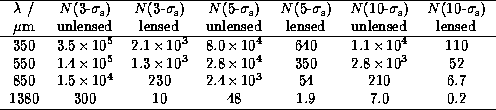
Table 1:
The surface densities of both lensed and unlensed sources expected in a
Planck survey  at different signal-to-noise ratios. The expected
sensitivities of a Planck survey
at different signal-to-noise ratios. The expected
sensitivities of a Planck survey  are listed in
Table2. The surface densities are calculated
assuming galaxy evolution model A, an Einstein--de Sitter world model and an
evolving population of lensing galaxies. The units of
are listed in
Table2. The surface densities are calculated
assuming galaxy evolution model A, an Einstein--de Sitter world model and an
evolving population of lensing galaxies. The units of  are
are
 .
.
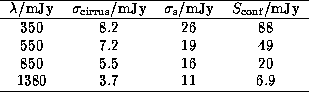
Table 2:
The sensitivities and confusion limits expected in a Planck
survey.  represents the expected galactic cirrus confusion
noise (Helou & Beichman (1990)), assuming that the mean galactic background intensity at a
wavelength of
represents the expected galactic cirrus confusion
noise (Helou & Beichman (1990)), assuming that the mean galactic background intensity at a
wavelength of  is
is  .
.  is
the expected sensitivity of a Planck all-sky survey (Bersanelli et al. (1996)).
is
the expected sensitivity of a Planck all-sky survey (Bersanelli et al. (1996)).
 represents the flux density at which the surface density of
galaxies is expected to exceed
represents the flux density at which the surface density of
galaxies is expected to exceed  ; the expected point
source confusion noise
; the expected point
source confusion noise  .
.
Between about 0.1 and 1% of the point sources detected in a Planck
survey are expected to be lensed by a foreground galaxy. Despite a relatively
large ratio of lensed to unlensed galaxies at wavelengths of  and
and  , the absolute surface density of detectable sources is expected
to be rather small, and so the most useful wavelengths for detecting lenses
will be
, the absolute surface density of detectable sources is expected
to be rather small, and so the most useful wavelengths for detecting lenses
will be  and
and  . Several tens of lenses could be detected
per unit solid angle in this systematic survey. Hence, despite the inevitable
exclusion of lenses that are hidden by galactic emission at galactic latitudes
less than about
. Several tens of lenses could be detected
per unit solid angle in this systematic survey. Hence, despite the inevitable
exclusion of lenses that are hidden by galactic emission at galactic latitudes
less than about  , several hundred lenses could still be
detected in an all-sky survey, increasing the number of known lenses by an
order of magnitude. The bright counts of unlensed galaxies in the
submillimetre/far-infrared waveband would also be determined accurately in such
a survey, and so tight limits could be imposed to the form of evolution of the
global star-formation rate at moderate redshifts.
, several hundred lenses could still be
detected in an all-sky survey, increasing the number of known lenses by an
order of magnitude. The bright counts of unlensed galaxies in the
submillimetre/far-infrared waveband would also be determined accurately in such
a survey, and so tight limits could be imposed to the form of evolution of the
global star-formation rate at moderate redshifts.
How efficiently could lensed sources be separated from the distant unlensed
galaxies that are detected in this survey? A careful analysis of the
submillimetre-wave colours of the point sources detected by Planck could
probably be used to reduce the size of the sample by a small factor.
Colour--colour and colour--magnitude diagrams that are derived from a simulated
 -
- sub-field of a Planck survey are presented in
Fig.3. The distribution of lensed and unlensed galaxies are clearly
different in each plot: lensed galaxies are found exclusively at large
redshifts; and if the dust temperature in star-forming galaxies is correlated
with their luminosity, then lenses would be expected to have redder colours as
compared with unlensed galaxies that emit the same flux densities. The field of
points in Fig.3(a) is bounded at small and large redshifts by lines
with a gradient of about 0.6. This slope reflects the relative wavelengths of
the three observing bands at
sub-field of a Planck survey are presented in
Fig.3. The distribution of lensed and unlensed galaxies are clearly
different in each plot: lensed galaxies are found exclusively at large
redshifts; and if the dust temperature in star-forming galaxies is correlated
with their luminosity, then lenses would be expected to have redder colours as
compared with unlensed galaxies that emit the same flux densities. The field of
points in Fig.3(a) is bounded at small and large redshifts by lines
with a gradient of about 0.6. This slope reflects the relative wavelengths of
the three observing bands at  ,
,  and
and  . If the
emissivity of dust grains was independent of wavelength, then both lensed and
unlensed galaxies would lie on a single line with this slope. The position of
each galaxy on this line would be determined by its redshift and dust
temperature. The points in Fig.3(a) are spread within a box-like
region because a wavelength-dependent emissivity is assumed.
. If the
emissivity of dust grains was independent of wavelength, then both lensed and
unlensed galaxies would lie on a single line with this slope. The position of
each galaxy on this line would be determined by its redshift and dust
temperature. The points in Fig.3(a) are spread within a box-like
region because a wavelength-dependent emissivity is assumed.
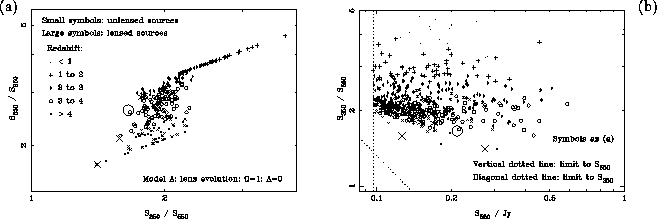
Figure 3: Colour--colour and colour--magnitude diagrams for
both lensed and unlensed galaxies in a  -
- sub-field of a
Planck all-sky survey. A sub-field is plotted in order to avoid saturating the
figure with a very large density of points. The galaxies are selected to exceed
the
sub-field of a
Planck all-sky survey. A sub-field is plotted in order to avoid saturating the
figure with a very large density of points. The galaxies are selected to exceed
the  -
- sensitivity of a Planck survey at a wavelength of
  . Lensed galaxies are always found at redshifts greater than
unity, and are typically redder as compared with unlensed galaxies.
. Lensed galaxies are always found at redshifts greater than
unity, and are typically redder as compared with unlensed galaxies.
A more vivid representation of the lensed and unlensed galaxies that would be
expected in a Planck survey is shown in Fig.4. The simulated
colours of the sources expected in a  -
- field are presented,
with the lensed galaxies highlighted by white cross-hairs. As shown more
quantitatively in Fig.3, the lensed galaxies tend to be rather red
as compared with unlensed galaxies that emit the same submillimetre-wave flux
density.
field are presented,
with the lensed galaxies highlighted by white cross-hairs. As shown more
quantitatively in Fig.3, the lensed galaxies tend to be rather red
as compared with unlensed galaxies that emit the same submillimetre-wave flux
density.
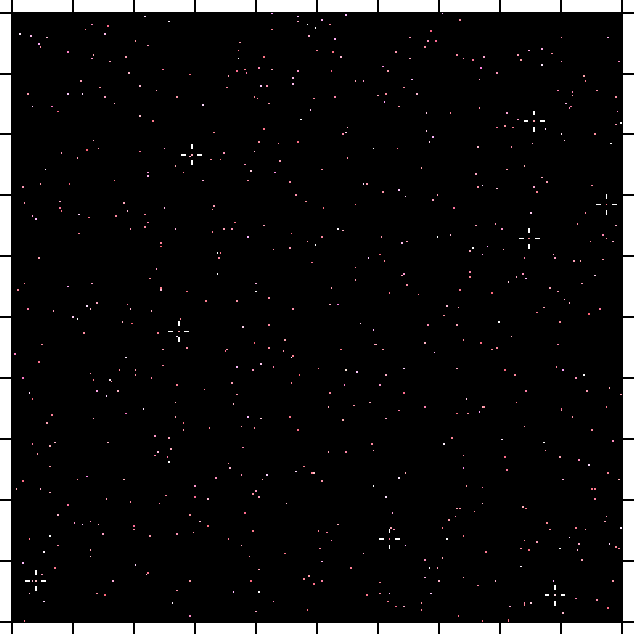
Figure 4: A simulated  -
- field of a
Planck all-sky survey with no galactic contamination or instrumental noise.
The primary survey wavelength is
field of a
Planck all-sky survey with no galactic contamination or instrumental noise.
The primary survey wavelength is  . The flux densities of the
lensed and unlensed galaxies at the three wavelengths surveyed by Planck
in the submillimetre waveband --
. The flux densities of the
lensed and unlensed galaxies at the three wavelengths surveyed by Planck
in the submillimetre waveband --  ,
,  and
and  -- are
represented by the intensity of the red, green and blue colours of the pixels
respectively. The lensed sources are highlighted by white cross-hairs. The
intensity scale at wavelengths of
-- are
represented by the intensity of the red, green and blue colours of the pixels
respectively. The lensed sources are highlighted by white cross-hairs. The
intensity scale at wavelengths of  ,
,  and
and  saturates at
  ,
,  and
and  respectively. The pixels are
square and are
respectively. The pixels are
square and are  in area. For acceptable reproduction of
this figure on paper a high-quality colour printer is required.
in area. For acceptable reproduction of
this figure on paper a high-quality colour printer is required.
In order to diagnose lensed sources unequivocally high-resolution imaging,
using either 8-m telescopes or large millimetre/submillimetre-wave
interferometer arrays (MIAs; Downes (1996)), would be required in order to
detect lensed arcs, rings or multiple images in the candidate sources. At a
wavelength of  a large MIA could detect a 10-mJy source at a
signal-to-noise ratio of about
a large MIA could detect a 10-mJy source at a
signal-to-noise ratio of about  at 0.1-arcsec
resolution in a 2-second integration (Brown (1996)). Hence, in a 1-minute
integration a large MIA could determine whether or not a detected source was
gravitationally lensed. However, the angular resolution of Planck is
about
at 0.1-arcsec
resolution in a 2-second integration (Brown (1996)). Hence, in a 1-minute
integration a large MIA could determine whether or not a detected source was
gravitationally lensed. However, the angular resolution of Planck is
about  and the width of the primary beam of an MIA is about
 , and so a more accurate position would be required for a
candidate lens unless about 100 different pointings of an MIA were used for
each follow-up observations. The FIRST space-borne observatory
(Beckwith et al. (1993)) will be equipped with a submillimetre-wave bolometer array
receiver with a 6-arcmin field of view and a resolution of about
, and so a more accurate position would be required for a
candidate lens unless about 100 different pointings of an MIA were used for
each follow-up observations. The FIRST space-borne observatory
(Beckwith et al. (1993)) will be equipped with a submillimetre-wave bolometer array
receiver with a 6-arcmin field of view and a resolution of about  . Hence, in a single pointed observation FIRST could locate a
candidate lens to within a single primary beam area of a large MIA for an
efficient follow-up observation. The submillimetre-wave flux densities of the
faintest sources in a Planck survey are expected to be about
. Hence, in a single pointed observation FIRST could locate a
candidate lens to within a single primary beam area of a large MIA for an
efficient follow-up observation. The submillimetre-wave flux densities of the
faintest sources in a Planck survey are expected to be about  . These sources could be detected by FIRST at a signal-to-noise
ratio of about 10 in a 1-minute integration. Hence,
. These sources could be detected by FIRST at a signal-to-noise
ratio of about 10 in a 1-minute integration. Hence,  lens candidates
could be observed in about three months of FIRST observations, a period
comparable with the time required for a shallow FIRST galaxy survey
(Rowan-Robinson (1997)). About 100 pointings of a large MIA could also be used to determine
an accurate position for a candidate lens within a
lens candidates
could be observed in about three months of FIRST observations, a period
comparable with the time required for a shallow FIRST galaxy survey
(Rowan-Robinson (1997)). About 100 pointings of a large MIA could also be used to determine
an accurate position for a candidate lens within a  -
- Planck resolution element, however several minutes of integration would be
required for each candidate.
Planck resolution element, however several minutes of integration would be
required for each candidate.
The most efficient technique for diagnosing gravitational lenses detected in a
Planck survey would be to image the fields of sources using FIRST
in order to find more accurate positions, and then to image the localised
source using a large ground-based MIA. In this way a sample of several hundred
lenses, drawn from about  candidates, could be catalogued in a concerted
programme of observations lasting several months.
candidates, could be catalogued in a concerted
programme of observations lasting several months.