
 postscript
1 Introduction...
postscript
1 Introduction...
 Abstract...
 3 Convolution of the ...
In this section we briefly present the basic issues for generating high resolution full sky maps which include CMB fluctuations and the Galaxy emission.
The CMB anisotropy is usually written as (Bond & Efstathiou (1987), White et al (1994)):
where  are the spherical harmonics:
We note that in the above equations all the dependence on  is in the
Legendre polynomials, while all the dependence on
is in the
Legendre polynomials, while all the dependence on  is in the exponential
factor. Provided that the anisotropies are a Gaussian random field, the
is in the exponential
factor. Provided that the anisotropies are a Gaussian random field, the
 coefficients are randomly distributed variables with zero mean and
variance given by the
coefficients are randomly distributed variables with zero mean and
variance given by the  , namely
 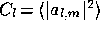 where
where  is the
angular power spectrum obtained from a given cosmological model. The Legendre
polynomials can be evaluated by the standard recurrence relations (see
Press et al. (1987)). These relations in some cases are inadequate to evaluate the
is the
angular power spectrum obtained from a given cosmological model. The Legendre
polynomials can be evaluated by the standard recurrence relations (see
Press et al. (1987)). These relations in some cases are inadequate to evaluate the
 , especially at high values of
  , and we have worked with a slightly
modified set of polynomials,
, and we have worked with a slightly
modified set of polynomials,  , and the corresponding recurrence
relations, related to the Legendre polynomials by:
, and the corresponding recurrence
relations, related to the Legendre polynomials by:
In addition, the reality of the temperature anisotropies imposes the condition:
taking into account that 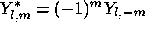 , it results
 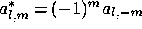 .
.
With this condition, we have that:
and therefore:
We have chosen to neglect here the cosmological dipole term,  , which is
dominated by the Doppler effect due to the relative motion of the earth respect
to the CMB.
, which is
dominated by the Doppler effect due to the relative motion of the earth respect
to the CMB.
In equation 6 only the polynomials  depends on
  ,
while all the dependence on
,
while all the dependence on  is in the square bracket part. This
particular feature makes the choice of the pixelization (i.e. the set of
is in the square bracket part. This
particular feature makes the choice of the pixelization (i.e. the set of  where to calculate
  ) a crucial parameter for
the computational cost of the simulation. Namely, if one is not particularly
interested in having an equal--area pixelization, the best choice is a
pixelization in which the
) a crucial parameter for
the computational cost of the simulation. Namely, if one is not particularly
interested in having an equal--area pixelization, the best choice is a
pixelization in which the  is the same for all
  ;
in this way it is possible to evaluate the
;
in this way it is possible to evaluate the  and
and  once for all and memorise them at the beginning, so diminishing the
computational time by a factor 10. In addition it allows one to use FFT
techniques to generate a full sky map and this further reduces the required
amount of computation (see for example Muciaccia et al. (1997)). We have chosen to keep a
general routine with no particular assumption on the pixelization but two
simple symmetry properties:
once for all and memorise them at the beginning, so diminishing the
computational time by a factor 10. In addition it allows one to use FFT
techniques to generate a full sky map and this further reduces the required
amount of computation (see for example Muciaccia et al. (1997)). We have chosen to keep a
general routine with no particular assumption on the pixelization but two
simple symmetry properties:  if
if  , then also
 ;
;  if
if  then also
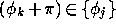 . The symmetry property for
  is
useful because of the parity in
is
useful because of the parity in  of the polynomials
  . This
property, together with the trigonometric properties of sines and cosines, allow
us to divide by four the computational time because the temperature anisotropy
can be computed in four points of the sky at the same time. The ``standard''
COBE-CUBE pixelization satisfies these conditions and we have used that for our
beam tests. It offers the advantage of good equal-area conditions, hierarchic
and that Galaxy maps and software are presently available for that pixelization
scheme (for an improved scheme see Gorski et al. (1997)).
. This
property, together with the trigonometric properties of sines and cosines, allow
us to divide by four the computational time because the temperature anisotropy
can be computed in four points of the sky at the same time. The ``standard''
COBE-CUBE pixelization satisfies these conditions and we have used that for our
beam tests. It offers the advantage of good equal-area conditions, hierarchic
and that Galaxy maps and software are presently available for that pixelization
scheme (for an improved scheme see Gorski et al. (1997)).
From a simulated map we can compute the correlation function  :
:
where 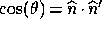 .
.
Directly from the  , and the corresponding
  , used for
generating a given map we can have the correlation function
, used for
generating a given map we can have the correlation function
 defined by:
We have generated maps at COBE-CUBE resolution 9, 10 and 11 (i.e. with typical
distances between two pixels of about  ,
,  ,
,  respectively) and with
 up to 1200 and we have verified the goodness of the maps obtained with our
code by comparing the correlation functions obtained from the two above
equations, in order avoid the ambiguity due to the cosmic variance. In addition
we have checked that the average of the correlation functions obtained by few
tens of maps tends to that obtained from the equation 7 when the
theoretical prescription for the
up to 1200 and we have verified the goodness of the maps obtained with our
code by comparing the correlation functions obtained from the two above
equations, in order avoid the ambiguity due to the cosmic variance. In addition
we have checked that the average of the correlation functions obtained by few
tens of maps tends to that obtained from the equation 7 when the
theoretical prescription for the  is used.
In the spectral range of interest here, the Galaxy emission is mainly due to three different physical mechanisms: synchrotron emission from cosmic rays electrons accelerated into galactic magnetic fields, free--free or thermal bremsstrahlung emission and dust emission.
Both synchrotron and free--free spectral shape can be described, in terms of
antenna temperature, by simple power laws,  , with
spectral indices:
, with
spectral indices: 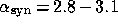 and
and  .
While free--free emission is a well known mechanisms and
.
While free--free emission is a well known mechanisms and  has
relatively small uncertainties, the synchrotron emission is still rather unknown
and it seems that a steeping of the spectral index will occur at higher
frequencies, as expected from the theory. It is also expected a spatial
variation of
has
relatively small uncertainties, the synchrotron emission is still rather unknown
and it seems that a steeping of the spectral index will occur at higher
frequencies, as expected from the theory. It is also expected a spatial
variation of  due to its dependence upon electrons energy
density and galactic magnetic field which change in the Galaxy
(Lawson et al. (1987), Banday & Wolfendale (1990), Banday & Wolfendale (1991), Kogut et al. (1996), Platania et al. (1997)).
due to its dependence upon electrons energy
density and galactic magnetic field which change in the Galaxy
(Lawson et al. (1987), Banday & Wolfendale (1990), Banday & Wolfendale (1991), Kogut et al. (1996), Platania et al. (1997)).
Dust emission spectral shape can be described by a simple modified blackbody
law 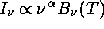 where
where  is the emissivity
and
is the emissivity
and  is the brightness of a blackbody of temperature
  . Recent
works, based upon COBE- DMR and DIRBE data (Kogut et al. (1996)), give
values of
. Recent
works, based upon COBE- DMR and DIRBE data (Kogut et al. (1996)), give
values of  and
and  , but also a model with
two dust temperatures is possible.
, but also a model with
two dust temperatures is possible.
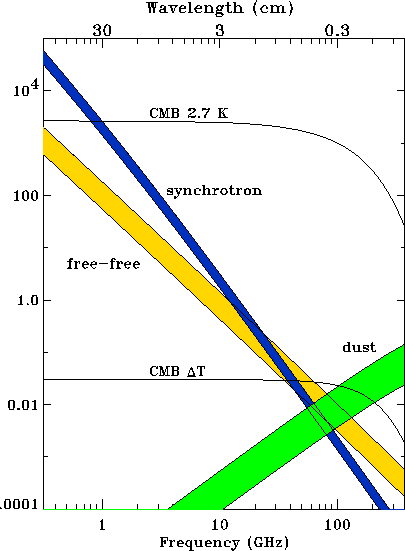
Figure 1: Schematic representation of the three
different components of Galaxy emission compared to the CMB emission and its
typical fluctuations in terms of antenna temperature (in mK).
Figure 1 shows a schematic representation of these spectral shapes.
In order to build up a realistic model of galactic emission we have to know both spatial and spectral behaviour of the three emission mechanisms. The best situation would be when we have measurements of galactic emission in those spectral regions where only one of these emission mechanisms is dominant. From Figure 1 it is clear that this is possible only for synchrotron emission (at very low frequencies) and for dust emission (at very high frequencies). For free--free emission is more complicated to derive detailed informations, because does not exist a spectral region where it is the dominant component of the signal. At the moment, our model does not yet include free--free emission in our Galaxy. We use a synchrotron spectral index constant in the sky, but our code allows to change its value within an appropriate range. For the dust model we took a two dust temperature model, but we are able to select different models.
The model we constructed is based upon two full-sky maps: the map of
Haslam et al. (1982) at 408 MHz and DIRBE map at  . Both maps
have nearly the same angular resolution: 0.85 deg and 0.6 deg respectively. It
is also clear that both maps lack the proper angular resolution to simulate
directly the PLANCK observations (
. Both maps
have nearly the same angular resolution: 0.85 deg and 0.6 deg respectively. It
is also clear that both maps lack the proper angular resolution to simulate
directly the PLANCK observations ( ).
).
Studies on the spatial distribution and power spectrum of galactic emission
(Gautier et al. (1992), Kogut et al. (1996)) show that dust and at least one component of the
free--free follow a power law with index  :
:  . For
synchrotron emission the situation is still under discussion: the index will
probably range from
. For
synchrotron emission the situation is still under discussion: the index will
probably range from  to
to  .
.
We then extended in power our maps to match the proper PLANCK resolution. In
order to do that we build square region of about  with different indices of the power law spectrum. We then ``cover'' the sky
with many of these fundamental patches with the condition that the signal in
the extended map on the smaller angular scales provided by the original
``true'' map (Haslam et al. (1982) or DIRBE) must be the signal in the ``true''
map. In this way we are able to construct maps of galactic emission with the
desired angular resolution for each of the PLANCK frequencies where the signals
are scaled in frequency according to their spectral shape. In particular we
built two maps of galactic emission at 30 and 100 GHz, that we have used for
the present beam tests.
with different indices of the power law spectrum. We then ``cover'' the sky
with many of these fundamental patches with the condition that the signal in
the extended map on the smaller angular scales provided by the original
``true'' map (Haslam et al. (1982) or DIRBE) must be the signal in the ``true''
map. In this way we are able to construct maps of galactic emission with the
desired angular resolution for each of the PLANCK frequencies where the signals
are scaled in frequency according to their spectral shape. In particular we
built two maps of galactic emission at 30 and 100 GHz, that we have used for
the present beam tests.







