
 postscript
2 Generation of simulated ...
postscript
2 Generation of simulated ...
 Abstract...
 4 Results of beam ...
A first application of our simulation code is the study of the effect of beam distortions on the measured sky temperatures. The sky is simulated adding the CMB and galactic components as described in section 3.
Different feedhorns must be located on different parts of the focal plane. The magnitude and the kind of beam distortion depend on several parameters: the beam FWHM, the observational frequency, the telescope optical scheme and the beam location with respect to the optical axis. Optical simulations (Nielsen & Pontoppidan (1996)) show that the main expected distortion in the off-axis beams has an elliptical shape, with more complex asymmetries in the sidelobe structure. Here we have assumed that the beam is located along the optical axis, but that it can have an elliptical shape, i.e. the curves of equal response are ellipses.
Let be  the spin axis vector, which is on the ecliptic plane for the
standard scanning strategy, and
the spin axis vector, which is on the ecliptic plane for the
standard scanning strategy, and  the vector of the direction of the
optical axis of the telescope, at an angle
the vector of the direction of the
optical axis of the telescope, at an angle  from the spin axis.
We choose two coordinates
from the spin axis.
We choose two coordinates  and
and  on the plane tangent to the celestial
sphere in the optical axis direction, with vector
on the plane tangent to the celestial
sphere in the optical axis direction, with vector  and
and  respectively; we choose the
  axis according to the condition that the vector
 points always toward the satellite spin axis; indeed, for standard
PLANCK observational strategy, this condition is preserved as the telescope
scans different sky regions. With this frame of reference choice, we have that
points always toward the satellite spin axis; indeed, for standard
PLANCK observational strategy, this condition is preserved as the telescope
scans different sky regions. With this frame of reference choice, we have that
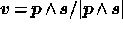 and
and 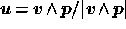 (here
(here  indicates the vector
product). With the simple work assumption that the beam centre is along the
optical axis, we have that the beam (elliptical) response in a given point
indicates the vector
product). With the simple work assumption that the beam centre is along the
optical axis, we have that the beam (elliptical) response in a given point
 is given by:
The ratio  between major and
minor axis of the ellipses of constant response quantifies the amount of beam
distortion (we have chosen the major axis along the
between major and
minor axis of the ellipses of constant response quantifies the amount of beam
distortion (we have chosen the major axis along the  axis, but we have
verified for a suitable number of cases that our conclusions are unchanged if
the major axis is chosen along the
axis, but we have
verified for a suitable number of cases that our conclusions are unchanged if
the major axis is chosen along the  axis). We have convolved the simulated
map with this beam kernel up to the level
axis). We have convolved the simulated
map with this beam kernel up to the level  ,
i.e. up to the
,
i.e. up to the  level. The integration has been performed by using a
2-dimensional Gaussian quadrature with a grid of
level. The integration has been performed by using a
2-dimensional Gaussian quadrature with a grid of  points. We have
performed the convolution under the assumption that the telescope points always
at the same direction during a given integration time; this artificially
simplifies the analysis, but it is useful to make the study independent of the
scanning strategy and related only to the optical properties of the instrument.
The sky map, obtained by using the COBE-CUBE pixelization, has been
interpolated in a standard way to have the temperature values at the grid
points. For maps at resolution 11 (9) we have about 50 (3) pixels within the
FWHM (
points. We have
performed the convolution under the assumption that the telescope points always
at the same direction during a given integration time; this artificially
simplifies the analysis, but it is useful to make the study independent of the
scanning strategy and related only to the optical properties of the instrument.
The sky map, obtained by using the COBE-CUBE pixelization, has been
interpolated in a standard way to have the temperature values at the grid
points. For maps at resolution 11 (9) we have about 50 (3) pixels within the
FWHM ( ) at 30 GHz and 6 (less than 1) at 100 GHz (FWHM
  ); then the true accuracy of the integration derives not only from the
adopted integration technique but from the map resolution too. For this reason
the use of high resolution maps and a careful comparison between beam test
results obtained from maps at different resolutions are recommended.
); then the true accuracy of the integration derives not only from the
adopted integration technique but from the map resolution too. For this reason
the use of high resolution maps and a careful comparison between beam test
results obtained from maps at different resolutions are recommended.
In order to quantify how the beam distortion affects the anisotropy
measurements, we use a simple estimator: the  of the difference between
the temperature observed by an elliptical beam and a symmetric one. We use here
thermodynamical temperature which does not depend on the observational
frequency; the present results can be translated in terms of antenna
temperature with the relation
of the difference between
the temperature observed by an elliptical beam and a symmetric one. We use here
thermodynamical temperature which does not depend on the observational
frequency; the present results can be translated in terms of antenna
temperature with the relation  where
where  (
( at
30 GHz, whereas
at
30 GHz, whereas  at 100 GHz).
