
 postscript
3 Convolution of the ...
postscript
3 Convolution of the ...
 Abstract...
 5 Discussion: implications of ...
We have considered circle scans that crosses (or not) the region near the
galactic centre to check the effects of Galaxy temperature gradients in
different situations. For standard PLANCK scanning strategy, a scan circle
consists of about 680 integrations at 30 GHz and of about 1700 integrations at
100 GHz. We have carried out simulations that either include or neglect the
contribution of the Galaxy for the both frequencies (we have adopted here the
scaling law  to extrapolate its fluctuations at small
angular scales). It results that the Galaxy does not affect the difference
between the temperature measured by symmetric and elliptical beams. We have
performed our tests using maps at different COBE-CUBE resolution (from 9 to 11)
to check the dependence of the result on the resolution of the map.
to extrapolate its fluctuations at small
angular scales). It results that the Galaxy does not affect the difference
between the temperature measured by symmetric and elliptical beams. We have
performed our tests using maps at different COBE-CUBE resolution (from 9 to 11)
to check the dependence of the result on the resolution of the map.
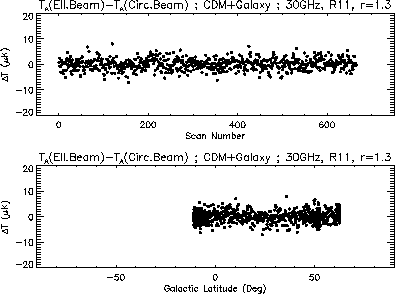
Figure 2: Difference between the (antenna)
temperature observed by asymmetric and symmetric beams for a typical scan
circle as function of the scan integration number (top panel) or the
corresponding galactic latitude (bottom panel).
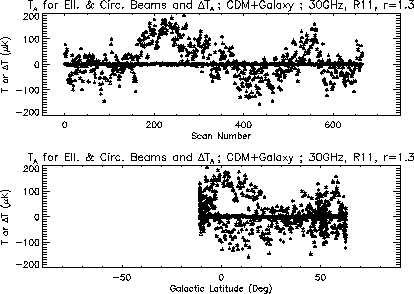
Figure 3: Antenna temperature observed by asymmetric
(triangles) and symmetric (crosses) beams and differences (circles) between the
two measurements for a typical scan circle as function of the scan integration
number (top panel) or the corresponding galactic latitude (bottom panel).
Figures 2 and 3 show our results for a test at 30 GHz, the frequency considered here where the emission of the Galaxy and its fluctuations are more important (Toffolatti et al. (1995), Danese et al. (1996)); the distribution of the temperature differences does not depend on the galactic latitude (see Figure 2) and, even where galactic emission coupled to CMB quadrupole large scale waves produces significant increases of the observed antenna temperature, the temperature differences remain practically equal to those obtained in other sky regions (see Figure 3).
Typical results obtained by using maps at COBE-CUBE resolution 11 are tabulated
in Table 1 in terms of  for different beam FWHM's
and distortion parameters
for different beam FWHM's
and distortion parameters  . The results do not change significantly by using
maps at different resolutions.
. The results do not change significantly by using
maps at different resolutions.
These results may be qualitatively interpreted from a geometrical point of
view: the contribution of the different parts of the sky observed by beams with
different shapes becomes more important and produces a growing effect as the
FWHM and/or  increases. These two parameters are the most important for what
concerns here, whereas the observational frequency is directly not relevant (a
part for the obvious relationship between the considered frequency and the beam
properties), due to the very small effect of Galaxy fluctuations.
increases. These two parameters are the most important for what
concerns here, whereas the observational frequency is directly not relevant (a
part for the obvious relationship between the considered frequency and the beam
properties), due to the very small effect of Galaxy fluctuations.
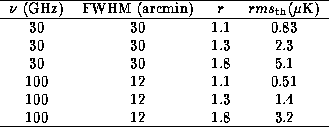
Table 1:  value of
  for different cases.