
 postscript
2 Component separation methods...
postscript
2 Component separation methods...
 Abstract...
 Acknowledgements...
In this paper we adopt a Bayesian approach to the separation of foreground components from CMBR emission for satellite observations. We find that by assuming a suitable Gaussian prior in Bayes' theorem for the sky emission, we recover the standard Wiener filter (WF) approach. Alternatively, we may assume an entropic prior, based on information-theoretic considerations alone, from which we derive a maximum entropy method (MEM). We apply these two methods to the problem of separating the different physical components of sky emission.
By assuming a Gaussian prior in Bayes' theorem, we derived the standard form of the Wiener filter. This approach is optimal in the sense that it is the linear filter for which the variance of the reconstruction residuals is minimised. This is true both in the Fourier domain and the map domain. Nevertheless, it is straightforward to show that this algorithm leads to maps with power spectra that are biased compared to the true spectra, and this leads us to consider variants of the standard Wiener filter.
At a given value of  , the estimator
  of the azimuthally
averaged power spectrum for the
of the azimuthally
averaged power spectrum for the  th physical component is obtained simply by
calculating the average value of
th physical component is obtained simply by
calculating the average value of  over those modes for
which
over those modes for
which  , i.e.
where  is the number of measured Fourier modes satisfying
 .
.
The bias in the power spectrum of the standard WF map reconstruction may be
quantified by introducing, for each physical component, a quality factor
 at each Fourier mode
  (Bouchet et al. (1997)). This factor
is given by
(Bouchet et al. (1997)). This factor
is given by

where  is the response matrix of the observations at
the Fourier mode
is the response matrix of the observations at
the Fourier mode  , as defined in equation (3), and
 is the corresponding Wiener matrix given in equation
(14). The quality factor varies between unity (in the absence of
noise) and zero. If
is the corresponding Wiener matrix given in equation
(14). The quality factor varies between unity (in the absence of
noise) and zero. If  is the WF estimate of the
  th
component of the signal vector at
th
component of the signal vector at  and
and  is the actual
value, then it is straightforward to show that
is the actual
value, then it is straightforward to show that

Thus, in similar way, the expectation value of the naive power spectrum
estimator defined in (28) is given by 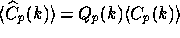 , where
  is the average of the quality
factors at each Fourier mode satisfying
is the average of the quality
factors at each Fourier mode satisfying  ; thus the estimator in
equation (28) is biased and should be replaced by
; thus the estimator in
equation (28) is biased and should be replaced by
 .
.
It is clearly unsatisfactory, however, to produce reconstructed maps with
biased power spectra and, from the above discussion, we might consider using
the matrix with elements  to perform the reconstructions.
Bouchet et al. (1997) shows that this leads to reconstructed maps that do indeed
possess unbiased power spectra and, moreover, the method is less sensitive to
the assumed input power spectra. However, one finds in this case that the
variance of the reconstruction residuals is increase by a factor
to perform the reconstructions.
Bouchet et al. (1997) shows that this leads to reconstructed maps that do indeed
possess unbiased power spectra and, moreover, the method is less sensitive to
the assumed input power spectra. However, one finds in this case that the
variance of the reconstruction residuals is increase by a factor
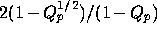 compared to those obtained with the standard WF and so
the reconstructed maps appear somewhat noisier.
compared to those obtained with the standard WF and so
the reconstructed maps appear somewhat noisier.
Another variant of the Wiener filter technique has been proposed by
Tegmark & Efstathiou (1996) and Bouchet et al. (1997), and uses the matrix  to
perform the reconstructions. This approach has the advantage that the
reconstruction of the
to
perform the reconstructions. This approach has the advantage that the
reconstruction of the  th physical component is independent of its assumed
input power spectrum. Nevertheless, for this technique the variance of the
reconstruction residuals is found to be increased by the factor
th physical component is independent of its assumed
input power spectrum. Nevertheless, for this technique the variance of the
reconstruction residuals is found to be increased by the factor  as compared to the standard WF, which results in even noisier
reconstructed maps.
as compared to the standard WF, which results in even noisier
reconstructed maps.
As a final variant, Tegmark (1997) suggests the inclusion into the WF
algorithm of a parameter  that scales the assumed input power spectra of
the components, This parameter can be included in the all of the versions of
the WF discussed above and is equivalent to assuming in Bayes' theorem a
Gaussian prior of the form
that scales the assumed input power spectra of
the components, This parameter can be included in the all of the versions of
the WF discussed above and is equivalent to assuming in Bayes' theorem a
Gaussian prior of the form

In the use of this variant for the analysis of real data,  is varied in
order to obtain some desired signal-to-noise ratio in the reconstructed maps by
artificially suppressing or enhancing the assumed power in the physical
components as compared to the noise. Clearly,
is varied in
order to obtain some desired signal-to-noise ratio in the reconstructed maps by
artificially suppressing or enhancing the assumed power in the physical
components as compared to the noise. Clearly,  plays a similar role in
the WF analysis to the parameter
plays a similar role in
the WF analysis to the parameter  in the MEM. Thus, by making the
appropriate changes to the calculation of the Bayesian value of
in the MEM. Thus, by making the
appropriate changes to the calculation of the Bayesian value of  in
Appendix B, we may obtain an analogous expression to (26) that defines
a Bayesian value for
in
Appendix B, we may obtain an analogous expression to (26) that defines
a Bayesian value for  . Indeed, with the inclusion of the parameter
 , the WF method is simply the quadratic approximation to the MEM, as
discussed in Section 2.5. However, even with the inclusion of the
, the WF method is simply the quadratic approximation to the MEM, as
discussed in Section 2.5. However, even with the inclusion of the
 factor, we find that the corresponding reconstructions of non-Gaussian
components are still somewhat poorer than for MEM.
factor, we find that the corresponding reconstructions of non-Gaussian
components are still somewhat poorer than for MEM.
