
 postscript
2 Receiver technology...
postscript
2 Receiver technology...
 Abstract...
 4 Interferometers...
In beam-switching experiments the objective is to scan a beam across the sky, synchronously detecting the component of the total power that is in phase with the scan (and hence in the sky), whilst rejecting signals due to receiver power fluctuations, the atmosphere, and groundspill. These spurious signal sources are extremely difficult to suppress to the high accuracy required, and are part of the reason why so many years passed between the discovery of the CMB itself and the measurement of its anisotropy. They are also the reason why, after early attempts to use `general-purpose' telescopes (such as the Owens Valley 40-m) for CMB work, almost all successful CMB observations have been made with `custom-built' instruments with stringent suppression of systematics as the over-riding design criterion.
Table 1 shows how a variety of switched-beam experiments have overcome these problems. Ground-spill is a particularly insidious systematic as it necessarily occurs at the switching frequency, and requires careful screening and under-illumination of mirrors. A related problem, the varying of the illumination of the primary by a switching secondary, can be circumvented, as in the Saskatoon experiment (Wollack et al. (1997)), by placing a switching flat mirror in front of all the focussing optics. All ground-based experiments chop in azimuth to minimize differential ground-spill and change of airmass.
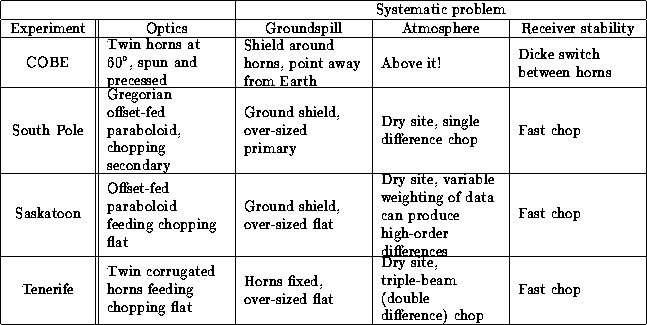
Table 1: Solutions to systematic problems in some
beam-switching experiments.