
 postscript
5 Foregrounds...
postscript
5 Foregrounds...
 Abstract...
 7 Conclusions...
Fig.3 shows some CMB power-spectrum results (adapted from
Rocha (1997)). The apparent smooth delineation of the the Doppler peak is
perhaps a little misleading as by chance there is little overlap in
 -coverage of the experiments plotted; when bolometric measurements are
included the picture becomes a little more obscure! It appears clear, however,
that the high power measured by Saskatoon combined with the lower power
measured by CAT points to the existence of a real peak in the power spectrum.
-coverage of the experiments plotted; when bolometric measurements are
included the picture becomes a little more obscure! It appears clear, however,
that the high power measured by Saskatoon combined with the lower power
measured by CAT points to the existence of a real peak in the power spectrum.
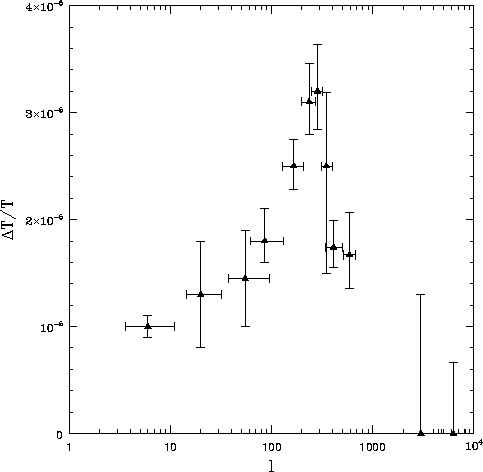
Figure 3: CMB power-spectrum results
from several experiments. From left to right: COBE; Tenerife; South Pole; five
Saskatoon points; two CAT points (the new CAT2 data (Baker (1997)) have been
added to the previous CAT1 results); Australia Telescope; Ryle Telescope.
This plot includes one new point, from the Ryle Telescope (RT), at 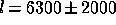 . This is from observations of the Lynx 2 field, which has been the
subject of several long integrations on different radio telescopes, including
the VLA (Windhorst et al. (1993)). This field was observed at 15.2 GHz with the RT
compact array on 54 occasions between 1994 February and 1997 April, resulting
in a map with a noise level of
. This is from observations of the Lynx 2 field, which has been the
subject of several long integrations on different radio telescopes, including
the VLA (Windhorst et al. (1993)). This field was observed at 15.2 GHz with the RT
compact array on 54 occasions between 1994 February and 1997 April, resulting
in a map with a noise level of 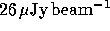 and a
resolution of
and a
resolution of  arcsec. After removal of two point sources the
visibility data were analysed for excess power using the same procedures as
used for CAT data (Scott et al. (1996)). This results in a preliminary limit for
flat-band power in the interval
arcsec. After removal of two point sources the
visibility data were analysed for excess power using the same procedures as
used for CAT data (Scott et al. (1996)). This results in a preliminary limit for
flat-band power in the interval 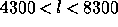 of
of  (67% confidence), further confirming the result that CMB fluctuations on
arcminute scales have an order of magnitude less power than on degree scales.
(67% confidence), further confirming the result that CMB fluctuations on
arcminute scales have an order of magnitude less power than on degree scales.