
 postscript
4 Interferometers...
postscript
4 Interferometers...
 Abstract...
 6 Results...
Foreground emission can be divided into that which is spatially similar to the
CMB (but may have a different frequency spectrum), e.g. diffuse Galactic
emission, and emission which is spatially distinct from the CMB, e.g.\
extragalactic point sources. In the frequency range in which HEMT experiments
operate Galactic emission is dominated by diffuse synchrotron and free-free
radiation, both of which have frequency spectra quite distinct from the CMB
(flux spectral indices  to
to  and
and  respectively, where
  , compared to
  for the
CMB.
for the
CMB.
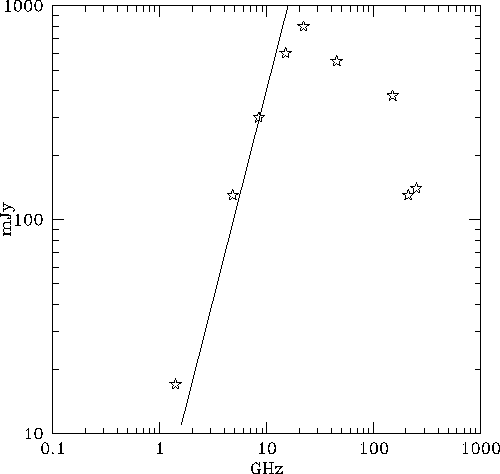
Figure 2: Radio to sub-mm
spectrum of RXJ1459.9+3337. The line is a spectrum of  , i.e. that
of the CMB. Other similar sources could peak at even higher frequencies. The
surface density of sources such as this is not well known.
, i.e. that
of the CMB. Other similar sources could peak at even higher frequencies. The
surface density of sources such as this is not well known.
Galactic emission can thus be separated from CMB structure if multi-frequency information is available, but only at the cost of loss of signal-to-noise ratio. The variance on the foreground-subtracted data is increased both by an factor which depends on the separation of the frequency channels used, and by an additional term which depends on how well the spectrum of the foreground is known (Dodelson (1995)):

The foreground degredation factor  usually dominates over the contribution
from the model uncertainty
usually dominates over the contribution
from the model uncertainty  . As an example, in an
experiment with two frequency channels at 28 and 35 GHz and a foreground with
flux spectral index
. As an example, in an
experiment with two frequency channels at 28 and 35 GHz and a foreground with
flux spectral index  ,
,  . That is, the noise level is
increased by a factor of nearly two by the act of subtraction the foreground
component. In the design of any experiment, serious consideration must be given
to
. That is, the noise level is
increased by a factor of nearly two by the act of subtraction the foreground
component. In the design of any experiment, serious consideration must be given
to  ; it may be that, for given technical and cost constraints, it is better
to have fewer, more sensitive channels to minimise
; it may be that, for given technical and cost constraints, it is better
to have fewer, more sensitive channels to minimise  rather than add
channels that do not significantly reduce
rather than add
channels that do not significantly reduce  .
.
Extragalactic point sources present a rather different problem. Their flux
spectral indices can vary in the range 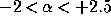 due to a
combination of synchrotron emission and self-absorbtion. Most sources have
negative spectral index, but not all; some 15% of sources have
due to a
combination of synchrotron emission and self-absorbtion. Most sources have
negative spectral index, but not all; some 15% of sources have  and the fraction with `inverted' spectra increases at
higher frequency (O'Sullivan (1995)). Also, individual source spectra are not very
predictable; in a sample of 31 sources with measured fluxes at 15 GHz (from the
CAT1 field) the true 15 GHz fluxes differed from those extrapolated from 1.4 to
5 GHz by factors between
and the fraction with `inverted' spectra increases at
higher frequency (O'Sullivan (1995)). Also, individual source spectra are not very
predictable; in a sample of 31 sources with measured fluxes at 15 GHz (from the
CAT1 field) the true 15 GHz fluxes differed from those extrapolated from 1.4 to
5 GHz by factors between  and
and  .
.
Point sources can of course be removed in the same way as diffuse foregrounds via their spectral differences, but at the cost in signal-to-noise described above. Much better is to measure their fluxes at higher resolution and subtract the exact contribution of the sources from the CMB data. Experiments that operate in the regime of sensitivity and resolution where sources are a significant problem must have access to higher-resolution source data.
Some sources can have spectra which mimic the CMB. Fig.2 shows the
spectrum of the source RXJ1459.9+3337, which has a flux spectral index of
 between 1.4 and 22 GHz. The only way sources such as this
can be distinguished from CMB fluctuations is by having higher resolution data
at the same frequency as the CMB observations. Sources can also be variable;
the brightest source in the CAT2 field (Baker (1997)) varied by a factor of
two during the time of the observations. The only answer for this is
simultaneous monitoring, requiring a telescope with higher resoltion and flux
sensisivity than the CMB telescope.
between 1.4 and 22 GHz. The only way sources such as this
can be distinguished from CMB fluctuations is by having higher resolution data
at the same frequency as the CMB observations. Sources can also be variable;
the brightest source in the CAT2 field (Baker (1997)) varied by a factor of
two during the time of the observations. The only answer for this is
simultaneous monitoring, requiring a telescope with higher resoltion and flux
sensisivity than the CMB telescope.
Point sources will become a more serious problem as experiments move to smaller angular scales and higher sensitivity. Table 2 shows the flux sensitivity per pixel of various CMB experiments, along with a very rough estimate of the density of sources above that flux level. These estimates are necessarily rough as there is little information on source counts above 8 GHz, and there are no high-resolution all-sky surveys between 5 and 3000 GHz.
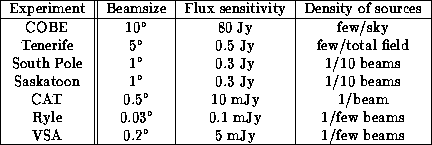
Table 2: Flux sensitivities and rough densities of
confusing sources for some CMB experiments.