
 postscript
1 Introduction...
postscript
1 Introduction...
 Abstract...
 3 Results...
The observation, carried out between the 25th of February and the 3rd of March,
was pointed towards RA  , DEC
, DEC 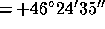 (J2000) with a total accepted exposure time of 15889 s. By comparing
to optical data enough sources could be identified so far to confirm the
absolute positioning of the ROSAT XRT to a few arcseconds.
(J2000) with a total accepted exposure time of 15889 s. By comparing
to optical data enough sources could be identified so far to confirm the
absolute positioning of the ROSAT XRT to a few arcseconds.
Fig. 1 shows an overlay of the CMB measurement onto the X-ray map of our observation. The individual points in the X-ray map correspond to single photons in the energy range 0.5--2.0 keV.
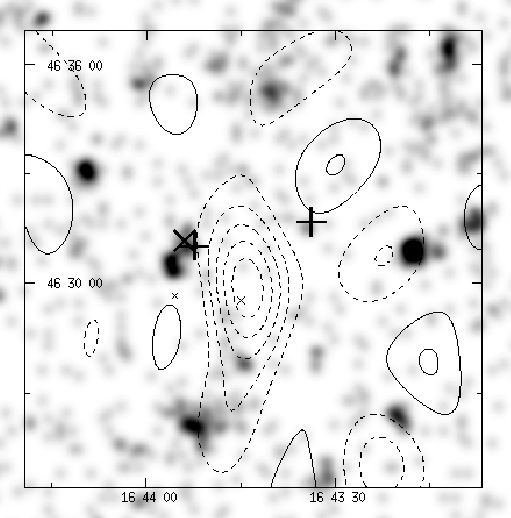
Figure 1: Overlay of the CMB
measurement onto the X-ray observation. The separation of the quasar pair
PC1643+4631 (+) A (right) & B (left) is  . Radio sources (
 ),
which were identified in the high resolution radio observation and removed from
the lower resolution data (shown here) are also marked. No enhancement of the
X-ray flux is seen within the inner
),
which were identified in the high resolution radio observation and removed from
the lower resolution data (shown here) are also marked. No enhancement of the
X-ray flux is seen within the inner  contours. Coordinates in this
figure are B1950.
contours. Coordinates in this
figure are B1950.
In Fig. 2 we show and detail in Tab. 1 the detected X-ray sources with a likelihood ratio greater than 5. This low likelihood ratio has been chosen to demonstrate that not even a marginally detected source can be found within the inner contours of the microwave decrement. Secure detections require at least a likelihood of 10.
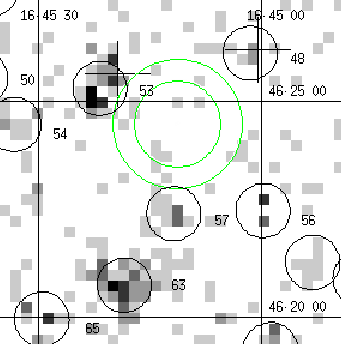
Figure 2: Source detections with
likelihood ratio  . No source is found near the center of the decrement.
The rings around the center indicate
. No source is found near the center of the decrement.
The rings around the center indicate  and
and  apertures for the
upper limits to the count rate. The coordinate lines are RA =
apertures for the
upper limits to the count rate. The coordinate lines are RA =  and DEC =
  (J 2000).
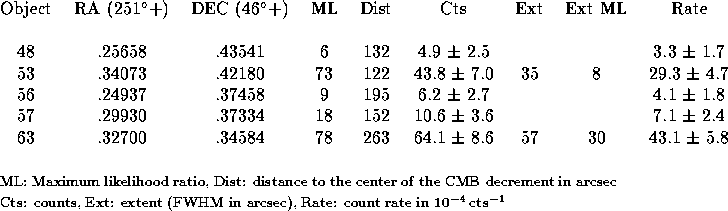
Table 1: Source detections with likelihood > 5 near
the center of the decrement.
No firm detection at the quasar positions can be made and we use the marginal
detection of sources at the quasar positions, 48 and possibly one component
(with  half the total count rate) of the ``extended'' source 53, to give
 upper limits of 7 and
 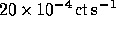 for
the respective sources.
for
the respective sources.
In determining the upper limits for the decrement we compared various energy
intervals and found 0.5--2.0 keV to give the best estimate, due to the enhanced
Galactic background rate at lower energies. In the Gaussian approximation for
the Poissonian photon distribution we find that 12.5 counts within an  radius around the center of the decrement can be excluded with 99.7%
confidence for the one-sided limit, which corresponds to a limiting count rate
of
radius around the center of the decrement can be excluded with 99.7%
confidence for the one-sided limit, which corresponds to a limiting count rate
of 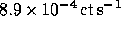 for the local exposure.
Deconvolved with the effective area and response of the instrument, and with
Galactic absorption of
for the local exposure.
Deconvolved with the effective area and response of the instrument, and with
Galactic absorption of 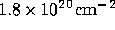 HI column density
taken into account, this correspondes to a bolometric flux limit of
HI column density
taken into account, this correspondes to a bolometric flux limit of  for a thermal spectrum
with temperature 2.5 keV in the observer frame.
for a thermal spectrum
with temperature 2.5 keV in the observer frame.