
 postscript
2 The ROSAT PSPC ...
postscript
2 The ROSAT PSPC ...
 Abstract...
 4 Discussion and Conclusion...
To obtain constraints on an X-ray luminosity for a gas halo, possibly seen in
the SZ effect, we take the measured CMB decrement as the observation of hot
cluster gas, with a spherical density profile, given by an isothermal halo with
 .
.
In an analytic approximation we find the flux limit to be given by

A is a normalisation factor accounting for the structural parameters of the assumed profile. It has the value

for the X-ray flux expected within an aperture radius  (
( here) for the
  model.
 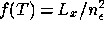 is the temperature
dependent cooling function,
is the temperature
dependent cooling function,  the core radius, and
  and
and
 are the observed quantities, the central Comptonization value
from the measured decrement and the X-ray flux limit. Given the parameter
dependence in the above relation, a choice of
are the observed quantities, the central Comptonization value
from the measured decrement and the X-ray flux limit. Given the parameter
dependence in the above relation, a choice of  , and
, and  , together with the assumed density profile, is conservative.
In Fig. 3 we show the SZ and x-ray limits on the x-ray luminosity of a gas halo in the energy range (observer) 0.5--2.0 keV.
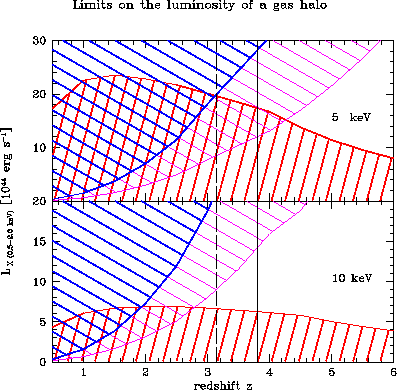
Figure 3: We show limits on the
luminosity of a gas halo for different redshifts. The lower limits are set by
the detected CMB decrement assuming the SZ effect. The upper limits at 99.7 %
and 95 % confidence for exclusion are set by our X-ray observation derived
with a Raymond-Smith code and assuming 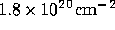 Galactic absorption, cosmic helium and 10 % cosmic metal abundances. For a
high assumed temperature of 10 keV, the redshift has to be greater than 2.8 (95
% CL). The solid vertical line marks the redshift of the quasar pair and the
dashed line the redshift of a damped Ly
Galactic absorption, cosmic helium and 10 % cosmic metal abundances. For a
high assumed temperature of 10 keV, the redshift has to be greater than 2.8 (95
% CL). The solid vertical line marks the redshift of the quasar pair and the
dashed line the redshift of a damped Ly absorption feature in the
spectrum of quasar A.
absorption feature in the
spectrum of quasar A.
For Fig. 3 we used a Raymond-Smith model below 10 keV and a
thermal Bremsstrahlungs-model above to convert the emission integral derived
from the SZ effect to a luminosity. We relate, also including Galactic
absorption of 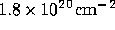 HI column density and the
PSPC instrument effective area and response matrix, our limit on the count rate
directly to the luminosity at various redshifts. For the Raymond-Smith model we
used cosmic helium abundance and 10 % of the cosmic metal abundance and only
cosmic helium abundance for the Bremsstrahlungs-model. Not excluded halos lie
at high redshift. For 5 keV gas the redshift limit is 4.2, higher than the
redshift of the quasar pair
HI column density and the
PSPC instrument effective area and response matrix, our limit on the count rate
directly to the luminosity at various redshifts. For the Raymond-Smith model we
used cosmic helium abundance and 10 % of the cosmic metal abundance and only
cosmic helium abundance for the Bremsstrahlungs-model. Not excluded halos lie
at high redshift. For 5 keV gas the redshift limit is 4.2, higher than the
redshift of the quasar pair  , for a hot 10 keV halo a redshift of
2.8 is still excluded at a 95 % confidence level and the redshift of the
quasar pair with at least 85 %.
, for a hot 10 keV halo a redshift of
2.8 is still excluded at a 95 % confidence level and the redshift of the
quasar pair with at least 85 %.
Comparing to a sample of clusters with measured SZ effect and which were found
to have a comparable temperature decrement: A2218, A478, A773, A1656,
CL0016+16, A2142 and A2163, we find their X-ray luminosities to be  , indicating that our luminosity estimate
of
, indicating that our luminosity estimate
of 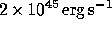 is conservative.