
 postscript
2 Using to Trace ...
postscript
2 Using to Trace ...
 Abstract...
 4 Conclusions...
 Maps
Maps
In Figure 1, we show the complete set of  images
after Gaussian smoothing with a
images
after Gaussian smoothing with a  FWHM beam (a mean value was subtracted
from each map prior to smoothing).
FWHM beam (a mean value was subtracted
from each map prior to smoothing).
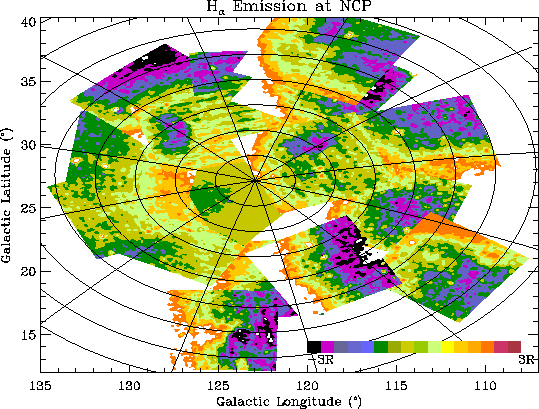
Figure 1:  maps of
the NCP smoothed with a
maps of
the NCP smoothed with a  beam. The maps contain galactic, and geocoronal
emission as well as stellar residuals.
beam. The maps contain galactic, and geocoronal
emission as well as stellar residuals.
The rms fluctuations per pixel in the raw  images are between
1--2 R, which already implies rather low levels of free--free emission. This
is, of course, why Simonetti et al. (1996) and Gaustad et al. (1996) are able to place such
stringent limits on the extent of free--free contamination in the Saskatoon
data. However, the
images are between
1--2 R, which already implies rather low levels of free--free emission. This
is, of course, why Simonetti et al. (1996) and Gaustad et al. (1996) are able to place such
stringent limits on the extent of free--free contamination in the Saskatoon
data. However, the  intensities in adjacent images do not
overlap smoothly, and it is in fact misleading to use these raw images to
compute the foreground contamination in CMB experiments. We therefore tried to
clean these images as explained below.
intensities in adjacent images do not
overlap smoothly, and it is in fact misleading to use these raw images to
compute the foreground contamination in CMB experiments. We therefore tried to
clean these images as explained below.
We assume that the large differences from field to field are primarily due to variable levels of geocoronal emission. Recall that geocoronal emission varies with season and solar depression angle. We found that simply subtracting a variable offset from each image was not sufficient, the geocoronal emission appears to be changing across each image. We subtracted this component by fitting a second order polynomial (i.e. a saucer shaped baseline) across each image. The average variation across a map is 1.72 R, and this variation is higher in the summer fields (1.93 R) as compared with the winter fields (1.36 R), which is consistent with our interpretation that geocoronal emission is responsible.
In addition to the geocoronal component, there are stellar residuals, as pointed out by Gaustad et al. (1996). We removed stellar residuals by setting all structure greater than a few (typically 3--5) standard deviations above (and occasionally, below) the local mean to the local rms value. There is another artifact clearly visible in Figure 1, and this is striping across the images. We removed the striations by subtracting typically a single fourier mode and its harmonics. These `cleaned' (beware that this is not a `CLEANing' in the usual radio astronomical sense) maps still contain structure on the few degree scale, as can be seen in Figure 2.
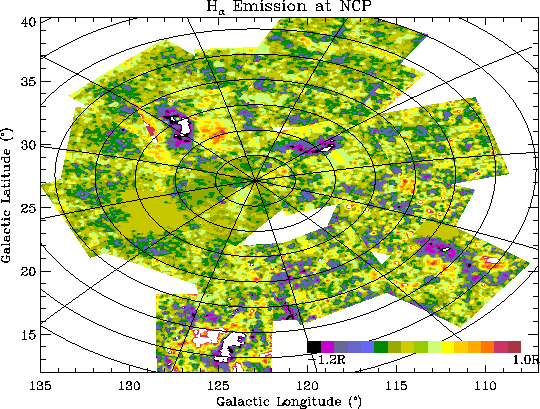
Figure 2: `Cleaned' maps showing
galactic  emission at the NCP.
The average rms variation in these maps is 0.32 R, and again there is a significant difference between the average rms of fields obtained under low (i.e. winter) and high (i.e. summer) geocoronal emission conditions (0.23 R vs. 0.38 R).
The final maps (Figure 2) are not perfect, the image boundaries are still occasionally visible. The uncertain geocoronal contribution makes it impossible to normalise the maps to the same baseline with enough confidence to produce a map of the entire NCP region. In this report, however, we are only concerned with the differential spatial structure on scales much smaller than any individual image, and for that purpose, the cleaned maps are quite adequate.
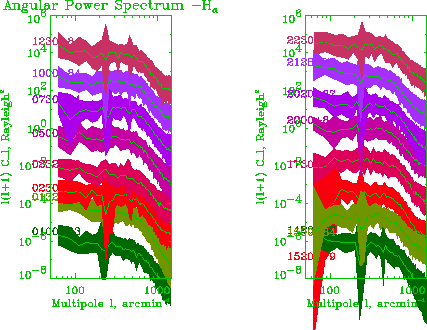
Figure 3: Angular power spectra of each of
the cleaned  maps. Spectra have been staggered upwards by
 for clarity.
Figure 3 shows the angular power spectrum of each of the `cleaned'
images. The spectra have been successively staggered upwards by a factor of
 to improve clarity. Fitting a single power law to the spectrum,
i.e.
to improve clarity. Fitting a single power law to the spectrum,
i.e.  , yields
  in the range
  to
to
 for
for  . The mean power spectrum scales as
  ,
which is flatter than the
,
which is flatter than the  spectrum obtained by Kogut et al. (1996a). This can
be seen clearly in Figure 4 where we have plotted both our average
spectrum obtained by Kogut et al. (1996a). This can
be seen clearly in Figure 4 where we have plotted both our average
 power spectrum and the power spectrum predicted by an
extrapolation of the Kogut et al. (1996a) free--free spectrum to smaller angular
scales.
power spectrum and the power spectrum predicted by an
extrapolation of the Kogut et al. (1996a) free--free spectrum to smaller angular
scales.
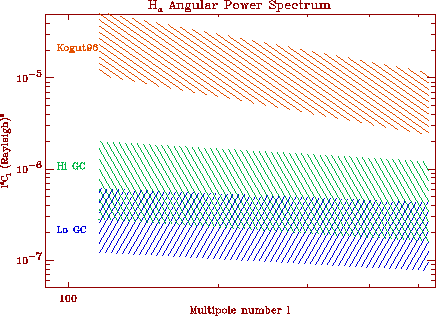
Figure 4: Average angular power spectra for
fields with low and high geocoronal emission, compared with the DMR spectrum
extrapolated to subdegree angular scales.
Our directly measured power spectrum is much lower than that expected from the
extrapolation from DMR angular scales. We have displayed separately the average
 power spectra for fields observed under conditions of high and
low geocoronal emission, and these are marginally different, presumably because
the geocoronal subtraction is not perfect. We assume that the lower amplitude
power spectrum, based on images taken under the better geocoronal conditions,
is the better measure of the true galactic contribution to the free--free
emission. In converting from free--free emission at 53 GHz to
power spectra for fields observed under conditions of high and
low geocoronal emission, and these are marginally different, presumably because
the geocoronal subtraction is not perfect. We assume that the lower amplitude
power spectrum, based on images taken under the better geocoronal conditions,
is the better measure of the true galactic contribution to the free--free
emission. In converting from free--free emission at 53 GHz to  emission as in Figure 4, we have assumed a gas temperature of
  . Changing this temperature, for example lowering it to 8000K, increases
the amplitude of the predicted
. Changing this temperature, for example lowering it to 8000K, increases
the amplitude of the predicted  spectrum by about 30%, but it
does not affect our main conclusion, which is that galactic free--free emission
on subdegree angular scales is much lower than that predicted from DMR
extrapolation.
spectrum by about 30%, but it
does not affect our main conclusion, which is that galactic free--free emission
on subdegree angular scales is much lower than that predicted from DMR
extrapolation.
Is this power spectrum typical of the galactic free--free contamination
expected on subdegree angular scales at high galactic latitude? It is
wellknown that the  emission obeys a cosecant law with respect
to galactic latitude
emission obeys a cosecant law with respect
to galactic latitude  . The average intensity of the diffuse
  emission off the plane is
  Rayleigh, with variations of
 dex on a
  scale (Reynolds (1992)). Since the NCP is at a
galactic latitude of
scale (Reynolds (1992)). Since the NCP is at a
galactic latitude of  , the cosecant law suggests that the
intensity at the galactic poles is about 50% lower. In addition, there is some
evidence that the variations in the
, the cosecant law suggests that the
intensity at the galactic poles is about 50% lower. In addition, there is some
evidence that the variations in the  intensity may be
considerably smaller on smaller angular scales (Reynolds (1992)).
intensity may be
considerably smaller on smaller angular scales (Reynolds (1992)).
Based on the set of images with low geocoronal activity, we have calculated a
best-fit angular power spectrum for the free--free emission. As before, we
assumed a gas temperature of  in converting the
  emission to an equivalent free--free emission, which was calculated for a
frequency of 53 GHz as in Kogut et al. (1996a). Our best fit estimate for the
free--free power spectrum is,
emission to an equivalent free--free emission, which was calculated for a
frequency of 53 GHz as in Kogut et al. (1996a). Our best fit estimate for the
free--free power spectrum is,

This power spectrum is significantly flatter than the  spectrum power
spectrum derived from the DMR-DIRBE cross-correlation (Kogut et al. (1996a)). However,
the normalisation is also considerably lower than the latter's normalisation,
and the result is that our measured free--free power is much lower on all
angular scales. For example, our predicted power at
spectrum power
spectrum derived from the DMR-DIRBE cross-correlation (Kogut et al. (1996a)). However,
the normalisation is also considerably lower than the latter's normalisation,
and the result is that our measured free--free power is much lower on all
angular scales. For example, our predicted power at  is a factor of 60
below the COBE extrapolation.
is a factor of 60
below the COBE extrapolation.