
 postscript
Abstract...
postscript
Abstract...
 Abstract...
 2 Basic assumption...
The PLANCK Surveyor is a European Space Agency (ESA) satellite mission to map spatial anisotropy in the Cosmic Microwave Background (CMB) over a wide range of frequencies with an unprecedented combination of sensitivity, angular resolution, and sky coverage (Bersanelli et al. (1996)). The data gathered by this mission will revolutionise modern cosmology by shedding light on fundamental cosmological questions such as the age and present expansion rate of the universe, the average density of the universe, the amount of dark matter, and other questions. As with any CMB experiment, achieving the desired performance requires careful attention to the control of systematic effects. In this paper we examine some of the systematic effects pertaining to the Low Frequency Instrument (LFI) radiometers. A more complete analysis, which takes also into account the effect of imperfect matching of amplifier gains and noise temperatures and of imperfect isolation in the two legs of the radiometer, can be found in a forthcoming paper (Seiffert et al. (1997)).
A simplified version of the LFI radiometer design is depicted in Figure
1 (see Bersanelli et al. (1995)).
We have made the simplifying assumption that there is no  contribution
from the detector diodes, and we have not considered the effects of the phase
shifting that is designed to control this contribution. The radiometer is a
modified Blum correlation receiver (Blum (1959), Colvin (1961)). The modification is that
the temperature of the reference load is quite different from the sky
temperature. To compensate, differing DC gains are applied after the two
detector diodes. Adjusting the ratio of DC gains,
contribution
from the detector diodes, and we have not considered the effects of the phase
shifting that is designed to control this contribution. The radiometer is a
modified Blum correlation receiver (Blum (1959), Colvin (1961)). The modification is that
the temperature of the reference load is quite different from the sky
temperature. To compensate, differing DC gains are applied after the two
detector diodes. Adjusting the ratio of DC gains,  , allows one to null the
output signal, minimise sensitivity to RF gain fluctuations, and achieve the
lowest white noise in the output. Although it may not be immediately apparent,
the fact that the reference load is not at the same temperature as the sky does
not increase the white noise level compared to a standard correlation receiver
(Seiffert et al. (1997)). There are several potential concerns for the current radiometer
scheme. Amplifier noise temperature variations, for example, might be confused
with real changes in the radiometer input. Fluctuations in the reference load
temperature can also mimic input changes. In what follows, we will see that
gain fluctuations and noise temperature fluctuations have the characteristics
of
, allows one to null the
output signal, minimise sensitivity to RF gain fluctuations, and achieve the
lowest white noise in the output. Although it may not be immediately apparent,
the fact that the reference load is not at the same temperature as the sky does
not increase the white noise level compared to a standard correlation receiver
(Seiffert et al. (1997)). There are several potential concerns for the current radiometer
scheme. Amplifier noise temperature variations, for example, might be confused
with real changes in the radiometer input. Fluctuations in the reference load
temperature can also mimic input changes. In what follows, we will see that
gain fluctuations and noise temperature fluctuations have the characteristics
of  noise. This leads to
  -type noise in the radiometer output. We
will define the ``knee'' frequency as the post-detection frequency,
-type noise in the radiometer output. We
will define the ``knee'' frequency as the post-detection frequency,  at
which the
at
which the  contribution and the ideal white noise contribution are equal.
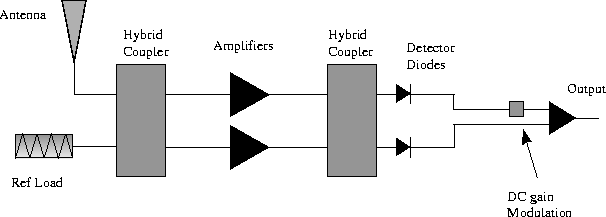
Figure 1: Shown is a simplified version of the PLANCK
LFI radiometer design. The reference load has a temperature in the range of
4--100 K, depending on the cooling option, and the ratio of DC gains,  ,
after the diodes is adjusted to produce a null output.
,
after the diodes is adjusted to produce a null output.
 -type noise in the radiometer output is a concern because it may lead to
striping in the final sky maps and increase the noise level. In general, a
value of
-type noise in the radiometer output is a concern because it may lead to
striping in the final sky maps and increase the noise level. In general, a
value of  that is significantly greater than the spacecraft rotation
frequency will lead to some degradation in sensitivity (Janssen et al. (1996)).
that is significantly greater than the spacecraft rotation
frequency will lead to some degradation in sensitivity (Janssen et al. (1996)).
In the following sections we will examine the underlying assumptions (section
2), and calculate the radiometer's sensitivity to amplifier gain
fluctuations, fluctuations in the amplifier noise temperature, in the reference
load temperature and in the DC gain ratio (section 3). We will use the
results of these calculations to estimate the  knee frequency of the
radiometer output. A summary of our results and a brief discussion of their
implications for PLANCK observations are presented in section 4.
knee frequency of the
radiometer output. A summary of our results and a brief discussion of their
implications for PLANCK observations are presented in section 4.