
 postscript
1 Introduction...
postscript
1 Introduction...
 Abstract...
 3 Susceptibility to various ...
Referring to Figure 1, we denote the voltage gain of amplifier 1
as  and the voltage gain of amplifier 2 as
  . The output,
  is
then given by:
is
then given by:
Here,  is the noise voltage at the sky horn,
  is the noise voltage
of the reference load,
is the noise voltage
of the reference load,  and
and  are the noise voltages contributed
by the amplifiers,
are the noise voltages contributed
by the amplifiers,  is the ratio of the DC gains after the two detector
diodes, and the diodes are assumed to be perfect square law detectors with a
constant of proportionality of
is the ratio of the DC gains after the two detector
diodes, and the diodes are assumed to be perfect square law detectors with a
constant of proportionality of  .
.
We will now denote the power gain of amplifier 1 as  (
( ) and of
amplifier 2 as
) and of
amplifier 2 as  (
( ) and calculate the time average of
  ,
denoted by
,
denoted by  . Terms like
  vanish because the
signal and amplifier noise are uncorrelated. Under the assumption that the
noise signals in the two amplifiers are uncorrelated, the
vanish because the
signal and amplifier noise are uncorrelated. Under the assumption that the
noise signals in the two amplifiers are uncorrelated, the  terms also vanish. The term
  is equal to
  , where
 is the effective bandwidth,
  is the noise temperature of the
signal entering horn 1, and
is the noise temperature of the
signal entering horn 1, and  is Boltzmann's constant. We have not specified
where the bandpass of the signal gets defined, and we have assumed that it is
the same in both legs of the radiometer. Using similar formulae for
is Boltzmann's constant. We have not specified
where the bandpass of the signal gets defined, and we have assumed that it is
the same in both legs of the radiometer. Using similar formulae for
 ,
,  , and
, and  ,
,  becomes:
We now see that in order to null the output (i.e. make  ), we
must adjust
), we
must adjust  to the proper value. In the simple case that
  and
and
 , this value is
Equation 2 identifies some potential systematic effects. If the
reference load temperature,  , changed slightly, or if the noise
temperature,
, changed slightly, or if the noise
temperature,  , of one the amplifiers fluctuated for example, there is the
potential that these changes could be confused with the sky signal variations
that we are interested in measuring. In the following section of this paper, we
will calculate the magnitude of these effects under the assumption that the
fluctuations in the various parameters are uncorrelated.
, of one the amplifiers fluctuated for example, there is the
potential that these changes could be confused with the sky signal variations
that we are interested in measuring. In the following section of this paper, we
will calculate the magnitude of these effects under the assumption that the
fluctuations in the various parameters are uncorrelated.
Before calculating these effects we briefly examine the expected magnitude of
gain and noise temperature fluctuations. We can infer that cryogenic HEMT
amplifiers have noise temperature fluctuations with a  type spectrum
because we know that the amplifiers have
type spectrum
because we know that the amplifiers have  type gain fluctuations
(Wollak (1995), Jarosik (1996), Seiffert et al. (1996)). We can estimate the magnitude of noise temperature
fluctuations from the following argument. Assuming that each stage of the
amplifier has the same level of fluctuation, we can conclude that the
transconductance of an individual HEMT device also fluctuates according to:
type gain fluctuations
(Wollak (1995), Jarosik (1996), Seiffert et al. (1996)). We can estimate the magnitude of noise temperature
fluctuations from the following argument. Assuming that each stage of the
amplifier has the same level of fluctuation, we can conclude that the
transconductance of an individual HEMT device also fluctuates according to:
where  is the number of stages of the amplifier, typically
  . An
optimal low noise amplifier design will have equal noise contributions from the
gate and drain of the HEMT, which mean the changes in
. An
optimal low noise amplifier design will have equal noise contributions from the
gate and drain of the HEMT, which mean the changes in  will lead to
changes in
will lead to
changes in  (Pospieszalsky (1989)). This can be expressed as
We can write the  spectrum of the gain fluctuations as:
Putting this together we get:
We can therefore write the noise temperature fluctuations as
with 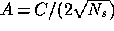 ; a normalisation of
 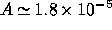 (relying on the references above) is appropriate for the 30 and 45 GHz
radiometers. Throughout, we will use units of
(relying on the references above) is appropriate for the 30 and 45 GHz
radiometers. Throughout, we will use units of  for
for
 so that we will not need to refer to the sampling frequency of the
radiometer. In these units then,
so that we will not need to refer to the sampling frequency of the
radiometer. In these units then,  has units of Hz
 and
and
 is dimensionless. We also note that the value of
  will generally depend
on the physical temperature of the amplifier. The values for
will generally depend
on the physical temperature of the amplifier. The values for  given here
should be regarded as estimates rather than precise values. For the radiometers
at higher frequencies, it will be necessary to use HEMT devices with a smaller
gate width to achieve the lowest amplifier noise figure. We expect that the
gate widths will be roughly
given here
should be regarded as estimates rather than precise values. For the radiometers
at higher frequencies, it will be necessary to use HEMT devices with a smaller
gate width to achieve the lowest amplifier noise figure. We expect that the
gate widths will be roughly  that of the devices used for the lower
frequency radiometers and this will lead to
that of the devices used for the lower
frequency radiometers and this will lead to  fluctuations that are
roughly a factor of
fluctuations that are
roughly a factor of  higher (Gaier (1997), Weinreb (1997)). We will
therefore adopt a normalisation of
higher (Gaier (1997), Weinreb (1997)). We will
therefore adopt a normalisation of 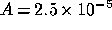 for the 70 and 100
GHz radiometers.
for the 70 and 100
GHz radiometers.







